
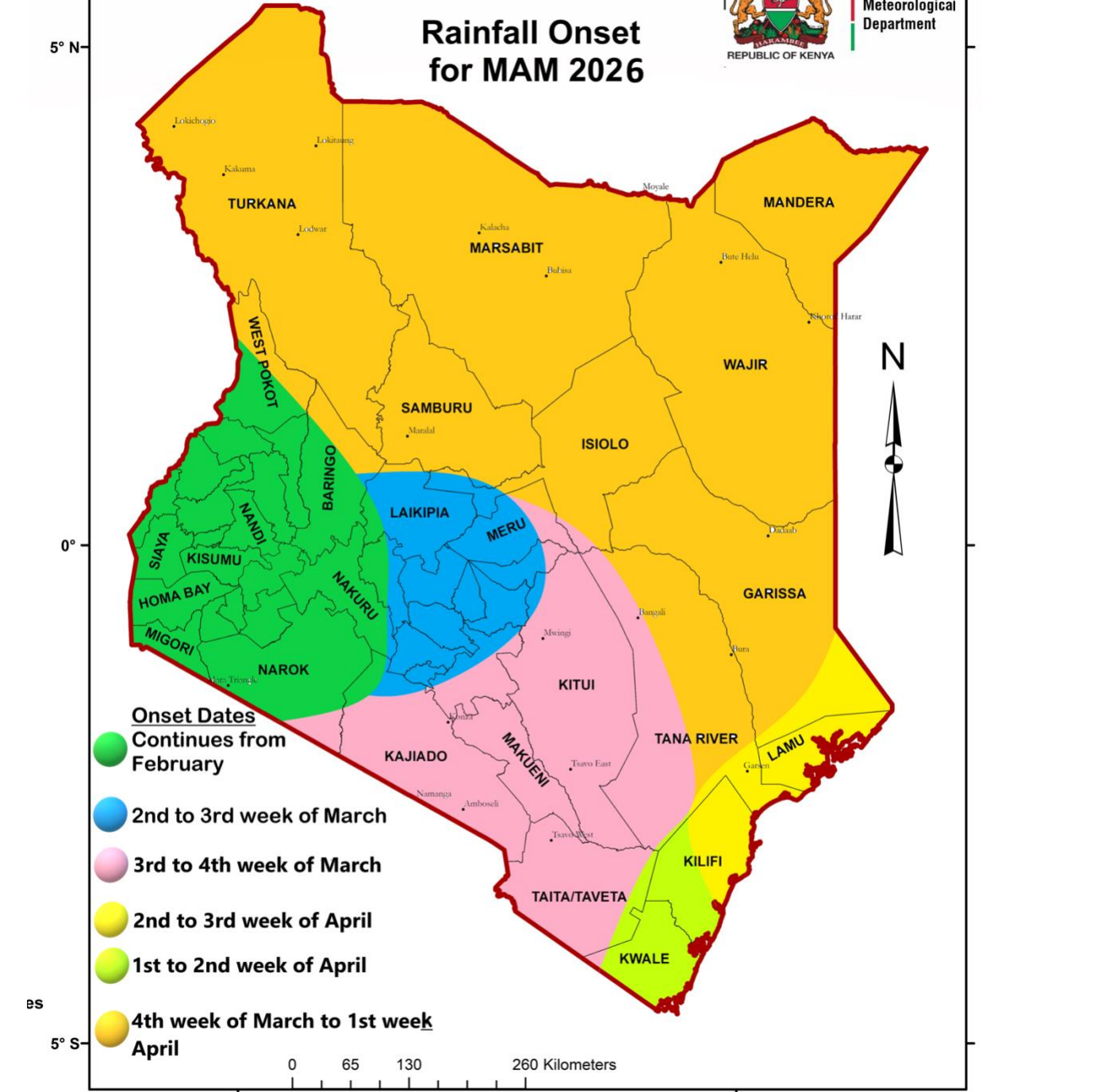
 The onset and cessation dates.
Malaria and cholera outbreaks may follow the heavy rains expected to begin next month, the Ministry of Health has warned.
At least 32 counties are forecast to experience heavy rainfall during the March–May 2026 long rains season, according to the Kenya Meteorological Department.
Read Also
Health officials, speaking during the release of the March–May seasonal forecast on Wednesday, said they expect outbreaks of diseases such as cholera, typhoid, malaria and respiratory illnesses, particularly in western and central Kenya.
“Based on the mitigation measures outlined in our advisories, we will focus on health system preparedness,” the officials said in a statement. “This includes stockpiling vaccines, water and sanitation and nutrition commodities, vector control supplies and establishing isolation centres.”
They added that measures will also include proper waste disposal and management, distribution of mosquito nets and antimalarial drugs, provision of testing kits and strengthening surveillance systems for early outbreak detection.
Head of Meteorological Services Edward Muriuki said heavy rains are expected in about 32 counties.
These include Kakamega, Vihiga, Bungoma, Siaya, Busia, Kisumu, Homa Bay, Migori, Kisii, Nyamira, Nandi, Kericho, Bomet, Nakuru, Trans Nzoia, Uasin Gishu, Elgeyo Marakwet, West Pokot, Baringo and Narok. These areas are expected to receive near to above-average rainfall between March and May.
In these regions, rainfall is expected to continue from February, with cessation likely in June.
Turkana and Samburu counties, where rains are expected to begin between the fourth week of March and the first week of April, are also forecast to receive near to above-average rainfall.
The highlands east of the Rift Valley are also expected to experience a favourable season. Counties in this region include Nyandarua, Laikipia, Nyeri, Kirinyaga, Murang’a, Kiambu, Embu, Meru, Tharaka Nithi and Nairobi.
Rains in these areas are expected to begin in the second to third week of March, with cessation in the third to fourth week of May.
“Rainfall is likely to be near average to above average, and occasional heavy rainfall events are expected in several parts of the stated regions,” said Muriuki, the Acting Director of Meteorological Services. “These events may be episodic, but they are important for water recharge.”
He said the March–May period remains Kenya’s main rainfall season, but warned that the overall outlook points to uneven distribution.
“The March to May period is the major rainfall season, popularly known as the long rains, over most parts of Kenya and much of equatorial eastern Africa,” he said.
Despite the positive outlook in some regions, several areas are expected to receive less rainfall.
In north-eastern Kenya, Marsabit, Mandera, Wajir, Garissa and Isiolo counties are forecast to receive near-average to below-average rainfall. The onset is expected between the fourth week of March and the first week of April.
“Rainfall is likely to be near average to below average, and occasional heavy rainfall events may occur in a few areas,” Muriuki said. “However, the amounts may not be sufficient to fully address existing moisture deficits.”
The south-eastern lowlands, including Machakos, Kitui, Makueni, Kajiado and Taita Taveta, as well as inland parts of Tana River county, are also expected to receive near-average to below-average rainfall, beginning in the third to fourth week of March.
The Coast is forecast to experience the weakest season.
“At the Coast, including Mombasa, Kilifi, Lamu and Kwale counties, as well as the coastal parts of Tana River county, rainfall is likely to be below average during the forecast period,” Muriuki said. “Despite the depressed totals, occasional heavy rainfall events may occur in a few areas.”
The onset at the Coast is expected later, between the first and third week of April. Rains are expected to continue into June despite overall reduced totals.
The Meteorological Department noted that the season is likely to have a normal to late onset over most parts of the country, with intermittent dry spells.
“The season is expected to be characterised by a normal to late onset, with intermittent dry spells,” Muriuki said. “However, occasional heavy rainfall events are likely in some parts of the country.”
The peak of the season is expected in April for most regions, except the Coast, where the peak is forecast for May.
Muriuki said the forecast may still be influenced by short-term weather drivers and urged the public and sector players to remain updated.
“Intraseasonal drivers such as tropical cyclones and the Madden–Julian Oscillation are only predictable at shorter lead times and can significantly influence the seasonal outcome,” he said. “We therefore recommend that the public stay updated with subsequent forecasts and advisories.”
He added that county- and ward-level forecasts will be released from next week to support local planning and decision-making as the long rains season approaches.