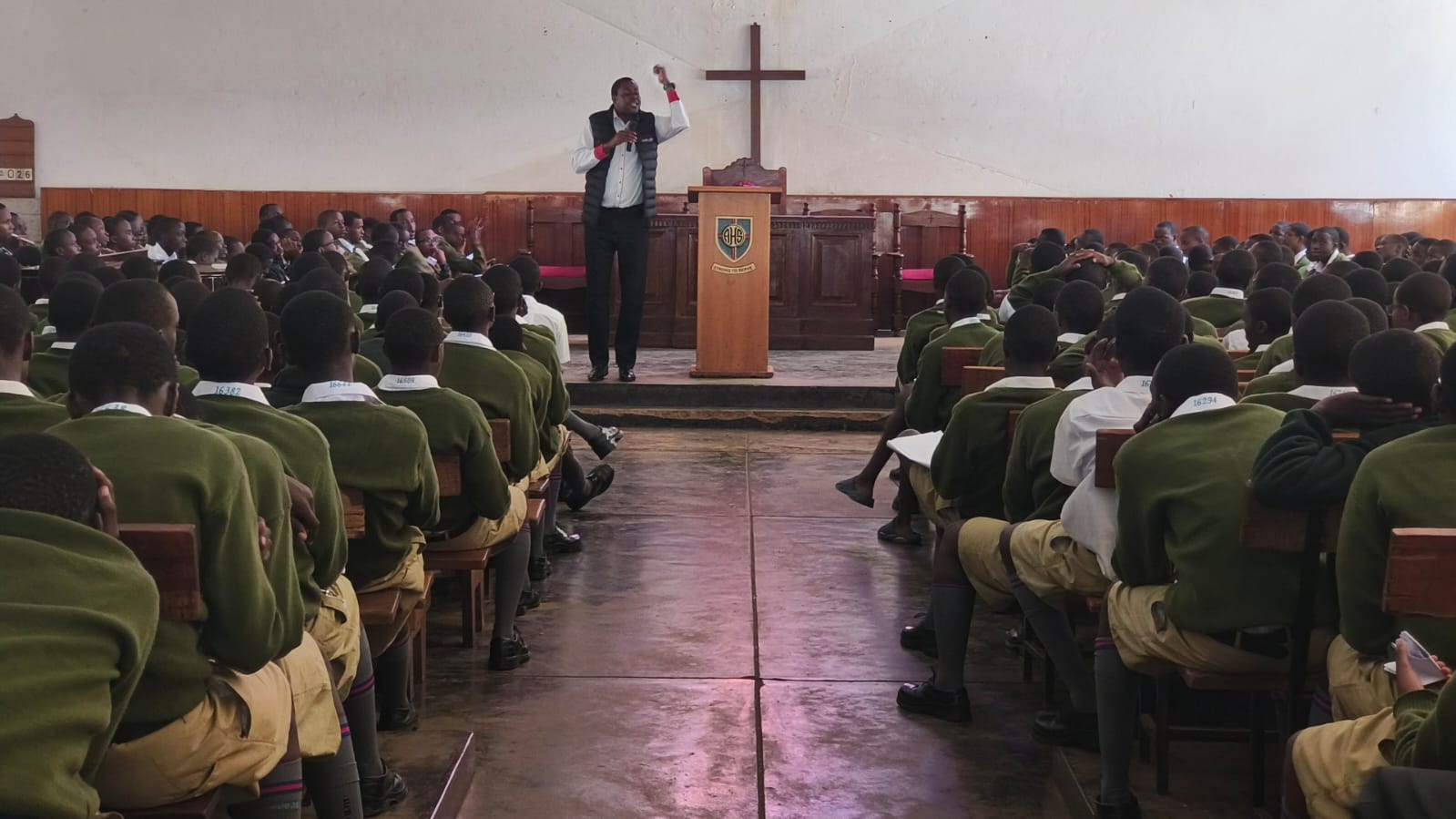
 A KUCCPS officer attends to Grade 10 students at Alliance High School guiding them on career pathways February 6 /KUCCPS
The transition of Form 4 leavers to institutions of higher learning has changed tremendously over the past decade, expanding the scope of options for students seeking to further their education.
Students now have multiple choices to pursue their dream careers, unlike previously when joining university was highly competitive and direct university entry under government sponsorship was the preserve of top-performing students selected by the Joint Admissions Board (JAB).
JAB, a body composed of vice chancellors from all public universities and representatives from the Ministry of Education, only picked girls with a minimum mean grade of B- (minus), equivalent to 64 points and boys with an even higher threshold of grade B or 68 points and above.
The board would often fluctuate the cut-off points to a higher threshold, such as B+ for boys and B for girls, in some years depending on the national average performance of candidates.
The board was disbanded following the enactment of the Universities Act of 2012 and replaced with the Kenya Universities and Colleges Central Placement Service (KUCCPS).
KUCCPS officially took office in 2014, but it was not until the 2016 Kenya Certificate of Secondary Education (KCSE) that it managed placements for public and private institutions, including Technical and Vocational Education and Training (Tvet) institutions.
It was the same year that the Commission for University Education (CUE) lowered the minimum university entry grade to C+ (plus), a move that coincided with strict reforms meant to curb exam malpractices and ensure uniformity in university admission.
"Even though we are under the Universities Act, we are not limited to the universities and colleges and that's why you find we are in the private universities and public universities as long as the university is registered and accredited to offer courses in this country," explained KUCCPS chief executive Agnes Wahome.
Wahome said the scope of placement has expanded beyond colleges under the Ministry of Education to institutions operating under other ministries and departments.
"We are working with 20 ministries, that's why we are doing placement for KMTC under the Ministry of Health. Utalii College just came on board, so our mandate really is expanding," she said.
Under her leadership, KUCCPS has focused on improving data-driven placement, reducing reliance on the minimum university entry grade and allowing students to make informed choices via the portal after results.
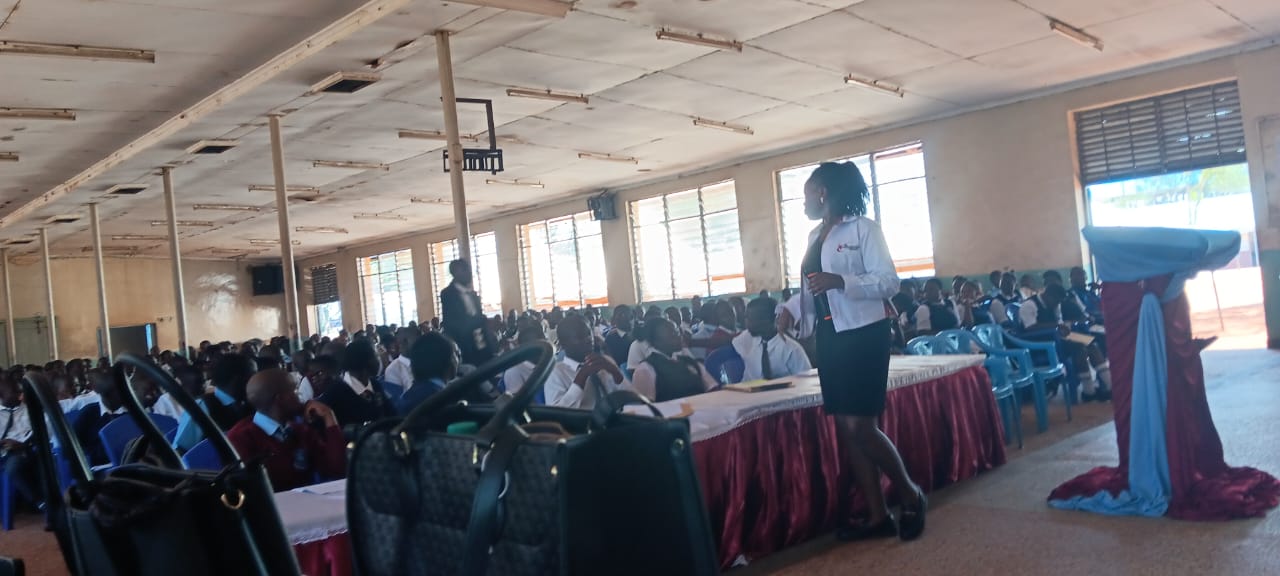 KUCCPS team facilitates career guidance session for students, teachers and principals from 31 secondary schools at Moi Girls' Vokoli in Sabatia Constituency, February 4, 2026. /KUCCPS
Speaking on NTV's Fixing the Nation on Wednesday, February 4, Wahome said the placement service is mandated by the Universities Act to also offer career guidance to joining students, with emphasis on Competency-Based Education (CBE).
The development marks a shift from when JAB would solely converge and place students based on their KCSE grades and subject clusters without offering individual counselling during the placement process.
JAB was often criticised for admitting students to courses that did not align with their preferences, a move sometimes viewed as neglecting the broader career prospects of learners.
Wahome said besides facilitating student placement, the service is actively involved in providing deep, personalised and holistic career counselling to students before opening the application portal to ensure they make informed choices based not only on their overall performance but also on skills match and career interests.
Towards this end, KUCCPS held its first-ever National Career Conference and Exhibition 2026 at the Kenyatta International Convention Centre (KICC).
The three-day event, held under the theme “Informed Career Choices; A Skilled and Competitive Workforce,” ran from January 27 to 29 and provided a platform for institutions to showcase their academic programmes, training opportunities and career pathways, bringing clarity to thousands of learners.
The forum complemented the continuous county career guidance sessions where KUCCPS officials continue to visit institutions of higher learning and attend academic open days in senior schools to sensitise Grade 10 learners on career pathways.
"Actually career guidance should start from the very basic stage of a child; it shouldn't be an event. It's a conversation that should start very early in life, very simple, just asking a child, 'what would you like to be', or a parent observing a child to see what the child loves doing," Wahome said.
She explained that identifying a child's gifts and talents from an early age forms an informed reference point upon which parents and guardians can rely to guide their children appropriately throughout their schooling.
This, she said, does not need to be academic stuff but just basic sports, music and other inborn skills and talents, which can be translated into lifelong career activities that provide a form of income.
"So it shouldn't be something that separates you from your normal life and that's the conversation that we've been having because as we move into the new education system, we are talking about pathways like Arts and Sports. We are basically talking about somebody's talent."
Wahome said CBE has presented a shift where sports and arts are no longer regarded as side hustles or merely extra-curricular activities for leisure to break boredom after classwork.
She said the placement service is actively involved in offering career guidance to junior school learners across the country, starting with Grades 7, 8 and 9.
"So those who have gone into Grade 10 now, we started off by training the teachers and having a conversation to find out where the gaps are. As you introduce every topic, as you look at every subject, how do you bring in the aspect of career in it," she said.
Competency-Based Education (CBE) is a student-centred learning system that focuses on a student's demonstration of what they know and can do, rather than the amount of time spent in a classroom.
Under the model, learning is mastery-based, according students the opportunity to master specific skills before progressing to the next level.
In a fresh shift from the 8-4-4 system, KUCCPS has signalled that it will scrap the C+ cut-off as the standard measure for university entry as it seeks to align placement with CBE and ensure every learner gets an equal opportunity to further their education.
"Even for us as we engage in career guidance, we realise there are more career opportunities than we thought because we are more traditional — we have gone through the same 8-4-4 where we are expected to recall," Wahome said.
"We are seeing more and more students who qualify for university making a firm decision to join Tvet because 'I want to be an engineer'. That's how you measure the impact of career guidance; people making decisions not because people want to see them in the university."
Wahome said the service will open the application portal for the 2026 cycle after the conclusion of the career guidance processes and encouraged eligible learners to apply.
She, however, said they have uploaded last year's placement to help guide learners on possible career paths based on individual universities' cut-off points for every programme.
"This year we had 270,000 students who got C+ and above, last year we had 245,000 so the competition will be higher this year. So if the last person who got into Nairobi University School of Medicine for example was 45.5, it's likely to be 45.7, so if we put it there it helps them make a choice."
Wahome said previously the portal would be opened before exams were done for teachers to input choices on behalf of students, often resulting in learners ending up pursuing careers they did not want.
"We had the teachers' platform so the teacher would feed in students' choices and where the student did not make a choice, the teacher would make a choice saying you are an A (plain) student, do medicine. The A and A- (minus) students are the ones who suffered the most because they have good grades across the sciences and the arts and sometimes a child wants to do communication."
She said KUCCPS has extended the application window to cater for students who sat their KCSE two years back but could not join university or college during their cohorts due to unavoidable circumstances.
"Of course we encourage you to apply immediately but where circumstances force you we have an opportunity for late application where we look at how you performed against your class, not the new one because if we check against the latest class, you will be disadvantaged," she said.