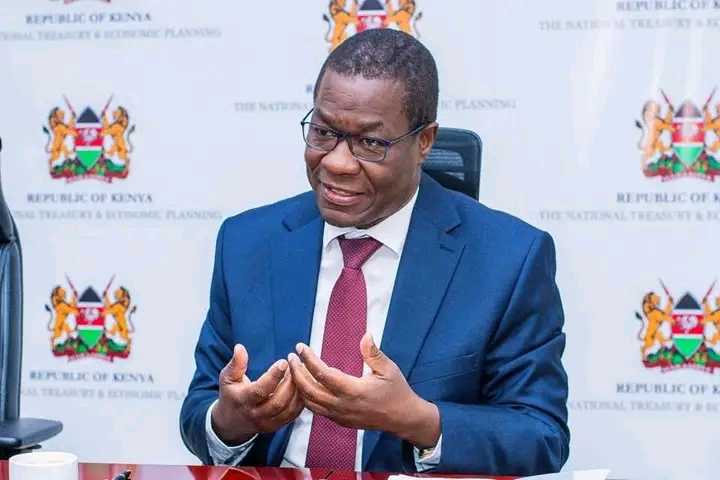
 Water Cabinet Secretary Eric Mugaa (left) with Eldama Ravine during the commissioning of Chemususu water supply project in Baringo/SCREENBGRAB
Water Cabinet Secretary Eric Mugaa has issued a firm directive to contractors and consultants overseeing public water projects.
He said quality and value for money will remain a priority under his oversight.
The CS made the remarks in Baringo during an inspection tour to observe the transfer of bulk water from Chemususu Dam to Nakuru County, where he raised concerns over workmanship at one of the project sites, noting deviations from standard engineering practices and specifications.
At the centre of the discussion was the installation of a critical valve that Mugaa claimed had been mounted without a supporting stool, leaving it suspended on a pipe despite its weight.
“This is a valve, correct? It is heavy, it has weight. It is supposed to sit on a stool. Where is the stool?” Mugaa asked, as engineers explained that ladders had been used in place of the required support.
He stated that such practices could compromise the durability and lifespan of public infrastructure.
He rejected explanations that the arrangement was temporary, stressing that even interim works must adhere to professional standards.
“If it is temporary, do it right. Where is the stool now? Even the stool is temporary? How will you build a stool there when you have already placed your valve?” he asked.
Mugaa also noted the absence of a speedo for operating the valve, indicating that operational and maintenance considerations were not fully addressed.
“How will you be opening and closing that valve without a speedo? It is supposed to be part of the specs,” he said, adding that inadequate execution could lead to deterioration and higher repair costs.
Eldama Ravine MP Musa Sirma, who joined the inspection team, supported the CS, describing the workmanship as unacceptable.
“This is very wrong,” Sirma said, noting that while residents welcomed the water supply, standards could not be overlooked.
“When the CS says this thing must be redone, he means it must be done properly.”
Mugaa also highlighted issues with the valve chamber, pointing out uneven formwork and areas with weak finishing.
“Look at the workmanship of the chamber. It is already crumbling. Where is the formwork? Is it the same size from here to there?” he asked, adding that such defects could indicate broader supervision challenges.
“Just do the right thing. And this is just one example,” he said, noting that other sites would also be closely monitored.
Despite the strong message, the CS reaffirmed the government’s commitment to delivering water to communities, noting that quality infrastructure is key for sustainability.
“It is a good day that we are bringing water to Nakuru, but the quality I will not compromise. That must be very clear,” Mugaa said.
The visit marked a milestone in the Chemususu-Nakuru bulk water project, which will transfer more than six million litres of water daily to Nakuru County once fully operational, improving access for thousands of residents.
During the tour, the team oversaw the handover of LMC domestic meters to Nakuru Rural Water and Sanitation Company (NARUWASCO), aimed at improving efficiency and accountability in water distribution.
Water Principal Secretary Julius Korir accompanied him.
Leaders present included Nakuru Deputy Governor David Kones, Baringo Deputy Governor Felix Kipng’ok, Rongai MP Paul Chebor and Nakuru County Woman Representative Liza Chelule, among others.
The delegation also inspected the Emkwen Tank, which has a storage capacity of 1,500 cubic metres and is designed to supply water to about 2,000 residents through a 53-kilometre pipeline.
Mugaa later visited the home of Mzee Cherono, a beneficiary of the project, observing the impact of reliable water supply on household livelihoods.
The tour concluded with a visit to Kabimoi Tank, which has a capacity of 50,000 litres and serves 435 active users through a 22-kilometre pipeline network.
The government says the projects underscore its commitment to expanding water access, improving sanitation and enhancing livelihoods across the region, contingent on contractors delivering work that meets required standards.