County governments are on the spot after a Senate watchdog committee exposed financial management lapses involving billions of shillings, stalled development projects, ballooning wage bills, and questionable expenditures.
The fresh revelations by the Senate County Public Accounts Committee (CPAC) raise concerns over accountability in the devolved units.
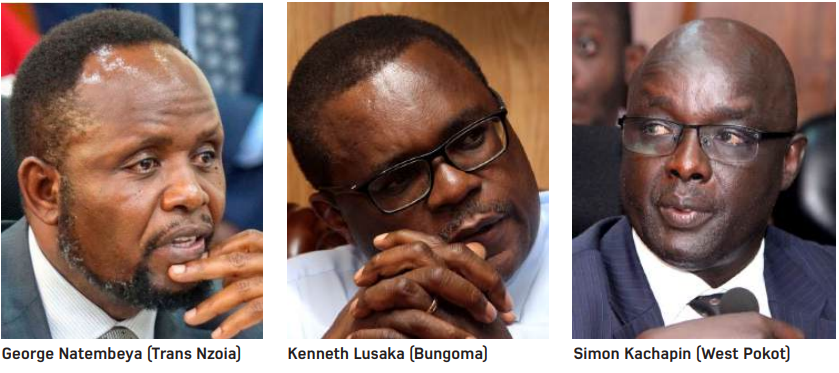
Governors George Natembeya (Trans Nzoia), Simon Kachapin (West Pokot) and Kenneth Lusaka (Bungoma) faced tough questioning from senators as they responded to queries raised by Auditor-General Nancy Gathungu for the financial year ended June 2025.
Trans Nzoia County, for instance, risks turning several multi-billion-shilling development projects into white elephants, with contractors owed more than Sh2.5 billion.
Auditors say key projects are delayed, payments are irregular, while some contractors have abandoned sites despite being overpaid.
Among the stalled projects are the Sh1.6 billion Kijana Wamalwa Teaching and Referral Hospital Phase Two, Sh874 million Multi-Storey Business Complex, Sh657 million Kenyatta Stadium, and Sh499 million County Aggregation and Industrial Park.
CPAC chairman Moses Kajwang condemned the growing backlog of unpaid bills, some dating back over three years. “If not prioritised, these noble projects risk becoming white elephants,” Kajwang' warned.
The hospital project, only 70 per cent complete, received 102 per cent of the contract value.
“How do you pay 32 per cent above contract for work not done?” Kitui Senator Enoch Wambua asked.
Governor Natembeya blamed court challenges over bill verification and claimed Sh750 million has been set aside to settle some debts.
Yet, auditors noted that 82 per cent of pending bills were incurred during his tenure, raising serious questions about financial oversight.
The multi-storey complex, delayed for over four years despite Sh818 million paid, lacked title deeds and allotment letters. Contractors abandoned the site at 95% completion after disputes over contract extensions.
Natembeya insisted the project would open by March “come rain or sunshine,” but senators warned against letting taxpayers’ money go to waste.
Kenyatta Stadium is also behind schedule, with the contractor allegedly responsible for part of the delay. Natembeya assured senators that work is ongoing and nearing completion.
In West Pokot, Governor Simon Kachapin faced tough questions over a Sh3 billion wage bill, representing 41 per cent of the county’s projected revenue of Sh7.3 billion—far exceeding the 35 per cent legal limit.
Actual expenditure consumed 46 per cent of realised revenue, violating the Public Finance Management Act.
Senator Johnes Mwaruma called the overspending “unacceptable,” noting that it constrains development and public service delivery.
Kachapin admitted the breach but promised cost-cutting through staff rationalisation, contract renewals only for critical positions, and enhanced revenue collection.
Senators, however, challenged him on stalled projects, including a tourism hotel and governor’s office complex, where funds were spent with little progress.
Kachapin said the education office block was complete, while other projects were scheduled for funding in the 2026/2027 budget.
Auditors also found irregularities in salary increments with 448 employees having received multiple annual raises in breach of human resource policies.
Kachapin acknowledged the irregularities, promising recovery through a phased, humane process.
Revenue collection gaps were exposed, with Sh185.4 million unverified due to lack of full automation and an outdated valuation roll.
Pending bills of Sh321.6 million were reportedly cleared, but senators also noted ethnic imbalances in staffing, with 90 per cent of new hires from the dominant community, contravening the County Government Act and National Cohesion Act.
Governor Kenneth Lusaka faced scrutiny over Sh549 million in gratuity arrears owed to former Bungoma county employees.
Lusaka admitted the problem originated under his predecessor but pledged to clear part of the backlog with Sh130 million and disciplining of errant officials.
The committee also questioned a Sh599 million expenditure for medical cover via a private broker, with Sh231 million unaccounted for and no list of beneficiaries. Senators asked why the county had not used the Social Health Insurance Fund, which would have been cheaper and verifiable.
Adding to the controversy was Sh3.6 million spent on Christmas tree lighting, labelled wasteful by senators.
Lusaka defended himself, saying the spending occurred in 2019 under a previous administration, and the responsible officer had been prosecuted.
The county’s wage bill, swelling from 47 per cent to 53 per cent of the budget from the previous year, alarmed senators.
Lusaka blamed court rulings that forced the absorption of 463 casual staff on permanent terms.
Delays in completing the Sh807 million Masinde Muliro Stadium were also criticised.
Lusaka assured senators that the project was 95 per cent complete and that discussions with the national government were ongoing to finalise it.
INSTANT ANALYSIS
The hearings laid bare systemic weaknesses across counties: mismanaged projects, overpayments, stalled infrastructure, bloated wage bills, unverified revenues, and irregular HR practices. Senators warned that unless counties prioritise settling pending bills, enforce financial controls, and comply strictly with public finance laws, taxpayers’ money risks being squandered while citizens are denied vital services.