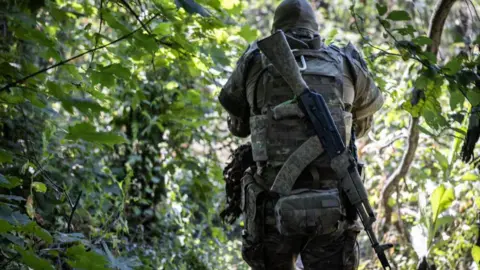
Returnees, those stranded there, their families and official government statements reveal a quiet but troubling pattern in which Kenyans are being recruited into Russia’s military campaign in Ukraine.
While many were duped with false job promises as drivers, cleaners and security guards, some with distinguished military careers have signed up knowingly.
Among those caught in the web is a decorated former Kenya Air Force pilot who requested not to be named.
The officer, who was trained locally and in South Africa, flew for eight years in the KAF, piloting seven different aircraft types.
These include the Cabri G2CA, Bulldog S100, Robinson 66, Fennec B2 H125, Huey UH-1H-1, Huey UH-1H-2 and the twin-turbine Dauphin.
A Bachelor's degree graduate (Military and Security Studies), he also served as a ground-flying instructor at Wilson Airport and a training manager with a neighbouring intelligence agency.
Yet in 2025, jobless and struggling to finance his aircraft rating and licence conversion needed to fly commercially, he found himself considering an unusual offer.
He didn’t disclose reasons and the manner he left KDF.
“A friend called me for this job… I was jobless,” he said from a hospital in Russia, where he was receiving treatment for injuries sustained in the war.
“I have never been able to fly again due to financial issues to do my aircraft rating and licence conversion. But I am really looking for assistance to acquire my Kenyan commercial pilot licence and go back to flying,” he told the Star.
For others like Duncan Chege and Reuben Ndung’u, rogue agents duped them with false job promises in Russia.
Chege who “miraculously” survived and returned last month was reportedly going to take up a job as a driver.
His job in Kenya where he transported groceries from Nairobi to Mombasa, was not fetching enough and through his friend, he sought an opportunity in Qatar.
He was connected to an agent, who initially said the available jobs were in Dubai.
He was told visas to UAE were delaying but there were even better opportunities in Russia paying Sh330,000.
Compared to the Sh70,000 in Dubai, this was a deal so good to refuse. The family took a loan to secure the opportunity. But as soon as Chege arrived in Russia, he realised too late he had been enlisted in the army, and despite protests to the commanders, there was no way out.
With him in the training camps were Ugandans, Chinese and Russians. While the others were aware of their mission, Chege was realising too late, he says.
This was the same case for Ndung’u, whose family is yet to hear from since October 8 — around the same time Chege travelled to Russia.
Ndung’u’s mother told the Star he had been recruited as a guard by an agent who has since gone mute.
Lawyer Danstan Omari, who represented Edward Gituku — accused of trafficking Kenyans to Russia — laid bare the extent of the recruitment. As of September, he said, at least 1,000 Kenyans had joined the war.
Omari said Gituku was allegedly involved in the relocation of former Kenyan military personnel, who were subsequently enlisted into Russian military.
Omari said those who had been recruited had to have had military experience and had the proper documentation authorising them to travel for military-related activities in Russia.
Foreign Affairs CS Musalia Mudavadi last year confirmed at least 200 Kenyans had been duped and recruited to the frontline.
While a number of them have been repatriated, the majority have been missing, feared dead, while others have been captured as prisoners of war.
According to Kyiv, more than 1,400 citizens from 36 African countries have been recruited to fight for Russia in Ukraine, and some are being held in Ukrainian camps as prisoners of war.
Ukraine Foreign Minister Andriy Sybiha said Moscow was enticing Africans to sign contracts that he described as "equivalent to ... a death sentence", and urged African governments to warn their citizens.
Chege said many of the comrades were killed by the Ukrainian drones in the “red zone” on the frontline.
Former Ukraine Deputy Prosecutor General Gyunduz Mamedov also links “Russian Houses” in Africa, to the recruitment, as the Centre for Countering Disinformation report found.
This is necessitated by the urgent need to constantly replenish its mobilisation pool.
“This has pushed the Russian authorities to intensify the activities of so-called operating recruitment hubs under the guise of cultural centres, which is already a well-established Russian practice.
“I clearly remember numerous such cases from my time at prosecutor general’s office. Back then, under the cover of promoting Russian culture, mercenaries were recruited to fight against Ukraine,” Mamedov says.
The Russian Embassy in Nairobi has on record denied any role in recruiting Kenyans into the Russian army.
The embassy denied any involvement in a statement last year following the arrest of Mikhail Lyapin, who was questioned by DCI for allegedly running a recruitment ring.
The DCI had claimed Lyapin worked for the Russian Embassy — a claim the mission dismissed.