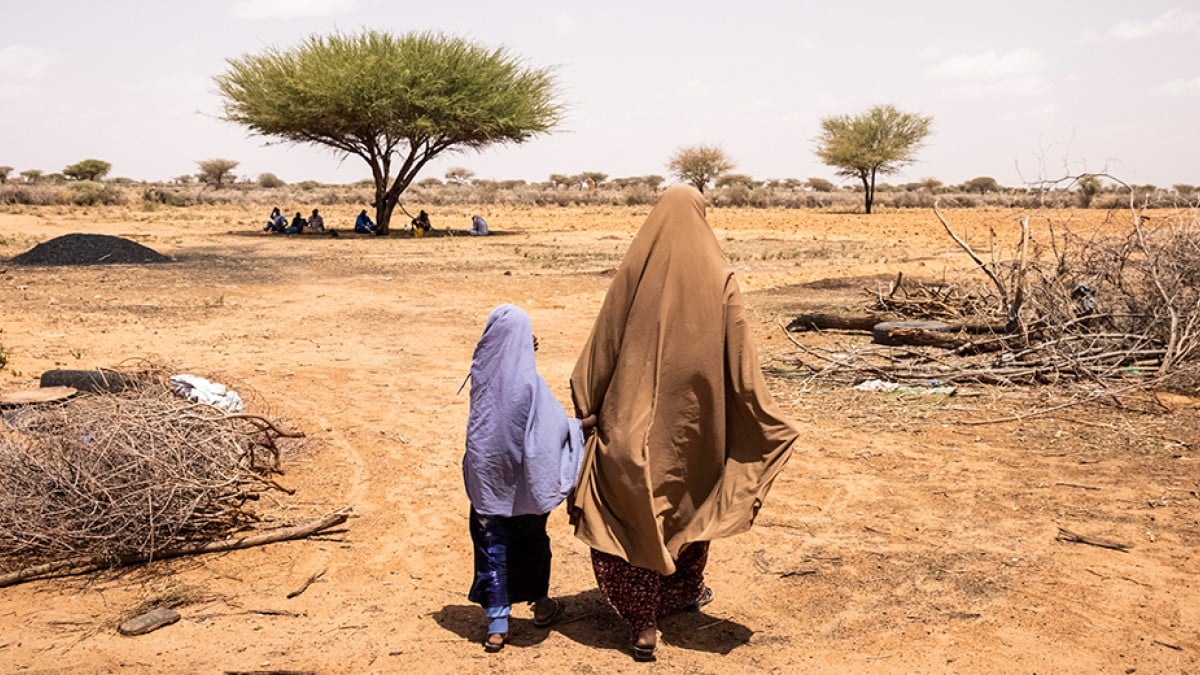
 A woman with her child in an arid area. /FILE
More people are likely to starve as a result of the dry conditions being experienced across the country, the latest forecast shows.
The sunny and dry weather conditions are expected to dominate most parts of the country during February.
Already, more than two million Kenyans are in dire need of food and water, with 784,000 children already reported to be malnourished.
The National Drought Management Authority (NDMA) says the drought situation across arid and semi-arid counties is deteriorating following poor performance of the Oct-Dec 2025 short rains season.
According to the Drought Early Warning System managed by NDMA, Mandera county remains in the 'alarm' drought phase.
NDMA is the government agency mandated to coordinate drought risk management.
Nine counties, including Turkana, Wajir, Garissa, Marsabit, Isiolo, Kajiado, Kilifi, Kwale, and Tana River, are classified in the 'Alert' phase.
Thirteen other counties remain in the 'normal' phase, though more than half show worsening trends, particularly in water and livestock indicators.
The government, in collaboration with humanitarian and development partners, is scaling up drought-response interventions to cushion the 2.1 million food-insecure people and protect livelihoods in affected areas.
The forecast says the dry weather conditions expected during the month are likely to worsen food security over the northern and parts of the eastern sectors of the country as availability of food, water and pasture for human as well as livestock use is expected to decline further.
The forecast has advised national and county governments as well as humanitarian organisations to take necessary action to avert any loss of lives.
“The current drought is expected to intensify and may spread to other parts of the country. Relevant authorities are advised to put in place measures to avert any loss of lives and livelihoods,” the forecast says.
Limited pasture and water in the Asal areas may lead to resource-based conflicts among the pastoral and farming communities.
Water availability for both human and livestock use is expected to further decline. Authorities have been asked to truck water to the most vulnerable people.
The forecast, however, says some rainfall is expected in the Lake Victoria Basin, the Highlands West of the Rift Valley, the Southern Rift Valley, parts of the Highlands East of the Rift Valley including Nairobi, and parts of the southeastern lowlands.
“Temperatures are also likely to be warmer than average over several parts of the country."
Siaya, Kisumu, Homa Bay, Migori, Kisii, Nyamira, Trans Nzoia, Baringo, Uasin Gishu, Elgeyo-Marakwet, West Pokot, Nandi, Laikipia, Nakuru, Narok, Kericho, Bomet, Kakamega, Vihiga, Bungoma and Busia will be sunny and dry during the month.
However, occasional rainfall is expected over several parts of those regions.
Nairobi, Nyandarua, Nyeri, Kirinyaga, Murang'a, Kiambu, Meru, Embu, and Tharaka Nithi will also experience sunny and dry conditions during the month with maximum temperatures ranging between 22°C and 31°C.
Wajir, Garissa, Isiolo, Mandera, and Marsabit will have maximum temperatures of between 26°C and 40°C, while minimum temperatures are expected to range from 16°C to 28°C.
Kajiado, Kitui, Makueni, Machakos, and Taita Taveta will also experience dry and sunny conditions, with maximum temperatures expected to range from 24°C to 36°C, while minimum temperatures will range between 12°C and 23°C.
Mombasa, Tana River, Kilifi, Lamu, and Kwale will also be dry throughout the month. However, a few areas along the south coast may experience rainfall during the month. Maximum temperatures are expected to range from 31°C to 35°C, while minimum temperatures are expected to range from 23°C to 27°C.
Cases of human-wildlife conflicts are likely to escalate as wildlife migrate in search of water and pasture.
Wildlife deaths could also increase in the conservancies due to lack of pasture and water.
“Relevant authorities are advised to provide watering points and pasture for the wildlife to prevent any deaths as well as minimise human-wildlife conflicts.”
The forecast cautioned the public against engaging in activities that can spark wildfires in forests, parks, and game reserves.