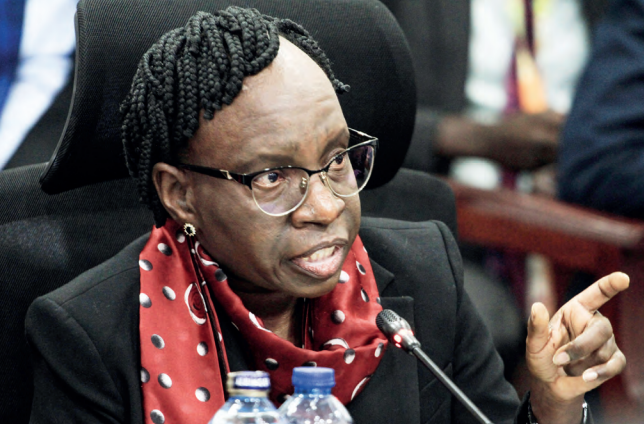
 Auditor General Nancy Gathungu/FILE
Read Also
County governments are haemorrhaging billions of shillings through dubious procurement practices, as officers entrusted with safeguarding public resources openly flout the law.
Fresh audit reports by Auditor General Nancy Gathungu paint a disturbing picture of systemic abuse of procurement systems across counties.
The reports expose a pattern in which procurement officers routinely ignore, bend, or violate the Public Procurement and Asset Disposal Act with little regard for accountability.
According to the Auditor General, tenders are frequently awarded to preferred firms, many of which lack the technical, financial, or professional capacity to execute the works.
The outcome has been shoddy projects, stalled developments and massive losses of public funds.
Shockingly, most of the firms benefiting from these lucrative contracts are not prequalified to offer goods or services to county governments, as required by law.
In several cases, contracts are varied arbitrarily—sometimes far beyond the legally allowed limits—raising serious concerns about collusion, favouritism and deliberate manipulation of procurement processes.
The reports further show that some counties have bypassed the government’s e-procurement platform, which was introduced to enhance transparency and curb irregularities.
By avoiding the system, the auditor warns, counties have created loopholes that allow billions of shillings in taxpayers’ money to be misappropriated with impunity.
In Baringo county, Gathungu found that firms awarded contracts lacked valid tax compliance certificates, while others had expired performance security bonds—basic legal requirements for any public procurement.
Despite these glaring shortcomings, the firms were still awarded contracts.
The county also raised eyebrows after procuring a contractor through direct procurement to construct an aggregation and industrial park for Sh435.6 million.
Auditors questioned the justification for using direct procurement for such a major project, citing concerns over due diligence, competitiveness and compliance with the law.
In Bomet County, the audit revealed that the county attorney handpicked 32 private law firms to provide legal services, bypassing competitive procurement procedures.
“The outsourced legal services were not competitively procured since they were directly procured by the county attorney through issuance of instructions,” the Auditor General’s report states, raising concerns over value for money and possible abuse of office.
Busia county was flagged for purchasing rice worth Sh21.46 million without providing documents to justify the procurement.
Auditors said the lack of supporting documentation made it impossible to establish whether the purchase complied with procurement laws or whether the county received value for money.
In Elgeyo Marakwet county, the audit exposed poor workmanship and weak supervision.
The county spent Sh2.49 million in 2014 to construct a one-bedroom staff house at Teror Health Centre, but barely a year after completion, the building developed leakages and became unusable.
“There was no value for money on the one-bedroomed staff house constructed at Teror Health Centre,” Gathungu said, underscoring the consequences of awarding contracts to unqualified or poorly monitored contractors.
Garissa county’s handling of public funds also came under scrutiny.
The county awarded Sh19.99 million for the construction of a seven-kilometre water pipeline in Balambala town through restricted tendering, contrary to Section 102(1)(a) of the Public Procurement and Asset Disposal Act.
The law allows restricted tendering only for complex or specialised works, a condition auditors said was not met.
Further compounding the irregularity, the firm awarded the contract was not among the county’s prequalified suppliers, in violation of Section 95(3) of the Act.
The county also awarded Sh43.14 million to a contractor whose performance security bond had expired for the construction of the Bour-Algi Giraffe Sanctuary.
In Kericho county, auditors flagged spending of Sh230.57 million on road projects that were not included in the approved procurement plan.
An additional Sh7.97 million was spent on assorted empowerment materials that were neither planned nor budgeted for, in breach of procurement and public finance laws.
Kiambu county was cited for awarding a Sh29.01 million tender for the construction of seven Early Childhood Development Education centres to a firm whose financial capacity could not be verified.
“The evaluation report revealed that the successful bidder did not provide evidence of financial capability but was recommended based on being the lowest evaluated bidder,” the Auditor General said.
“Therefore, the bidder did not meet the evaluation criteria.”
In Vihiga county, a contractor was awarded Sh1.77 million to construct an ECDE classroom, but less than six months after completion, the classroom floor developed cracks even before learners could occupy it—clear evidence of substandard work.
“In the circumstances, value for money incurred in the construction of classrooms could not be confirmed,” the audit report shows.
Taita Taveta county was faulted for procuring a defective laundry machine for Sh17.82 million.
A review of procurement documents showed that the inspection and acceptance committee identified several defects, including missing heaters, a non-functional door safety micro-switch and undelivered overflow hose pipes.
“Despite the defects, the management received the machines, and no evidence was provided to confirm that the defects were corrected before or after acceptance of the equipment,” the report notes.
In Lamu county, auditors flagged the use of an inappropriate procurement method to purchase fuel, oil and lubricants worth Sh67.56 million.
The items were procured through a request for quotations, a method legally restricted to procurements valued at no more than Sh3 million.
Regulation 91 of the Public Procurement and Asset Disposal Regulations, 2020, requires procuring entities using requests for quotations to strictly adhere to prescribed thresholds—rules auditors said were ignored.
Laikipia county was cited for awarding a Sh1.45 million tender to a supplier who was neither registered under the appropriate category nor listed among the county’s prequalified suppliers.
The county further handpicked eight law firms and paid them Sh24.93 million to provide legal services, without proof of urgency to justify direct procurement as required by law.
In Samburu county, the Auditor General flagged apparent unfairness in the award of tenders.
The county awarded contracts worth Sh578.55 million to 65 suppliers for the construction of access roads, buildings and other works.
However, Sh399.94 million—representing 69 per cent of total payments—went to just 22 suppliers.
“This concentration of payments indicates potential unfairness and lack of equitable distribution in the award of contracts,” the report says, adding that the fairness, transparency and regularity of procurement amounting to Sh578.55 million could not be confirmed.
The county also paid Sh2.07 million to an insurance agency that was not licensed, further highlighting weak compliance with procurement regulations.
INSTANT ANALYSIS
The Auditor General’s findings expose a troubling culture of impunity in county procurement systems, where weak oversight, favouritism and deliberate disregard for the law continue to drain billions from public coffers. The losses not only stall development projects but also reward incompetence at the expense of qualified contractors. Experts warn that unless counties urgently reform procurement processes, enforce accountability and sanction errant officers, devolution risks being undermined by waste, mismanagement and deepening public distrust.