It is 6 pm in Huruma Estate, Nairobi. The baking sun is slowly dipping low behind rows of weather-beaten flats, and with it comes a tired wind that lifts dust from the unpaved paths, spinning it into the air before it settles on everything.
As dusk creeps in, Juliet, 32, a casual worker at a manufacturing business in Industrial Area, navigates dark alleys separating multiple-storey buildings in a tiny area the size of a netball court, before entering a tiny black corrugated gate that leads to her house.
To get home, she navigates darkness, water dripping from clothes hanging on narrow balconies, sagging power lines, burst sewage lines and a cacophony of noise from multiple bars and church services.
It’s much the same up and down, both ongoing and unfinished, multiple-storey buildings like the one housing Juliet and her three children: Leah, 12 years old, Leo, eight, and Lenox, two, and thousands of other tenants.
“This is where I live with my children. Our worries switch from being electrocuted to the possibility of a building crumbling on top of us,'' Juliet says, ready to embark on evening house chores.
“We thank God for his grace every passing minute.”
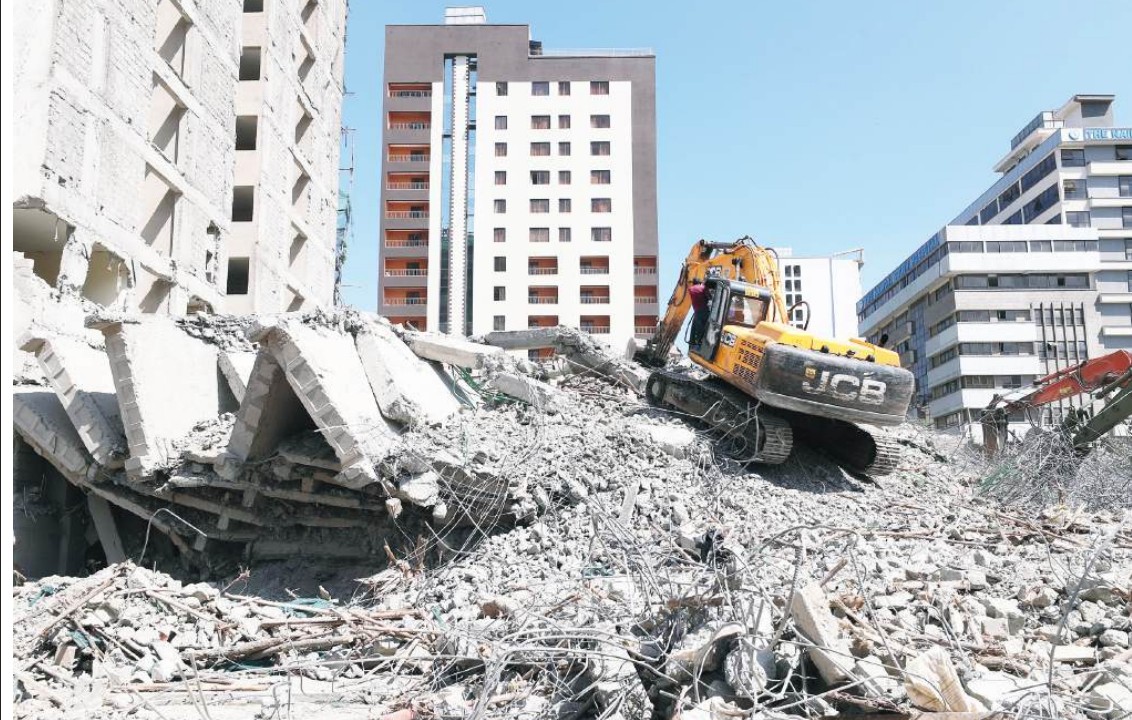
Her block stands less than 50 metres from where a building collapsed, killing 52 people in 2016.
The investigations that followed led to an audit report that called for the demolition of 388 buildings in the city.
City Hall was tasked to execute those demolitions. To date, only eight have been brought down.
This resistance and laxity have been partly attributed to lengthy legal challenges by owners of the condemned buildings and allegations of outright bribery to induce inspectors and city county officials to look the other way.
The death traps still stand, sort of, despite the then Nairobi Governor Mike Sonko calling on key City Hall departments to move swiftly and save Nairobians from impending disaster.
"We shall hold all county staff who have been frustrating the demolition of these buildings accountable," Sonko said in 2018.
The current governor, Johnson Sakaja, who was the senator at the time, accused selfish individuals at City Hall of thwarting the demolition.
"In 2016, when another building collapsed in Huruma and claimed lives, a raft of measures was agreed on, including the demolition of buildings unsuitable for habitation,'' Sakaja said.
“These buildings are still up. They must come down. Immediately.”
A spot check in various estates, including Pipeline, Kariobangi, Dandora, Kayole, Kileleshwa, Parklands, South C, Mathare, Thome and Roysambu, revealed incomplete but occupied buildings.
Early this month, various agencies unveiled a report claiming that 85 per cent of buildings in the city are not safe for occupation.
They include the Institution of Engineers of Kenya (IEK), the Architectural Association of Kenya (AAK) and the Kenya Institute of Planners (KIP).
This followed a survey of 15,000 buildings by the National Building Inspectorate in the aftermath of a recent building that collapsed in South C on January 2, killing two people.
According to the Institution of Engineers of Kenya, only 15 per cent are safe, while eight per cent are rated fair and capable of improvement.
Institution president Shammah Kiteme has blamed this impending disaster on collusion along the approval chain, with quacks in the engineering and construction industries allowed to have their way as long as they give "something small" to the relevant authorities.
Architectural Society of Kenya president George Ndege described the state of buildings in Kenya as ''dire''. "We are living by the grace of God. If a tremor, even at a low scale, were to occur, many buildings would come down,'' he told the Star.
The National Construction Authority (NCA) says that although the country has building codes and safety requirements, enforcement is patchy. NCA boss Maurice Akech says developers often bypass approval processes, or approvals are granted without a thorough technical review.
"In practice, this means buildings rise without proper geotechnical surveys, structural designs or adherence to zoning regulations,'' he told the Star."
The research also identifies inadequate structural design and overloading as recurring causes. Some buildings are designed without considering soil conditions, wind loads or future modifications."
He adds that some are overloaded when additional floors are added without structural appraisals.
"Poor maintenance contributes to failures. Buildings are not static; they require regular inspection and maintenance,” Akech said.
“Cracks, leaks and corrosion are ignored until they escalate into structural failures."
He emphasised the importance of quality building materials and adherence to standards, saying that good materials are the backbone of any structure.
"When cement achieves the right compressive strength, when steel reinforcement meets international standards and when aggregates are properly graded, the concrete gains resilience,” he said.
“Conversely, when materials are compromised, even the best design cannot save a structure."
In Nairobi, where urbanisation pressure is immense, Akech says the temptation to cut corners is high.
Developers race to meet housing demand, contractors compete on cost and regulators struggle with limited capacity. Yet the cost of neglect is catastrophic.
"Collapsed buildings claim lives, destroy property and erode public trust in the construction industry," Akech said.
“They also burden the economy as resources are diverted to emergency response and reconstruction.”
To move from reactive disaster management to proactive safety, NCA has proposed several measures, such as rigorous policy harmonisation.
For instance, it wants the current regulatory maze between counties and national government agencies streamlined.
"This calls for the entrenchment of a comprehensive National Construction Industry Policy to ensure institutional synergy, harmony, information sharing and adequate and prudent use of resources."
Central to this is a "one-stop" approval system to ensure every project undergoes rigorous, non-duplicated scrutiny.
"There is also a need to continue investing heavily in training and the professionalisation of contractors," the NCA boss said.
Nairobi Urban Planning chief officer Patrick Akivaga says the safety of buildings is dependent on the quality of materials used, quality workmanship, strict supervision by professionals and inspection by regulators.
He dismissed as “malicious scapegoating” the corruption allegations by some city politicians linking city planning officials to recent and past collapsed buildings.
The politicians include Kileleshwa MCA Robert Alai and Embakasi East MP Babu Owino. In one instance, Alai claimed county officials in the urban planning sector colluded with a broker to collect a Sh25 million bribe to okay four additional floors on a multi-storey building.
"Why would a sane person pay Sh25 million for a permit that costs only Sh800,000?'' Akivaga said.
“Three individuals have already been arrested for flouting construction rules on the condemned building. Bribery allegations are unfounded and a plain witch-hunt.”
Lands CS Alice Wahome has warned that her ministry will take firm action against professionals found to have violated the law, including striking them off the professional register.
Addressing the press on the South C tragedy, the CS seemed to place blame on city construction inspectors.
She said that although the developer had been licensed to construct the building, the project grossly violated approved plans, ultimately leading to the collapse.
The building had been approved for 12 storeys only by the relevant authorities in her ministry. However, developers illegally added four extra floors, pushing the structure to 16 storeys.
Her remarks came amid claims by Nairobi Governor Johnson Sakaja that county officials had repeatedly flagged the building for non-compliance, but developers ignored enforcement notices and went on building.
Sakaja now wants the county government to be granted prosecutorial powers to directly sue developers who violate construction laws, noting that such authority currently lies with the Office of the Director of Public Prosecutions.
As authorities trade blame, the lives of city residents are in danger.
Kenya has maintained a high safety record with negligible incidents of structural failure until the early 1980s and mid-1990s. According to the NCA, the 1990 collapse of a high-rise in Dagoretti marked a critical shift, representing the first documented case of fatal structural failure in Kenya.
In the decades since, building collapses have become a chronic issue driven by multifaceted systemic factors, with the authority recording 72 cases of structural failures between 2014 and 2024.
The data indicates that the collapse of primary buildings represents the most critical threat, accounting for more than 62.5 per cent of all collapses, followed by failures in perimeter walls at 16.7 per cent and specialised infrastructure, such as elevated water towers and bridges.
Other cases involve the collapse of scaffolding, crane malfunctions and the collapse of excavated grounds.
Geographically, these incidents are concentrated in high-growth areas, with Nairobi City county recording the highest frequency at 22.2 per cent due to its dense concentration of high-rise developments, which naturally carry an elevated risk profile.
This is followed by Kiambu at 9.7 per cent, Kisumu at 8.3 per cent, Kajiado and Meru with 6.9 per cent each, among a long list of urban areas.
The findings from NCA's inquiry blame this on a culture of developer-related impunity, characterised by non-compliance with statutory requirements, the exclusion of professional consultants and a blatant disregard for legal work-stoppage orders.
In 2020, the authority conducted comprehensive nationwide research into building collapses, incorporating extensive stakeholder participation.
The research paints a clearer picture: the causes are multiple, interconnected and deeply rooted in both technical and institutional shortcomings. Of the evaluated factors, poor workmanship is the main cause with 35 per cent.
This is followed by the use of substandard materials at 28 per cent, poor structural design at 25 per cent, non-compliance with statutory and safety requirements at nine per cent and inadequate maintenance at three per cent.