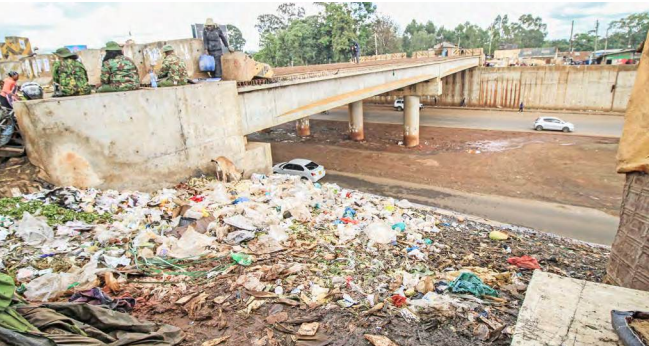
Kenya’s cities are growing at breath-taking speed. Every year, hundreds of thousands of people arrive inmajor cities and dozens of secondary towns in search of opportunity. Yet beneath the skyline of new buildings and roads lies a quieter, more urgent question: how do we ensure that every urban resident has access to safe, dignified sanitation?
For too long, sanitation has been treated as an afterthought, something to be solved once water, housing or transport are in place. This mindset has cost us dearly.
Poor sanitation undermines public health, degrades the environment and deepens inequality, particularly in low-income neighbourhoods where the majority of urban Kenyans live. If Kenya is serious about inclusive and sustainable urban growth, sanitation must move from the margins to the centre of city planning.
Over the past year, we have seen encouraging signs of this shift. Working alongside national and county governments, organisations like Water & Sanitation for the Urban Poor have strengthened their role as a trusted technical partner in shaping how Kenyan cities plan, finance and deliver water and sanitation services.
The focus has been simple but transformative: embed inclusive sanitation into the core business of urban utilities, rather than treating it as a temporary project or donor-driven intervention.
One of the most significant breakthroughs has been the mainstreaming of non-sewered sanitation as a core utility function. For decades, the dominant assumption was that sanitation equals conventional sewerage, an expensive, slow-to-expand option that rarely reaches informal settlements.
The reality is that non-sewered systems will continue to serve millions of urban residents for the foreseeable future. Recognising this, we supported six water and sanitation service providers to integrate low-income service delivery and sanitation into their business plans and establish dedicated sanitation units. This is not a pilot; it is institutional change.
Regulation matters just as much as infrastructure. Together with the Water Services Regulatory Board, the agency has co-developed Kenya’s first pro-poor sanitation indicators, which are now being piloted across 10 water service providers.
These indicators shift the focus from kilometres of pipes laid to people served, especially those historically left behind. By strengthening governance and accountability, they offer a practical pathway to accelerate sanitation coverage where it is needed most.
Of course, ambition without financing will not deliver results. Sanitation has long suffered from fragmented and inadequate funding. To address this, the organisation partnered with utilities to introduce sanitation development fees and worked with the Water Sector Trust Fund to design a resource mobilisation strategy aimed at unlocking domestic and blended financing.
This approach recognises that public funds alone are not enough; we must crowd in private capital and deploy it strategically.
Public–private partnerships are already showing what is possible. Collaborations with enterprises such as Fresh Life and LIXIL/SATO have expanded access to improved sanitation services and sanitation microfinance, using market-based models that can scale efficiently. These partnerships demonstrate that sanitation can be both a social good and a viable economic activity, provided the right policy and regulatory environment is in place.
Technology, too, has a role to play. In Kisumu and Nakuru, WSUP, in collaboration with Wasreb and the Eastern and Southern Africa Water and Sanitation network, started the piloting of the Sanitracker App.
By enabling real-time emptying requests between residents and service providers, the platform will improve responsiveness and accountability, turning sanitation into a service that works for users, not just planners.
Infrastructure innovation is equally critical. Simplified sewer systems, now scaled in Nairobi, Nakuru and Naivasha, offer a cost-efficient and adaptable alternative to conventional sewer networks.
By connecting low-income areas to central lines at a fraction of the cost, these systems raise sanitation standards while contributing to reduced sanitation-related illnesses. They remind us that appropriate solutions, not necessarily expensive ones, are often the most effective.
Looking ahead, the task is clear. We must deepen public–private collaboration to formally integrate small-scale providers into county-led urban water and sanitation systems. We must continue strengthening regulatory frameworks that enable services to scale while protecting consumers.
Above all, we must keep inclusion at the heart of urban sanitation, ensuring that no one is left behind because of where they live or how much they earn.
Sanitation may not grab headlines like mega infrastructure projects, but it is foundational to dignity, health and economic productivity. Kenya has the policy momentum, technical capacity and partnerships to get this right.
The unfinished urban revolution is not about pipes and pits alone; it is about building cities that work for everyone.
The writer is the country manager for Water and Sanitation for Urban Populations. He can be reached at [email protected]