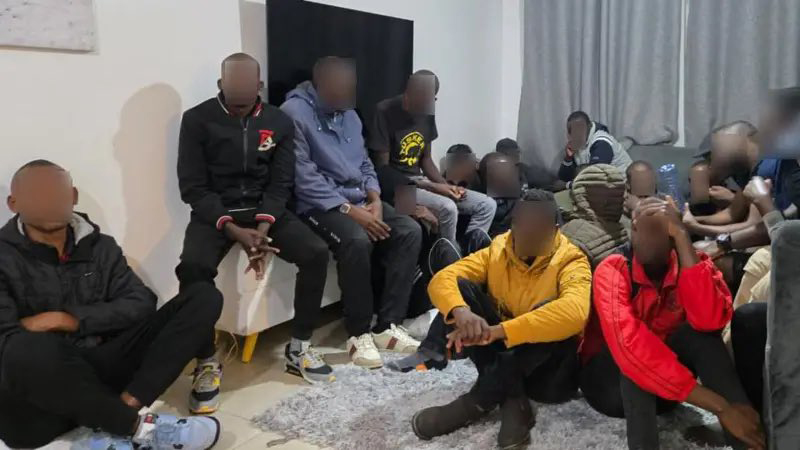
A group of young men, who were allegedly being trafficked to Russia, at a holding house in Athi River/FILE
Kenya’s ruthless criminal gangs, notorious for politically-induced violence, have their infamy etched in continental records after being ranked as second only to Libya in the people smuggling enterprise.
A new report indicates the country is only second to Libya in human trafficking, where gangs lure people with promises of good jobs abroad only to force them into slavery once they arrive.
Overall, the report places Nigeria as Africa’s top country in organised crime, followed by Kenya, South Africa, Libya and Uganda.
It accuses state officials of protecting Mafia-style criminal gangs operating in Kenya.
The findings come as the country prepares for next year’s election, when most organised criminal activities are said to take place.
“The very high scores for state-embedded actors in Nigeria and Kenya highlight their influence in driving criminality in these countries, especially during elections, when state-embedded actors collaborate with criminal organisations to intimidate opponents or finance campaigns,” the report shows.
The report — the Africa Organised Crime Index — was produced by the ENACT project (Enhancing Africa’s Response to Transnational Organised Crime), funded by the European Union.
The index provides a snapshot of organised crime trends up to 2024, drawing on several years of data collection and analysis to capture recent developments across the continent.
The findings corroborate recent findings by the Jukwaa la Usalama Report, handed over to President William Ruto in December, which found that Nairobi county alone hosts more than 130 criminal gangs.
“The activities of the gangs range from political violence, kidnapping, to murder. Some of the gangs are organised, while a majority are amorphous, only regrouping for assignments during elections,” the report Jukwaa La Usalama noted.
Nairobi Regional Commissioner Gilbert Kitiyo said the government is currently mapping the leaders of these gangs, operational areas and methods.
“What we normally do is very clear mapping where we identify those groups and even gang leaders, their telephone numbers, where they operate and how they operate, and then we take care of them,” Kitiyo said.
The Africa-wide Enact index measures the scale of criminal markets and the strength of criminal actors operating within and across borders.
“In Nairobi, Kenya, youth gangs operating in informal settlements within governance grey zones employ various forms of aggression, offer protection services and serve (at times) as enforcers for political actors or local elites. This contributes to a cycle of violence that is often tolerated, if not tacitly supported, by elements within formal power structures,” the index said.
The index challenges long-held doubts about whether organised Mafia-style crime exists in Africa at all.
“There has been a long-standing debate about whether organised crime can truly be said to exist in Africa,” the report states. “The enduring nature of this debate underscores the need for greater conceptual clarity on this matter, as it has significant implications for empirical research and effective policy responses.”
ENACT notes that scepticism has often come from narrow definitions that fail to reflect African realities.
“This scepticism partly stems from the idea that organised crime, understood as coordinated, mafia-like formations modelled on the Sicilian mafia and its patronage networks, does not exist in Africa,” the report says. “The lack of a universal definition compounds the problem.”
Based on empirical evidence, the index concludes that Africa’s illicit markets clearly meet the threshold of organised crime.
“Our analysis of empirical evidence clearly shows that the different illicit activities observed today, including how they have developed and how they connect to global trends, constitute organised criminal activity, sometimes operating transnationally,” the report states.
In Kenya, the most powerful drivers of organised crime are cybercrime and financial crime, alongside human trafficking and human smuggling.
These markets are highly profitable and increasingly sophisticated, feeding off rapid digitisation and regional mobility.
The economic cost is already significant.
“In 2024, Kenya and South Africa lost 3.6 per cent and 3.4 per cent respectively of their GDP to online scams,” the report states. “These losses underline the growing scale and impact of cyber-enabled financial crime on national economies.”
Enact’s findings also indicate criminal networks dominate Kenya’s organised crime landscape, followed closely by state-embedded actors, raising serious concerns about corruption and institutional compromise.
The index defines organised crime broadly but clearly.
“Organised crime encompasses illegal activities conducted by groups or networks acting in concert through violence, corruption or related means to obtain, directly or indirectly, financial or material benefit,” the report states. “Such activities may be carried out both within a country and transnationally.”
This definition reflects the Kenyan reality, where criminal networks often intersect with legitimate business and public institutions.
Mafia-style groups, foreign criminal actors and private sector actors are also present, though to a lesser extent.
Human trafficking and human smuggling are major components of Kenya’s criminal profile.
The index shows that trafficking networks exploit Kenya’s position as both a source and transit country, moving victims across borders through deception and coercion.
The index is widely accepted among policymakers and justice institutions.
“The Africa index is recognised as a source of evidence-based research and is widely used by policymakers and criminal justice practitioners,” ENACT states. “It has been endorsed by state institutions and multiple states and regional bodies.”
Kenya is a signatory to the United Nations Convention against Transnational Organized Crime, which commits states to prevent and combat organised criminal networks.
UN agencies have repeatedly warned that cybercrime, trafficking and financial crime are rising fastest in countries with strong digital infrastructure but weak enforcement.
According to ENACT, Kenya’s vulnerability lies in the convergence of opportunity and weakness.
Rapid digitisation has expanded access to financial services and global markets, while enforcement capacity and cross-border cooperation have struggled to keep pace.
The report warns that criminal systems become entrenched when states fail to respond decisively.
“Understanding how criminal markets have developed, and how they interact with broader dynamics within and across countries, is essential for crafting effective responses,” ENACT states.
“Research provides the evidence base for targeted policies and equips national and regional actors with the tools to dismantle entrenched criminal systems and tackle emerging threats.”