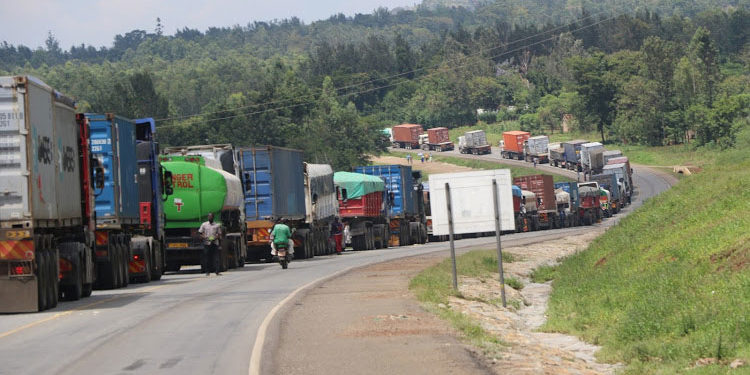
 Trucks along the Northern Corridor. /COURTESY
Kenya’s Northern Corridor has emerged as the country’s most dangerous road network, accounting for a growing share of fatal traffic accidents and exposing deep failures in road safety, enforcement, and infrastructure planning.
The deadly reality of the corridor was brought into sharp focus earlier this month following the tragic death of three siblings from a Waterloo, Iowa, family who were involved in a horrific road crash along the Naivasha–Nairobi highway.
The accident occurred on January 4, 2026, cutting short what had been a family holiday. Emmanuel DeLeon, 13, and Kairu Winkelpleck, 6, died on the spot, while their sister Njeri DeLeon, 16, sustained critical injuries and was admitted to a Nairobi hospital, where she was placed in a medically induced coma. After days of fighting for her life, she died on the evening of January 16, 2026.
The children were the sons and daughters of Wangui Ndirangu, formerly of New Jersey and now living in Iowa. Their parents survived the crash with minor injuries. Images from the family’s memorial service resonated widely, becoming a painful symbol of the escalating carnage on Kenya’s highways.
Their deaths are among dozens already recorded this year along the Northern Corridor, a vital trade artery that has increasingly turned into a death trap for motorists, pedestrians and motorcyclists alike.
The Northern Corridor comprises major highways linking the Port of Mombasa to landlocked East African countries, including the Mombasa–Nairobi Road (A109) and sections of the Nairobi–Malaba Highway (A1).
These roads serve Uganda, Rwanda, Burundi, South Sudan, and the eastern Democratic Republic of Congo, making them critical to regional trade and economic integration.
Yet despite their importance, officials concede that a disproportionate number of fatal crashes occur along this route. Road users cite chronic congestion, poor road conditions, and inadequate capacity as key contributors to the danger.
STATISTICS
Police statistics reveal a grim trend. Kenya recorded 4,579 road deaths in 2021, rising to 4,690 in 2022. Fatalities declined slightly to 4,324 in 2023 and 4,311 in 2024 before climbing again to more than 4,458 in 2025.
The situation worsened sharply towards the end of 2025 and into early 2026. In the first 20 days of January 2026 alone, at least 287 people were killed on Kenyan roads, up from 276 deaths recorded during the same period last year.
Among those killed between January 1 and January 20, 2026, were 99 pedestrians, 30 drivers, 61 passengers, 24 pillion passengers, six cyclists, and 67 motorcyclists. During the same period in 2025, the deaths included 88 pedestrians, 16 drivers, 59 passengers, 28 pillion passengers, three cyclists and 82 motorcyclists.
Injuries have also risen. Police recorded 660 serious injuries during the January 2026 period, compared to 639 in 2025, while 471 people sustained minor injuries, slightly fewer than the 477 reported last year. Many victims remain hospitalised, imposing heavy emotional and financial burdens on families.
According to preliminary assessments by road safety authorities, most of the accidents were preventable. Police cite reckless driving, speeding, driver fatigue, and drunk driving as leading causes. Persistent traffic violations by boda boda riders—including riding against traffic and using pedestrian walkways—were also identified as major risk factors.
Crash data further shows that fatalities are highly concentrated in a few locations. About 45.7 per cent of road deaths occur in just eight of Kenya’s 47 counties, which together account for only 32 per cent of the population.
In Nairobi, five roads representing just two per cent of the city’s road network account for 36 per cent of all fatal accidents, most of them occurring between 7pm and 10pm.
Beyond the human toll, the economic cost is enormous. In 2025, road accidents were estimated to cost Kenya as much as Sh800 billion annually—roughly five per cent of the country’s GDP—excluding lost productivity, long-term disability, and the social cost borne by affected families.
GOVERNMENT MEASURES TO CUB CARNAGE
The government acknowledges the scale of the crisis. Transport Cabinet Secretary Davis Chirchir has said the planned construction of the Rironi–Mau Summit Highway will help reduce congestion and improve safety along one of the corridor’s most dangerous sections.
Under the project, the Nairobi–Naivasha road will be upgraded to a dual four-lane carriageway, while the Naivasha–Gilgil stretch will be expanded into a dual six-lane highway to accommodate increasing traffic volumes.
Chirchir urged motorists to observe speed limits, avoid driving under the influence of alcohol or drugs, ensure vehicles are roadworthy, and always wear seatbelts.
He also called on pedestrians and cyclists to remain vigilant, use designated crossings, and wear reflective clothing.
“The dualling of the road is very critical, as it aims to reduce congestion, improve road safety, and facilitate the movement of goods and passengers between Nairobi, Nakuru, Western Kenya, and our East African neighbours, thereby promoting regional integration and boosting trade,” he said in a statement.
He added that the Nairobi–Naivasha section is being upgraded into a dual four-lane carriageway, while the Naivasha–Gilgil stretch will expand into a dual six-lane carriageway to accommodate heavier traffic.
“It will improve connectivity between rural areas and urban centres, facilitating access to markets and essential services. Upgrading this road is also expected to cut travel time between Nairobi and western Kenya significantly, boosting trade and tourism.”
He told road users to observe speed limits and traffic regulations, avoid drunk driving and driving under the influence of drugs, and ensure vehicles are roadworthy before travel.
“Wear your seatbelts and ensure that all passengers do the same, exercise patience and courtesy on the roads and to pedestrians and cyclists, please remain vigilant, use designated crossing points, and wear reflective clothing where possible.”
Meanwhile, the National Transport and Safety Authority (NTSA) has rolled out the National Road Safety Action Plan (2024–2028), which aims to reduce road deaths and serious injuries by at least 50 per cent from 2022 levels through improved enforcement, coordination, and infrastructure upgrades.
However, experts warn that the plan risks failure due to weak coordination among government agencies responsible for policy, regulation, and enforcement.
Without decisive action, Kenya’s road safety crisis will continue to worsen, with the Northern Corridor remaining at its deadly centre.
Police continue to describe the situation as alarming, warning that reckless overtaking, speeding, drunk driving, mechanical failures, and poor road conditions—including potholes, inadequate lighting, and poor signage—continue to claim lives despite sustained public safety campaigns.
The National Police Service spokesman Michael Muchiri said they are doing all possible for the safety of road users.
“We are doing all that is needed to ensure the road users are safe. Let all play their role in this campaign,” he said.