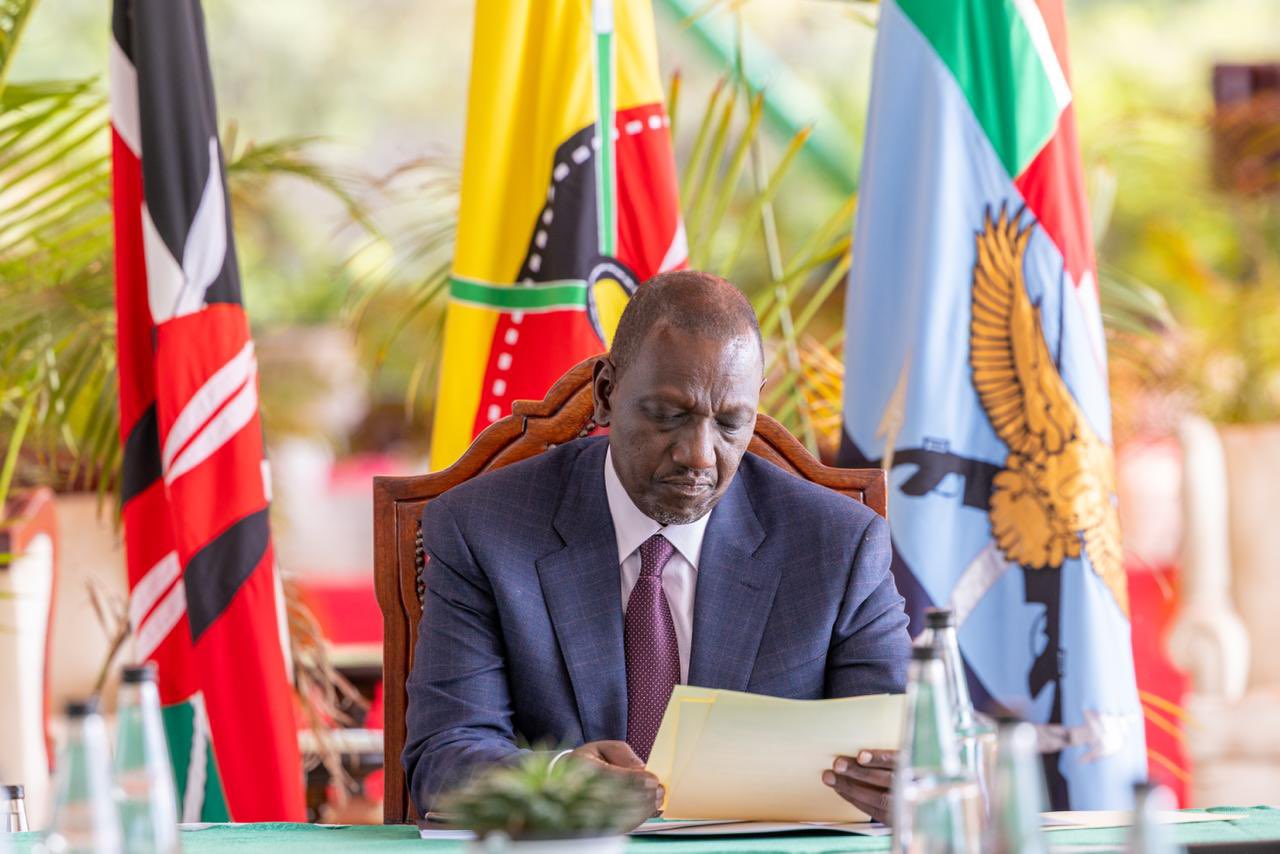
 President William Ruto during a meeting at State House on January 28, 2026/PCS
What begins as a campaign promise at rallies and on the campaign trail is increasingly ending up in court.
Political party manifestos, once seen as aspirational roadmaps, are steadily becoming legal flashpoints, pitting popular electoral mandates against strict constitutional safeguards.
President William Ruto’s administration has found itself at the centre of this growing tension. Several flagship policies that formed the backbone of his 2022 campaign have faced court challenges, with judges suspending or quashing it.
In some other instances judges have questioned government actions over alleged constitutional violations, lack of public participation or failure to follow procedures laid out in law.
The result has been a deeper national debate: when Kenyans vote for a manifesto, what exactly are they endorsing, a political promise or a legally enforceable policy direction?
Since taking office, Ruto has pushed an ambitious reform agenda anchored on the Bottom-Up Economic Transformation Plan, promising to uplift those at the base of the economic pyramid, reduce the cost of living, expand access to health care, tackle corruption and unlock opportunities for small traders, farmers and informal workers.
Yet, as the government has moved to translate those promises into laws, regulations and executive directives, the courts have repeatedly stepped in.
Among the most prominent of these battles has been the Affordable Housing programme.
Central to Ruto’s economic vision, the initiative seeks to address Kenya’s housing deficit while creating jobs and stimulating local industries.
“To deal with the huge challenge of youth unemployment, we will roll out our social and affordable low-cost housing programme, targeting an average of 250,000 units a year. This is a programme for ordinary Kenyans to own decent homes,” he said during one campaign rally.
To fund it, Parliament enacted a law allowing a 1.5 per cent housing levy on employees and employers.
Almost immediately, the levy became the subject of multiple court petitions, with challengers arguing that it amounted to an unlawful tax, that the process of enacting the law was flawed, or that public participation was inadequate.
At various points, courts issued orders suspending the collection of the levy, creating uncertainty for the government, private developers and potential homeowners.
Although some rulings later cleared the way for implementation, the legal tussle exposed a recurring pattern: policies born in the political arena must still survive intense constitutional scrutiny before taking effect.
Health care reforms have followed a similar path.
During the 2022 campaign, Ruto promised to deliver universal health coverage by fixing what he described as a broken and corrupt National Hospital Insurance Fund (NHIF).
He pledged a system that would ensure every Kenyan could access quality health care without falling into poverty, insisting that health insurance would become a social guarantee rather than a privilege.
“For far too long, too many households have lived on the edge, just one illness away from financial catastrophe…this agenda is not just a promise; it is a bold commitment to deliver health through transformative financing reforms, making healthcare accessible and affordable, digitising healthcare services to enhance efficiency, eliminate fraud and stop corruption,” Ruto said.
Once in office, his administration dismantled NHIF and replaced it with the Social Health Authority, backed by new legislation restructuring how health contributions are collected and how services are financed.
But the transition quickly ran into legal turbulence.
Petitions challenged the legality of the new framework, questioning whether Parliament had complied with constitutional requirements and whether the reforms unfairly burdened citizens.
Some courts responded by temporarily halting the implementation of sections of the health laws, arguing that the issues raised required full judicial determination.
The delays reignited public anxiety over access to medical services and exposed the fragile balance between urgent policy reform and constitutional compliance.
Digital reforms meant to fight corruption have also faced scrutiny.
One of Ruto’s early directives was the migration of all government payments to the e-Citizen platform, a move he argued would seal revenue leakages and eliminate opportunities for graft.
Throughout the campaign, he had portrayed digitisation as a weapon against corruption, repeatedly telling voters that technology would help track public money and restore trust in government.
“When I campaigned, I made a fundamental statement, I said in my administration there would be no money to steal, and part of that journey is through digitisation,” Ruto said, adding that digitising government services would tie service delivery directly to revenue collection and strengthen transparency.
Yet, the sweeping nature of the e-Citizen directive sparked legal challenges.
Petitioners questioned whether such a significant overhaul of government payment systems could be implemented through executive action without clear statutory backing or adequate consultation.
Courts again intervened, forcing the government to defend the legal foundations of a policy that had been sold politically as common sense and long overdue.
Even programmes that survived early court challenges did not escape legal attention.
The Hustler Fund, a cornerstone of Ruto’s campaign narrative, was designed to provide affordable credit to millions locked out of formal banking.
He had campaigned aggressively on the promise of empowering “hustlers,” arguing that access to capital would unlock productivity and dignity for ordinary Kenyans.
Shortly after its launch, a petition was filed seeking to halt the fund’s operations.
The court declined to issue temporary orders suspending disbursements, allowing the programme to continue as the case proceeded.
While the decision was a relief to the government, it underscored how quickly manifesto-linked initiatives can find themselves before judges, even when they enjoy broad public support.
The judiciary has also stepped into the government’s anti-corruption push.
 President William Ruto inspects the progress of Boma Yangu Wote Pool Affordable Housing Estate in Makueni / PCS
Recently, the High Court temporarily halted the operations of a newly unveiled multi-agency team established to wage war against corruption, following a petition challenging its legality.
The ruling added another layer to the unfolding debate over how far the Executive can go in setting up task forces and special units without explicit legal frameworks.
President Ruto has now responded to these developments with a mix of caution and concern.
Speaking Wednesday during the swearing-in of Court of Appeal judges, he acknowledged the independence of the judiciary but said some rulings appeared to cross into what he called judicial overreach.
"We respect the courts and will always follow their orders," Ruto said.
"But I cannot ignore the impact of decisions that slow down policies meant to improve the lives of millions of Kenyans. Our duty is to serve the people, and when court rulings delay programmes that were voted for, it raises important questions."
He insisted that his administration has consistently obeyed court orders, choosing lawful appeals rather than defiance, and pledged that it would never disregard judicial decisions.
At the same time, Ruto revealed his intention to approach the courts for clarity on the status of political manifestos.
"I will soon seek guidance on where a manifesto stands in law," he said.
"When millions of Kenyans vote for a manifesto, endorsing it as a policy direction, how should that mandate be weighed when implementation is challenged on technical or procedural grounds? The ultimate authority in Kenya is the people, and their vote must matter.
Ruto’s remarks opened a new chapter in Kenya’s constitutional conversation.
He emphasised that his argument was not about giving manifestos precedence over the Constitution but about recognising the democratic weight they carry.
"If manifestos are ignored in courts, our political discourse risks returning to personalities rather than ideas and policies," he said.
"We want leaders elected on what they stand for and how they intend to change our country, not just who they are."
He went further, suggesting that if manifestos hold little legal significance, political parties might as well abandon them and campaign purely on individual appeal.
Yet, he noted that Kenyans increasingly demand clarity on policies and programmes, and that campaign promises shape expectations of governance.
"The people expect more than slogans. They expect action, and our policies must reflect that," he said.
In November 2025, Deputy President Kithure Kindiki raised similar points, calling for clarity on the balance between judicial independence and the functions of other state organs.
Speaking at the launch of the State of the Judiciary and Administration of Justice Report 2024/2025, Kindiki stated that judicial independence is vital, but so is cooperation with other arms of government.
“Independence must be exercised within defined limits, decisional, financial, administrative and operational, while ensuring smooth governance," he said.
His remarks reflected growing unease within the Executive over what it perceives as judicial intrusion into policy-making, particularly where programmes are concerned.
What legal experts and critics say
Legal experts, however, caution that the courts are simply enforcing the Constitution.
They argue that public participation is not a technicality but a cornerstone of Kenya’s governance system, designed to protect citizens from unilateral government action.
From this perspective, even the most popular manifesto promise must comply with constitutional procedures.
"No policy can override the law. The constitution lays certain channels through which the promises within the manifesto must be effected through which are public participation, involvement of parliament and key ministries," said lawyer Wachira Ndeto.
He noted while the manifesto is a legal document it must align itself within the provisions of the constitution.
“The constitution is superior than the manifesto in as much as manifesto is also important,” he stated.
Wachira said despite Ruto having held forums with various groups in the run up to the 2022 general election that saw the policy document drafted, he was not the president.
“He was conducting them as a presidential candidate and he did not have the legal authority. That was a good public participation for the endorsement of the manifesto but once you are elected to power you must now conduct public participation as per the law,” he stated.
Critics of the government note that some policies were rushed and lacked proper consultation, arguing that the courts are acting as guardians of constitutional order rather than obstacles to development.
Supporters of Ruto’s administration counter that excessive litigation and repeated injunctions risk paralysing governance and frustrating the will of the electorate.
A judicial pronouncement on the legal status of manifestos could reshape future elections, governance, and policy-making.
It could determine whether campaign promises remain political aspirations subject to procedural hurdles, or whether they acquire greater legal recognition once endorsed by voters.
"We want clarity so that the people’s vote counts not just in the ballot but in the policies that follow," Ruto said.