 Auditor General Nancy Gathungu/FILE
Billions of shillings in public funds are tied up in stalled, delayed or poorly implemented projects across several counties, new reports have revealed.
The revelations have raised renewed concerns over wastage, weak oversight and the failure to deliver value for money under devolution.
New details contained in the latest auditor general’s reports for the financial year ended June 30, 2025, revealed that projects that were initiated to transform communities have either ground to a halt, dragged on for years, or been completed only to remain unused.
Some of the projects were initiated way back in 2013, at the advent of devolution.
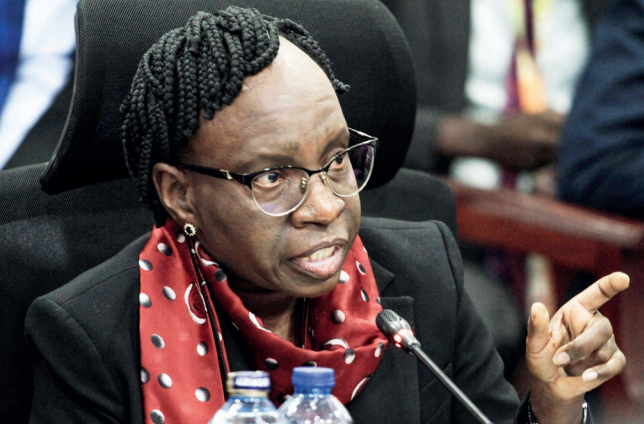
Auditor General Nancy Gathungu says the affected projects cut across key sectors such as health, education, water, infrastructure and industrial development.
They expose counties to losses through cost escalation, vandalism, depreciation of assets and possible litigation by contractors.
“The stalled and non-completion of projects within the planned timelines is an indication of inadequacy in project planning, control and monitoring to ensure sufficient absorption of available funds,” Gathungu notes.
County governments have often blamed delays in the release of exchequer funds, ballooning wage bills and underperforming own-source revenue for the slow pace of development.
However, the audit points to deeper structural problems, including poor conceptualisation of projects, overambitious budgeting, weak feasibility studies and the use of contractors without adequate technical or financial capacity.
In Turkana county, projects worth Sh1.03 billion have stalled, some dating back to the 2013-14 financial year.
They include the construction of Kataboi Eco-Lodge for Sh76.34 million, a plastic re-use facility costing Sh13.62 million, the Kalokol Resource Centre valued at Sh25.10 million and the county headquarters, estimated to cost Sh695.85 million.
Other stalled initiatives include the governor’s residence, valued at Sh90.56 million, and the construction of a modern business centre costing Sh132.39 million.
The prolonged delays have exposed the projects to vandalism and cost escalation, further compounding losses.
The report further reveals that Turkana had planned to implement 374 projects valued at Sh2.02 billion during the year under review.
By the end of the financial year, six projects worth Sh69.11 million had stalled, 63 projects valued at Sh372.48 million had not started, while 19 were still ongoing.
“In those circumstances, the residents may not have obtained value for money in respect of projects that were set to be implemented during the year ended June 30, 2025,” the auditor concludes.
In Mombasa county, projects worth more than Sh201.45 million were either stalled or delayed, raising the risk of losing funds already spent.
Among them is the construction of a county aggregation and industrial park valued at Sh68.09 million, which remains incomplete.
Two Early Childhood Development Education (ECDE) centres at Amani Primary School and Majaoni Primary School, costing Sh17.72 million and Sh21.60 million, respectively, were also flagged for delayed completion, denying young learners access to improved facilities.
Kitui county was cited for stalled and delayed projects valued at more than Sh164.84 million. Some projects were completed but not put into use, while others were implemented outside their approved scope.
The auditor highlighted vandalism at Ithookwe Showground, haphazard implementation of the Ngomano–Mwitika Market sump well water supply project costing Sh43.03 million, and the construction of a sump well and solar pumping unit valued at Sh17.92 million.
The situation appears more severe in Baringo county, where stalled projects are valued at more than Sh1.33 billion, with Sh131.05 million already paid before works ground to a halt.
Key projects affected include the delayed upgrade of the 64 Stadium at a cost of Sh1.16 billion, construction of the Chagaiya High Altitude Training Camp for Sh117.13 million, the governor’s office costing Sh91.88 million and the deputy governor’s office valued at Sh62.14 million.
“The stalled projects expose the county to loss of assets and funds through wasteful expenditure, legal disputes and cost escalation due to inflationary pressures,” the report warns.
The auditor further notes several dispensaries in Baringo had been completed but were not operational due to a lack of essential equipment and staff.
As a result, residents continue to travel long distances for healthcare despite millions of shillings having been spent on the facilities.
In Bomet, projects valued at Sh753.65 million were flagged for delayed implementation.
These include the construction of the governor’s office costing Sh78.01 million, the stalled construction of Bomet Stadium valued at Sh257.49 million and the destroyed Dr Laboso Memorial Mother and Child Wellness Centre, which had cost Sh296.93 million.
“In the circumstances, value for money may not be realised from the public funds spent on these projects,” the auditor cautions.
Siaya county also features prominently in the report, with projects worth about Sh500 million lagging behind schedule.
These include the construction of the Siaya County Aggregation and Industrial Park at a cost of Sh483.68 million and an ECDE block at Maranyona Primary School costing Sh4.13 million.
In Wajir county, the auditor revealed idle projects valued at Sh694.91 million. Although completed, the projects were not equipped and remain unutilised.
They include the construction of the Wajir county assembly building costing Sh404.61 million and the upgrading of Katulo Health Centre to level 4 status and Sarif Health Centre at costs of Sh41.16 million and Sh24.75 million, respectively.
“In the circumstances, value for money for the Sh694.91 million spent on the projects could not be confirmed,” the report states.
The auditor also flagged the delayed construction of the county aggregation and industrial park in Wajir, valued at Sh189.94 million, which remains incomplete despite significant expenditure.
In Kajiado, nine projects valued at Sh116.79 million were flagged for irregular implementation.
Although some were paid for based on inspection reports certifying them as “practically complete”, the auditor raised concerns over compliance with procurement laws and implementation requirements.
Machakos county was also cited, with the auditor flagging stalled construction of ECDE centres at Kitooni, Nguluni AIC and Kangundo costing Sh4.40 million, as well as the construction of twin workshops at Matuu Vocational Training Centre valued at Sh17.39 million.
Tana River recorded one of the highest values of problematic projects, with the auditor flagging projects worth Sh1.76 billion that were either completed and left idle, delayed, stalled or whose details were not provided for physical verification.
They include the stalled construction of the county headquarters valued at Sh495.26 million and the incomplete construction of the deputy governor’s residence.
“In the circumstances, the value for money for the amount spent on these projects totalling Sh1.76 billion could not be confirmed,” the report says.
In Marsabit, projects worth more than Sh1.16 billion were either stalled, delayed or completed but left unutilised.
They include the idle Sololo Level 4 Hospital, constructed for Sh483.36 million, and the delayed construction of the county aggregation and industrial park valued at Sh498.91 million.
The findings once again highlight persistent governance and accountability gaps in county governments, even as billions of shillings continue to be allocated annually to development projects under devolution.
INSTANT ANALYSIS
Projects in counties are stalling primarily due to a vicious cycle of delayed and inadequate funding from the national government, which leads to non-payment of contractors who then abandon sites. Other major factors include weak oversight by county executives and assemblies, poor project planning that ignores lessons from previous failures, corruption, political interference and recent glitches in the new e-procurement system. Unless these systemic issues are addressed, auditors warn that billions more could be sunk into projects that never deliver services to wananchi.