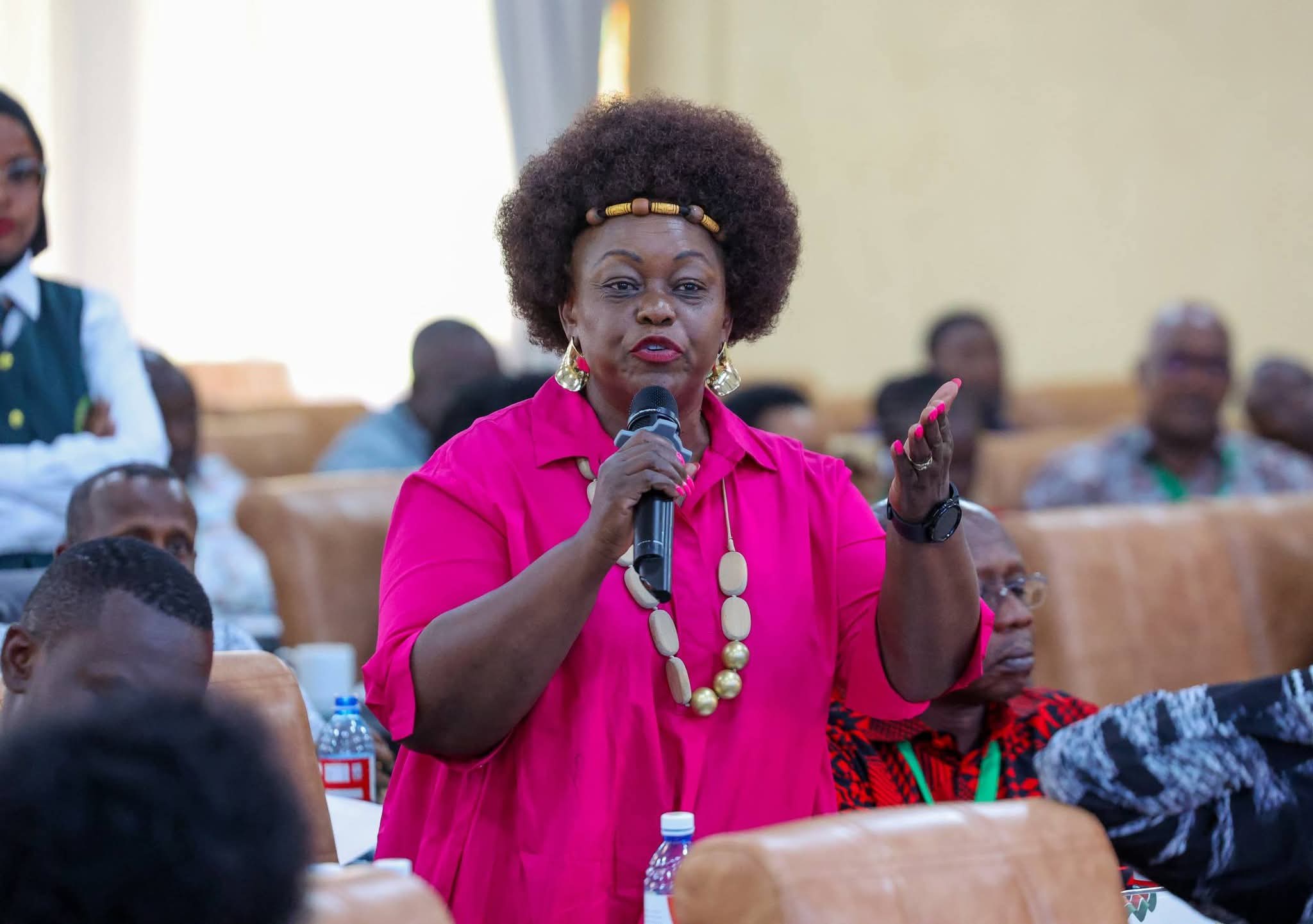
 Suba North MP Millie Odhiambo during the legislative retreat in Naivasha on January 26, 2026/NA
As Kenya gears up for the 2027 General Elections, MPs are calling for stricter oversight and transparency in the financing of political parties, warning that gaps in regulation could undermine the country’s democratic integrity.
The demand came during the ongoing 2026 legislative retreat in Naivasha, where lawmakers engaged the Office of the Registrar of Political Parties (ORPP) on emerging challenges in party regulation, funding, and compliance.
The session underlined the growing concerns about political parties’ accountability in the lead-up to one of the country’s most contested election cycles.
According to the Registrar of Political Parties, John Cox Lorionokou, Kenya currently has 90 fully registered political parties and 32 provisionally registered.
While the political landscape remains vibrant, he revealed that two parties, the Ukweli Party and the Vibrant Democratic Party, were deregistered earlier this month for failing to comply with statutory requirements.
Lorionokou also noted the formation of three new parties since the 2022 elections- the Democracy for Citizens Party (DCP), The We Alliance Party (TWAP), and the National Economic Development Party (NEDP).
Conversely, the Amani National Congress (ANC) voluntarily dissolved in 2025.
Lawmakers acknowledged that political parties are the cornerstone of Kenya’s democracy, serving as vehicles for political competition, citizen representation, and governance.
Yet, persistent compliance gaps, weak enforcement, and limited institutional discipline have eroded public trust in the system.
“As we prepare for the next General Elections, we must ensure that political parties operate within the confines of the law, with full transparency in financing and accountability in expenditure,” said Kathiani MP Robert Mbui.
Mbui stressed that public confidence in democratic processes depends largely on how well party structures are regulated.
The discussion highlighted a key operational challenge.
While the ORPP requires Sh1.6 billion to execute its mandate for the 2025-26 financial year, it has received only Sh508.6 million, leaving a massive funding shortfall that hampers compliance monitoring.
“We have exhausted our annual allocation and are currently unable to verify the offices of 32 provisionally registered political parties as required by law. Each verification costs approximately Sh3.9 million,” Lorionokou explained.
This, as he warned, underfunding threatens the ORPP’s ability to enforce regulations effectively.
Equitable party funding was another major concern raised by lawmakers, particularly regarding inclusivity in political participation.
“If we want women, youth, and persons with disabilities to take leadership roles in political formations, we must fix the resource question. The current model entrenches inequality,” said Suba North MP Millie Odhiambo.
She noted that structural funding gaps limit broad-based representation.
Members also discussed the role of independent candidates, urging the ORPP to strengthen support frameworks for those operating outside mainstream party structures.
“Our democracy must be inclusive. We must not overlook independent candidates who represent the voice of Kenyans outside mainstream political formations,” said Marakwet West MP Timothy Torotich.
Toroitich called for mechanisms to recognise and support independents financially and administratively.
The retreat further explored the need for stronger monitoring of party finances, including stricter auditing of donations, expenditures, and internal party accounts.
Lawmakers warned that the absence of robust checks could allow party funds to be misused, compromising fair competition and voter confidence.
The timing of these discussions is critical.
With over 120 political entities registered or operating in Kenya and new formations emerging regularly, ensuring compliance ahead of the 2027 elections is paramount.
The MPs stressed that without improved transparency and enforcement, public perception of politics could further erode, especially as electoral contests grow more competitive.
“Equitable financing and accountability are crucial for levelling the political playing field, particularly for minority and underrepresented groups,” they said.
With current funding models favouring established parties, smaller and newer formations often struggle to meet statutory obligations or compete effectively during campaigns.
The leaders made a unified call for the ORPP to be fully funded and empowered to verify party offices, audit financial statements, and monitor compliance rigorously.
They stressed that political party regulation is not just a legal requirement but a democratic safeguard, protecting voters and ensuring the integrity of the electoral process.
According to the lawmakers, transparent funding and rigorous oversight are essential to preserve Kenya’s democratic integrity and foster fair political competition.