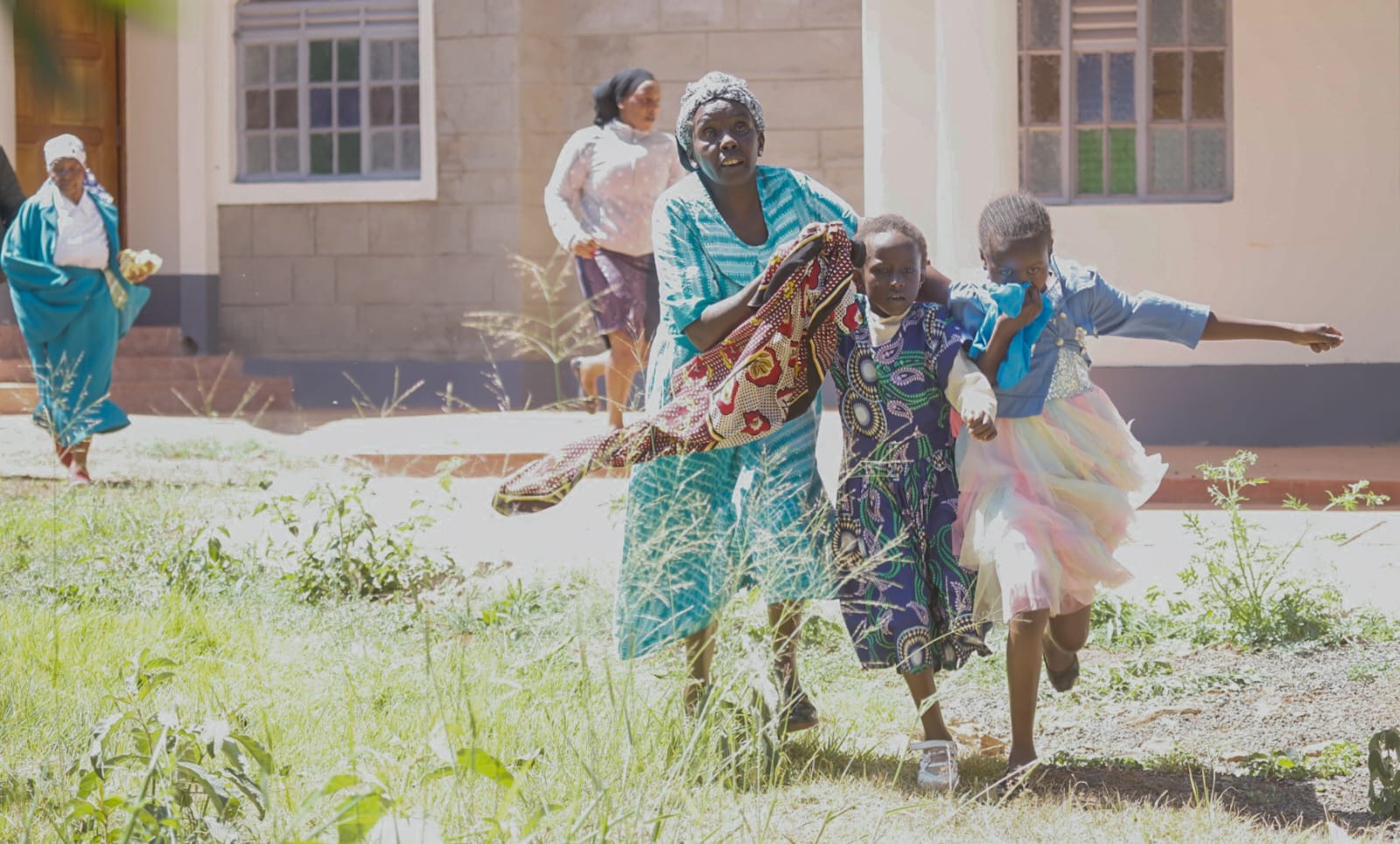
 Women and children flee ACK Church Witima, Othaya, Nyeri county after police and goons attacked on Sunday
The attack on former Deputy President Rigathi Gachagua at the ACK Church Witima in Othaya has deepened tensions between President William Ruto and mainstream churches.
The Sunday incident in which police accompanied by armed goons lobbed teargas in and around the church compound further risks undoing recent political gains that Ruto allies had sought to consolidate in the vote-rich Mt Kenya region.
The church fraternity has heavily condemned the attack, terming it a grave violation of religious freedom.
In a statement on Monday, the National Council of Churches of Kenya accused the police of violating the Constitution, which guarantees the right to worship freely, either individually or in community with others, in public or private.
The church umbrella body also expressed “grave concern” over the desecration of places of worship by police, warning that the incident in Othaya was not isolated but part of a disturbing national pattern.
NCCK listed the incidents that had been reported in the past, noting that the Nyeri disruption was the ninth incident in which police have allegedly attacked worshippers in recent years.
“NCCK avers that the deliberate, unwarranted, and unprovoked lobbing of teargas canisters at worshippers in a place of worship is not only illegal and unconstitutional but an attack on the body of Jesus Christ of Nazareth who is our Lord and Saviour,” the statement said.
The church demanded an apology from Interior CS Kipchumba Murkomen and the Police IG Douglas Kanja.
ACK Archbishop Jackson ole Sapit also condemned the attack, and called on the Church and worshippers to maintain peace and protect the sanctity of sacred spaces.
In his devotion on Monday, Archbishop Sapit said the church condemns the attack without hesitation, and stands in grief and solidarity with those who were injured, frightened, and shaken.
“We carry especially our children before the Lord, asking that He heals what their young hearts and bodies were forced to endure,” Sapit said.
The attack, which is being blamed on the police with alleged instruction from pro-government elements further soils the relationship between Ruto and the church, a key constituency and platform for his 2022 presidential election victory.
“The question is, from whose command and for what purpose were the police vehicles and officers operating? Has the Police Service been compromised and held hostage by the goons and militia” ACK clerics posed on Tuesday.
The NCCK warned that the failure to hold police officers accountable in past incidents signals “state approval at the highest level”, a charge likely to inflame already strained relations between the government and the churches.
“In all these incidences, the police officers who deliberately broke the law have not been interdicted, investigated, prosecuted or otherwise held accountable,” the statement said.
The timing and location of the incident also carried political significance as Mt Kenya remains a critical electoral battleground.
Former Mukurweini MP Kabando wa Kabando said what happened in Witima was not an isolated incident but one that touches a region with a long memory of state abuse, and that memory is being reawakened.
Kabando warned that such actions risk further alienating Mt Kenya.
“Othaya and the wider Mt Kenya region have a long history of resisting state excesses, and incidents like this only harden public sentiment against the government,” Kabando said.
“If you think Rigathi is your main torment, woe unto you. The anger, the frustration ranging from across Aberdare villages is akin to a flooding River Sagana, you can't stop its flow, its floods, using you bare feet.”
President Ruto and his allies have in recent months made visible efforts to rebuild relations with residents, mainly through church leaders following strained ties during nationwide protests, tax debates, and police crackdowns.
The increased violent attacks on Gachagua in churches and during political meetings are also likely to reinforce perceptions that the state is intolerant of dissenting voices, even within religious spaces.
The escalation comes at a sensitive moment for President Ruto’s administration, who is yet to mend fences with the mainstream churches.
On several occasions following the Gen-Z demonstrations, the Catholic and ACK churches have rejected donations from President Ruto.
The decision, the cleric have argued, is aimed at upholding church integrity, neutrality, and avoiding political exploitation.
Churches have a huge influence among the populace, shaping public opinion at the grassroots and offering platforms for politicians to speak.