
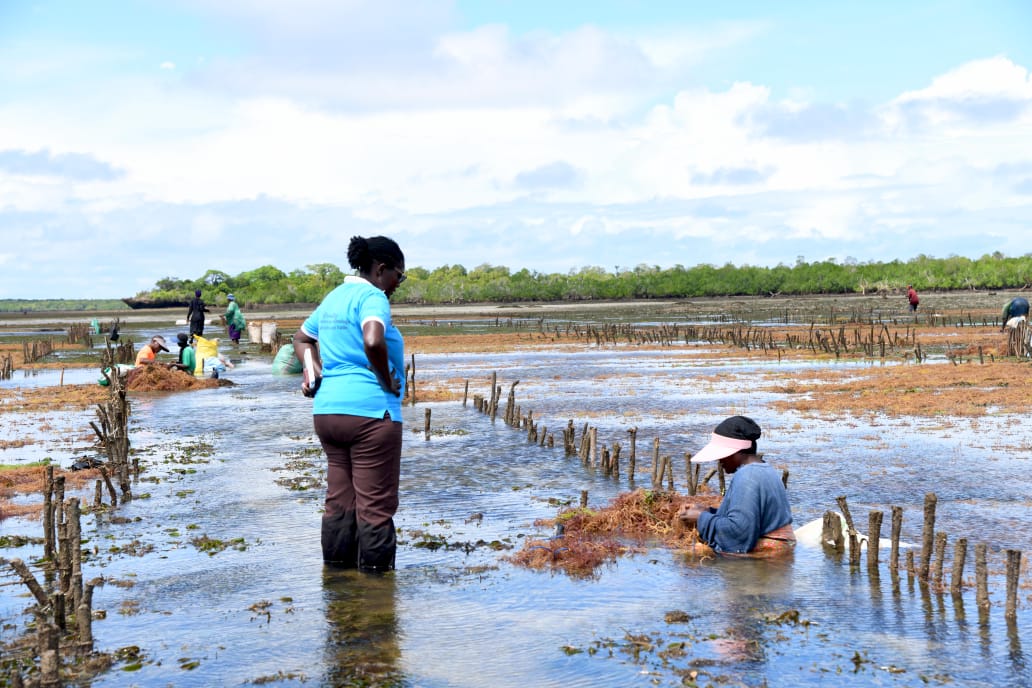
For Mwaziza Mwamtaka of the Mtimbwani Seaweed Group, and Abdalla Suleiman and Marinda Tsuma from Kibuyuni in Kwale county, seaweed is far more than a crop harvested from the ocean.
It is a lifeline—one tethered to the tides, shaped by climate change, and sustained through sheer resilience.
At dawn, long before the coastal sun hardens the sand and sea, the farmers begin their daily trek.
From their homes, they walk towards the shoreline, preparing to plant, tend and harvest the marine crop that pays school fees, buys food and keeps their families afloat.
The work is physically demanding, repetitive and increasingly unpredictable as rising temperatures and changing ocean conditions take their toll.
For some, the burden has eased slightly.
Farmers like Mwaziza and Suleiman now use boats provided through the support of organisations such as The Nature Conservancy (TNC) and Plan International, ferrying them from shore to offshore farms. What once took hours of wading through water now takes minutes.
For others, like Marinda, the journey remains punishing.
Without access to a boat, she and fellow farmers walk and wade through the ocean, covering distances of up to 10 kilometres a day to reach their farms.
“Seaweed farming is not easy, and that explains why some of our members left along the way,” Marinda says.
“Walking to and from the farms is not for the faint-hearted. But we do it because of the passion we have—and because of the income we get from selling it.”
Despite the hardship, seaweed—an often-overlooked marine resource—is steadily emerging as a cornerstone of Kenya’s blue economy.
Along the Coast, it is offering communities a practical response to climate change, dwindling fish stocks, entrenched poverty and limited livelihood options.
Seaweed farming has long flourished in Zanzibar and mainland Tanzania, where it contributes significantly to national economies.
In Kenya, the sector is now attracting renewed attention as governments, researchers, conservation groups and private investors work to unlock its potential through improved farming practices, scientific research, policy reform and better market access.
Unlike extractive marine activities, seaweed farming is non-destructive.
It aligns with indigenous cultures and environmental values and has diverse uses across food, cosmetics, pharmaceuticals and industrial products.
Yet despite its economic and ecological importance, the sector faces major obstacles: climate change impacts, fluctuating prices, limited access to quality seedlings, weak processing infrastructure and policy gaps.
These challenges were at the centre of discussions during the country’s first national seaweed sector stakeholders’ workshop, held last December in Diani, Kwale county.
Convened by the Kwale government and the State Department for Blue Economy and Fisheries, the forum was organised in collaboration with TNC, the Kenya Fisheries Service (KeFS), the Kenya Marine and Fisheries Research Institute (KMFRI) and Jumuiya Ya Kaunti Za Pwani (JKP), with funding from TNC.
The meeting brought together government officials, researchers, conservation organisations, private investors and farming communities to chart a shared vision of transforming seaweed into a thriving, climate-smart and restorative blue economy.
“Selling raw seaweed will never bring real wealth,” Mwaziza told the forum.
“Products made from seaweed fetch good money. That is where the future lies.”
He credited development partners with easing some of the farmers’ daily struggles.
“Our biggest challenge was transport. Getting to the farms was very difficult,” he said.
“TNC hired a boat for us, and Plan International has bought one that we are expecting to receive anytime.”
Suleiman, who also attended the forum, described the experience as eye-opening.
“I learnt a lot from the national seaweed stakeholders’ meeting,” he said.
“Interacting with different organisations showed me how big the seaweed industry really is. The success stories from Tanzania, Zanzibar and Pemba are inspiring—and they show us what is possible if we do things right.”
For Marinda and her colleagues from the Amkeni Utamba Seaweed Group, the national dialogue renewed hope the sector’s fortunes are beginning to change.
For decades, Kibuyuni—Kenya’s earliest seaweed farming site—was defined by deep poverty, illiteracy and entrenched patriarchal norms that excluded women from leadership and decision-making.
Today, seaweed farming is quietly reshaping that reality.
Women farmers are increasingly visible economic actors, and the village landscape reflects the shift.
Mud-walled houses are gradually giving way to permanent structures, signalling a slow but steady erosion of poverty driven largely by a female-dominated enterprise.
One of the strongest messages from the inaugural forum was that seaweed farming is far more than aquaculture.
It is a livelihood anchor, particularly for women, who make up more than 70 per cent of seaweed farmers nationwide.
“Seaweed aquaculture presents a unique and largely underutilised opportunity—one that is environmentally regenerative, economically inclusive and particularly beneficial to women and youth,” said Benson Kirathe, assistant director at the State Department for Blue Economy and Fisheries.
He said the government is keen to invest in supportive conditions to scale up restorative seaweed aquaculture in Kenya.
Unlike extractive marine activities, seaweed farming improves water quality, absorbs carbon, enhances habitats and strengthens ecosystem resilience.
Globally, it is increasingly recognised as a nature-based solution to climate adaptation and mitigation—an approach Kenya is now preparing to embrace.
“Restorative seaweed aquaculture goes beyond production,” Kirathe said.
“It contributes to improved water quality, carbon sequestration, habitat enhancement and the resilience of coastal ecosystems, while generating income through enterprise.”
Zanzibar offers a glimpse of what is possible. Seaweed is the island’s third-largest foreign exchange earner after tourism and spices, employing about 26,000 people—nearly 80 per cent of them women.
In 2023, Zanzibar produced 16,653 tonnes of red seaweed, ranking among the world’s top producers.
Kenya, by contrast, produces just about 146 tonnes annually. Production remains fragmented, low-value and weakly linked to global markets.
“This gap shows Kenya has immense untapped potential to develop its seaweed aquaculture sector sustainably,” Kenya Vision 2030 Delivery Board and founding CEO of JKP chairperson Emmanuel Nzai.
George Maina, Africa fisheries strategy manager at TNC, said the organisation is working with governments and industry players to ensure aquaculture growth improves marine ecosystems while delivering climate-smart livelihoods.
“TNC’s approach combines place-based interventions, market development and scientific research,” he said.
TNC Kenya country director Ruth Masha emphasised the importance of community-centred partnerships.
“As we confront the dual crises of climate change and biodiversity loss, our seafood system must be part of the solution,” she said. “That means strengthening governance, building conservation capacity and ensuring communities see tangible benefits.”
From a regulatory standpoint, KeFS reaffirmed its role in enabling responsible investment.
However, Beatrice Akunga acknowledged a major gap: Kenya lacks a seaweed-specific regulatory framework, leaving farmers and investors navigating unclear processes.
Market access and pricing emerged as the sector’s most critical bottleneck.
In some areas, farmers earn as little as Sh35 per kilo of dried seaweed, compared to international prices of about Sh70.
“Without market reforms, increased production will not translate into improved livelihoods,” Akunga warned.
Kwale agriculture executive Roman Shera urged stakeholders to promote domestic consumption, particularly seaweed as food.
Science and research were repeatedly identified as central to the sector’s future.
KMFRI continues to lead efforts in seed development, disease management, site selection and value addition.
Climate change has introduced new threats, including rising sea temperatures and diseases such as ice-ice syndrome.
To counter this, researchers are developing climate-resilient seed strains, deep-water nurseries and real-time temperature monitoring systems.
Innovation is already reshaping the sector.
In Lamu, Mawimbi Ocean Innovation Ltd is pioneering deep-water seaweed farming using longlines—an approach that shifts farms away from warming near-shore waters.
“Near-shore farming methods have not changed since the 1970s,” Mawimbi co-founder Fiona Moejes said.
“With climate change and disease, we had to innovate.”
By moving into deeper waters, the company is cultivating Cottonii, a higher-value species not previously grown in Kenya. Within three years, Mawimbi has established commercial-scale farms, demonstrating the sector’s investment potential.
“Our goal is to show that seaweed can inject real money into coastal economies,” Moejes said.
Throughout the workshop, the need for value addition remained a recurring theme. Kenya still exports raw dried seaweed, while countries such as Indonesia and the Philippines process it into high-value carrageenan.
Hope for the sector’s future was reinforced by the presence of international buyers. Indonesian processor Indadi Setia expressed interest in sourcing seaweed from Kwale county, citing strong production potential and growing farmer capacity.
As Kenya looks to the ocean for answers to climate resilience and inclusive growth, seaweed—once overlooked—may yet become one of its most powerful solutions.