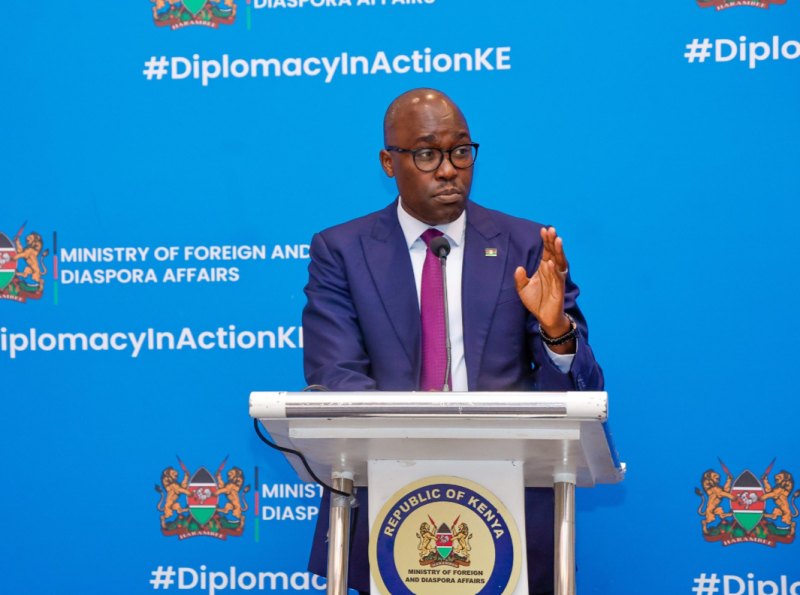
 The Kenya Tobacco Control Alliance chairman Joel Gitali address the e press in Kakamega
The concern comes after Principal Secretary for Interior Raymond Omollo held talks with the board of British American Tobacco Kenya to discuss illicit trade in tobacco and nicotine products.
The engagement has drawn criticism from tobacco control groups, who say the issue of tobacco regulation squarely falls under the Ministry of Health and should not involve security officials.
Joel Gitali, chairman of the Kenya Tobacco Control and Health Promotion Alliance (Ketca), questioned both the purpose and the legality of the meeting.
“I am still trying to understand how PS for Interior, Raymond Omollo coordinated a meeting with the Board of Directors of BAT to discuss how to deal with illicit trade in Tobacco and Nicotine Products, and how to protect public health in Kenya. What's happening? Ministry of Health has a very competent CS and very informed PSs. Why leave them aside and sit with tobacco industry to solve a problem associated with the industry in general?” Gitali said.
Gitali said Kenya already has strong legal and policy frameworks to deal with illicit tobacco trade, and that the solution lies in enforcement, not engagement with tobacco companies.
“We have WHO-FCTC, Tobacco Control Act, Tobacco Control Regulations, the Protocol on Elimination of illicit trade in Tobacco products, and other policies. Those who understand them very well are at Ministry of Health. Very well informed. What is needed is coordination and enforcement of these policies. MOH collaborates with NACADA, KRA and sometimes, CSOs in enforcing the law,” he said.
PS Omollo said the meeting covered both proven past measures and new interventions, immediate and long-term, to address the vice, protect public health and safeguard government finances. Present from BAT Kenya were Chairperson Rita Kavashe, Managing Director Crispin Achola, Phyllis Wakiaga, and other board members.
“Our discussions focused on collaborative action to stem the proliferation of illicit and counterfeit tobacco products that threaten the health of Kenyans and substantially erode government revenue,” the PS said in a statement.
The tobacco industry complains that illicit tobacco products now account for more than one-third of all cigarettes sold. One study by Kantar indicates that illicit cigarettes made up about 37 percent of the market in 2024, up from roughly 27 percent the previous year, signaling an accelerating trend.
“Every illicit cigarette sold represents an increase in organised crime and a threat to legitimate local businesses and jobs,” the company has said.
All tobacco products, legal or not, have no health benefits and are harmful. Ministry of Health says tobacco kills 9,000 Kenyans annually through diseases such as cancer.
Kenya is a party to the World Health Organization Framework Convention on Tobacco Control, a global treaty that seeks to reduce tobacco use and protect public health policies from tobacco industry interference.
Article 5.3 of the Convention requires governments to protect health policies from the commercial interests of the tobacco industry and to limit interactions with tobacco companies to those that are strictly necessary for regulation.
These principles are reflected in Kenya’s Tobacco Control Act and the Tobacco Control Regulations. The law requires that interactions between public officials and the tobacco industry be limited, transparent and solely for regulatory purposes. It also discourages partnerships or collaborations that could be seen as endorsing or legitimising the industry.
Public health experts say the tobacco industry has a long history of using issues such as illicit trade to gain access to policymakers and influence regulation, often shifting blame away from manufacturers and onto informal traders.
Gitali warned that the involvement of senior political leaders in such meetings sets a dangerous precedent.
This is not the first time high-level meetings with tobacco companies have sparked outrage. In 2023, health groups strongly condemned former Trade Cabinet Secretary Moses Kuria after he hosted the leadership of British American Tobacco and publicly praised the company’s role in the economy.
At the time, civil society organisations accused Kuria of undermining Kenya’s commitments under the WHO tobacco treaty and weakening efforts to shield public health policy from industry influence. They warned that such engagements send the wrong signal and embolden tobacco companies to seek political legitimacy.
END