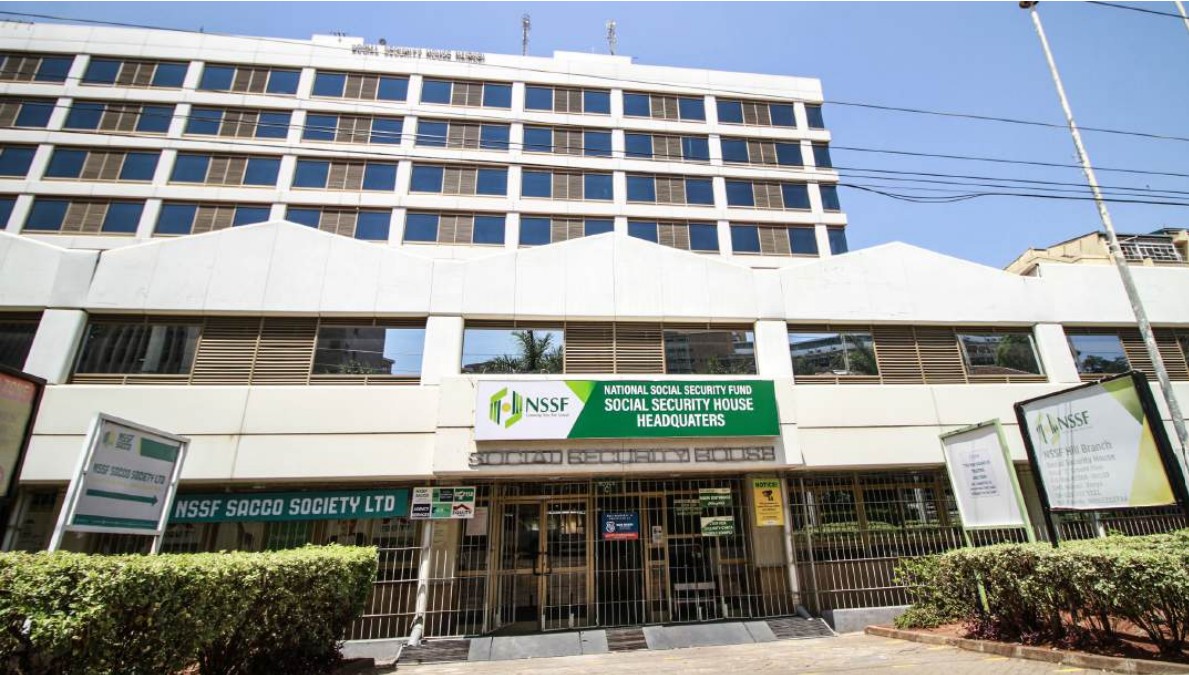
Salaried Kenyans earning Sh108,000 and above will see a slight cut from their pay slips as the implementation of the National Social Security Fund (NSSF) Act of 2013 enters its fourth year in February.
The law, which came into effect in 2023 after facing a decade-long legal battle, transformed NSSF from a provident fund to a pension scheme, allowing the splitting of statutory deductions sliced from employees’ salaries and matched by employers into two Tiers.
The implementation has seen annual graduation in both lower and upper limits, with the former moving from Sh6,000 in 2023 to Sh7,000 in 2024 and Sh8,000. Starting February, the lower limit will rise to Sh9,000.
Tier 2, on the other hand, has risen from Sh18,000 in the first year of implementation to Sh36,000 in 2024, Sh72,000 in 2025 and will now move to Sh108,000 starting next month.
NSSF managing director David Koross says there is no change in deductions for those with a gross salary of Sh108,000, accounting for close to 90 per cent of the 3.2 million people with formal jobs in the country.
Latest data shows that the number of Kenyan workers earning over Sh100,000 monthly increased by more than 10,000 to 397,541 last year. Of these, 66 per cent were men (262,555), while 34 per cent were women (134,986).
Those earning less than Sh9,000 will continue to part with six per cent of their gross pay to be matched by their employers.
This means that a person earning a gross pay of Sh7,000 will part with Sh420 and add a similar amount will be paid by the employer, pushing the total contribution to Sh840.
The maximum contribution in this category is Sh540 from the employee to be matched by the employer, taking the top Tier I contribution to a total of Sh1,080.
To calculate the Tier 2 deduction, the employer will first apply the Tier I deduction on the first Sh9,000 before subjecting another six per cent cut on the balance to be matched by another six per cent by the employer.
This means that those earning Sh50,000, for instance, will continue paying a total of Sh1,080 for Tier 1 and another Sh2,460 to be matched by the employer, pushing total contributions to Sh6,000.
There will, however, be a slight increase for those earning above Sh108,000, where, apart from paying Sh540 on Tier 1 to be matched by the employer, Tier 2 will see Sh5,940 deducted from the pay to be matched by a similar amount from the employer, hence a total contribution of Sh12,960.
This is an increase from the total Tier 2 contribution of Sh7560 in the current regime that caps the upper limit at Sh72,000.
Gabriel Obenji, an accountant at a private secondary school in Nairobi, wonders how he is going to meet his monthly bills in the wake of the increment in NSSF deductions.
“I earn a gross salary of Sh120,000. I take home less than Sh80,000 after taxes and various statutory deductions and loans, including Sh4,320 for NSSF. I now have to part with close to Sh7,200 for Tier 1 and Tier 2 contributions starting next month, further slashing my net pay,’’ he said.
“Life has become unbearable. Although the government has a good intention to help me to save for the future, compelling my employers to match my contributions, I will really struggle to meet my monthly needs with a lower net pay."
He says that apart from basic needs, he pays school fees for his two girls, who just joined Grade 10.
His sentiments are echoed by Mary Mwai, a communications expert at a local Public Relations firm.
“Why should I be forced to save for the future if I cannot afford to survive now? The government must rethink policies. Right now, young people depend more on the older generation due to a lack of job opportunities. I need more of my salary now than in the future,’’ she said.
Derrick Musyoka, on the other hand, fears that his employer will make redundancies to cut operational costs in the wake of new rates as firms are forced to match employees’ contributions.
“The cost of doing business is really high. I foresee a scenario where many people are going to lose their jobs as firms adjust to the new reality. It will be a double tragedy losing a job in the environment where the cost of living is already too high.’’
Even so, Samson Majale, a nurse at a private health facility in Nairobi, is ready for the increased deductions, terming it a viable savings plan that will save many from troubles in their old age.
“Imagine the government forcing an employer to match every shilling that you save for the future every month. My parents were paying a maximum of Sh200 for NSSF. They got less than Sh100,000 in their retirement after working for close to 30 years! The new plan will see many save millions of shillings,’’ he said.
Although employers were initially opposed to the plan, they are now playing a frontal role in helping the government to implement the scheme aimed at improving the country's saving culture.
Kenya lags its regional peers in the rate of saving, with a national saving rate of less than 16 per cent compared to over 20 per cent posted by Uganda, Tanzania, and Rwanda.
Mike Macharia, employers' representative at the NSSF board, says that increased contribution is an added value to employees.
"The fund declared an 11 per cent interest on a net basis, for all members last year. This was unprecedented as it was several points higher than other pension providers."
According to the government, the long-term effect of these contributions is improved retirement savings and greater pension security for workers.
“The higher contribution amounts mean employees are likely to enjoy enhanced retirement benefits in the future,’’ President William Ruto said while defending the progressive increase in NSSF deductions from payrolls.
The fund has termed the increase as a necessary, long-term strategy to strengthen the country's retirement system and encourage a robust savings culture.
While both the government and employers are seeing the glass half full, some experts are viewing it half empty, with the FinTech Association of Kenya saying that while strategically, the change strengthens the “forced savings” layer of Kenya’s retirement system—good for long-term pension adequacy—but it lands at a delicate moment for household cashflow.
“For employers, the combined employer-employee pension bill rises as well, increasing payroll costs and intensifying pressure to redesign total-reward packages (medical, allowances, and supplementary pension schemes) to protect take-home pay and retention.”
It adds that at the macro level, the key trade-off is timing: higher statutory deductions can dampen near-term consumption, but a bigger pool of long-duration domestic savings can support capital-market depth over time, especially if pension assets are allocated into productive long-term instruments.
“The immediate political and economic test will be whether the reforms can be communicated as credible, rules-based, and pro-worker rather than perceived as another deduction layered onto already-stretched pay slips.”
A human resource management firm, FaidiHR, is urging employers to note compliance timelines to avoid harsh penalties that could further erode operational costs.
According to the firm’s boss, Peter Muchemi, as the fourth phase of the NSSF Act 2013 takes effect this February, understanding these new tiers and strict timelines is essential for maintaining compliance and avoiding costly penalties.
All contributions must be remitted by the ninth day of the following month, with late payment attracting apenalty of 5% of the total contributions due for every month or part of a month that the payment remains outstanding.
Apart from increased deductions, members of the public who spoke to the Star expressed concerns about the slow payment of benefits, with the majority complaining about the stiff-neck bureaucracy required for a claim.
“I was asked to go collect a letter from the area chief in the village when I went to claim my late father’s benefits. This is despite providing a certified death certificate, support letters from both employers, and my siblings. I have given up chasing the money,’’ Jack Oketch told the Star.
Others are concerned about the safety of their contributions based on past revelations by the auditor general that close to Sh16 billion cannot be accounted for.
Many others have expressed fears about the planned investment of their contributions into public infrastructure after the fund announced that it will be pumping funds into the Rironi-Mau Summit Road project to be recouped through a toll system.
Revenue growth
In a detailed response to the Star on these matters, NSSF revealed that in the last financial year, the Fund processed 128,836 benefit claims and paid Sh8.74 billion to 91,851 exiting members, with an average turnaround time of about 10 working days.
This accounts for 71.2 per cent of all claims during the financial year under review, illustrating a fairly good balance between claims made and disbursements made.
According to NSSF, where individuals experience delays, these cases are usually linked to gaps in documentation or employer remittance issues, which create variances in member statements and may require reconciliation before full payment is made.
"The Fund has prioritised proactive reconciliation of accounts for members who are due for retirement so that benefits can be processed promptly once they are lodged, and this clean-up has already reduced balances in transit and allocation accounts, a focus area we are continuing to strengthen."
It clarified that the increased subscription, especially by the informal sector, courtesy of the innovative product like Haba Haba, saw the fund grow active membership to about 3.5 million, registering and activating over 611,127 new members.
The revised contribution rates, together with better compliance and wider coverage, saw member contributions rise by 35 per cent to Sh84 billion in 2024/25, above the set target for the year, yielding competitive returns for contributors.
The management financial discrepancies raised in the past reports by the Auditor General, saying that the bulk of this amount relates to penalties.
"These are amounts due to the Fund, not money missing, and we are recovering them through alternative dispute resolution, negotiated payment plans, court action, and engagement with public entities,'' a senior NSSF told the Star.
"We would like to reassure members that the Fund received an unqualified audit opinion for both the 2023/24 and 2024/25 financial years, meaning the Auditor-General found our financial statements to be a fair and accurate reflection of our position."
During the last Financial Year 2024/25, total assets grew by 43 per cent to Sh575 billion while investment income increased to Sh105.3 billion.
Role in Rironi-Mau Summit Road
The management defended the decision to invest in Rironi-Mau Summit Road, saying that it was consistent with the Retirement Benefits Authority (RBA) Act and Regulations, which allow investments through government securities, listed equities, real estate, private equity, and offshore investments.
"The Rironi–Mau Summit Road is a government public– private partnership project, and NSSF’s role is that of an institutional investor, not a project implementer or contractor. NSSF is therefore not constructing the road; it is investing in an infrastructure asset class that is expressly allowed under the Retirement Benefits Authority (Investment) Regulations."
"The road will be tolled, and the Fund’s return will come from the project’s agreed cash-flow and revenue structure, ultimately for the benefit of members."