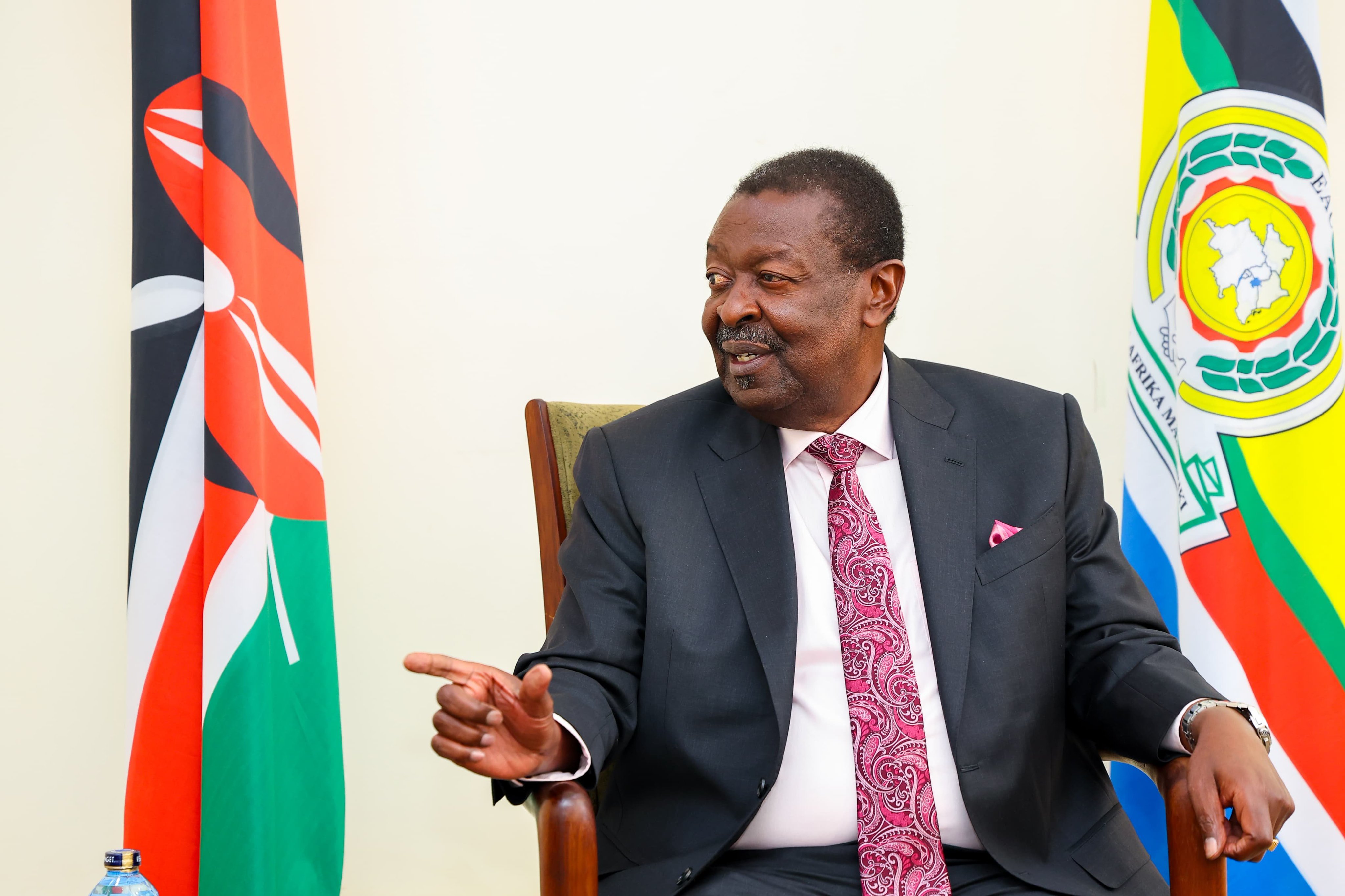
Speaking during a joint press briefing with visiting German Foreign Minister Johann Wadephul, Prime CS Musalia Mudavadi said the initiative could undermine the United Nations–centred international security architecture.
He added that Kenya, despite being a key regional mediator in the Horn of Africa and the Great Lakes region, was not invited to participate in the peace board that Trump launched on Thursday in Davos.
Initially intended to manage the fragile Gaza ceasefire and help resolve global conflicts, the Board of Peace is being viewed in some capitals as an initiative that could weaken the role of the UN.
Some traditional US allies have responded cautiously, with a few rejecting Trump’s proposal, while others have opted to join.
However, Mudavadi made it clear that Nairobi does not regard the initiative as a substitute for existing, internationally recognised institutions.
“From our perspective as Kenya, it is important that institutions such as the UN are strengthened,” Mudavadi said, stressing that global peace and security frameworks are firmly anchored in the United Nations system.
He argued that the legitimacy and effectiveness of peace interventions depends on multilateral consensus and established mechanisms, particularly the UN Security Council.
“The whole aspect of the global peace architecture is anchored around the UN framework,” Mudavadi said.
“That is why we have the Peace and Security Council, an entity recognised internationally as a pillar of peace initiatives, including the nature and level of intervention.”
Kenya, he added, remains firmly committed to multilateralism, warning that fragmented or parallel initiatives risk weakening coordination at a time when global conflicts are becoming increasingly complex and interconnected.
“We believe multilateralism is the way forward. If there are challenges, it is better to reform the UN than to create parallel processes, if a coordinated approach is to be achieved,” he said.
Germany backed Kenya’s position, with Wadephul also calling for reform of the UN.
“I fully agree with what my colleague has said regarding the peace board,” he said.
Wadephul suggested that even Washington recognises the need to improve existing systems rather than replace them.
“What I understood from the US President is that the system does not need to be replaced but reformed and made more effective,” he said.
Germany, he added, fully supports the UN80 Initiative spearheaded by UN Secretary General António Guterres.
The initiative aims to modernise the organisation, improve efficiency and adapt it to current global challenges.
A key pillar of Germany’s position, Wadephul said, is addressing long-standing imbalances in global governance, particularly Africa’s underrepresentation on the UN Security Council.
“We believe Africa should be more represented at the UNSC,” he said, echoing calls by the African Union for permanent African representation as part of broader UN reforms.
While Egypt is reported to be among the countries that agreed to join the initiative, Morocco was the only African state to sign up on Thursday.
Other participating countries include Kosovo, Kazakhstan, the United Arab Emirates, Saudi Arabia, Pakistan, Paraguay, Qatar, Turkey, Uzbekistan, Mongolia, Jordan, Bahrain, Argentina, Armenia, Azerbaijan, Bulgaria, Hungary and Indonesia.
The formation of the board comes against the backdrop of renewed international debate over the effectiveness of the UN system, fuelled by frustration over repeated deadlock at the Security Council on major global crises.
Trump’s Peace Board has been presented by its supporters as an alternative mechanism for conflict resolution, though details about its structure and mandate remain unclear.