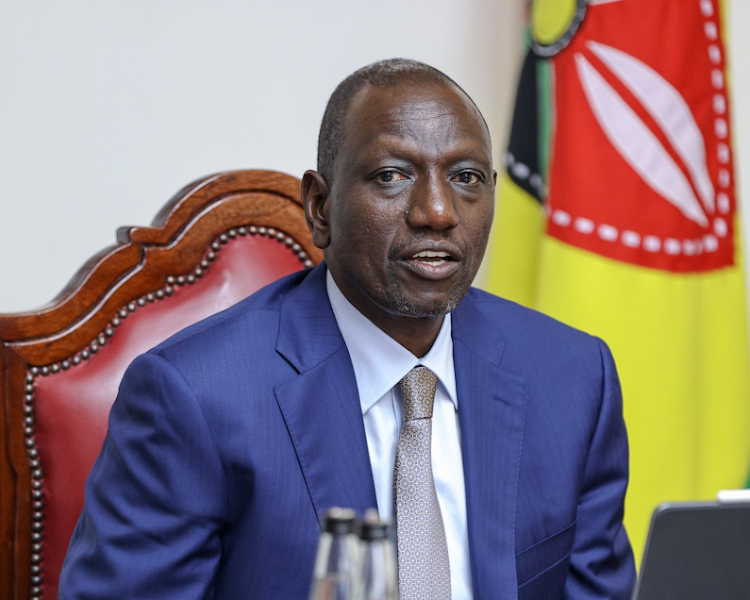
 President William Ruto/PCS
The High Court’s decision to declare presidential advisory offices and the appointments of 21 individuals to those posts unconstitutional marks a significant legal and political development in Kenya’s constitutional governance.
The ruling lays bare fundamental questions about executive authority, constitutional limits, public appointments, and the oversight role of independent institutions, with implications that will reverberate through public service, governance, and politics in the run‑up to the 2027 general elections.
On January 22, 2026, a Milimani High Court judge ruled that the creation of advisory offices within the Executive Office of the President, and the subsequent appointment of 21 advisors, was made in violation of the Constitution and relevant public service laws.
The court declared the appointments “null and void ab initio”, meaning they have had no legal effect from the outset, and quashed all decisions relating to their creation and staffing.
“A permanent injunction be and is hereby issued restraining the first and second respondents and their agents from recognising, facilitating or effecting any payments to the interested parties pursuant to the appointments for the said unconstitutional offices,” Justice Bahati Mwamuye ruled.
AG was named as the first respondent, while PSC and SRC were the second and third respondents, respectively.
The judgment also issued a permanent injunction preventing the respondents or anyone acting under their authority from recognising or facilitating payments or benefits arising from the offices.
“An order of certiorari be and is hereby issued to remove into this Court for the purposes of quashing, which this Court hereby does, the decisions to create the impugned Offices of Advisors to the President impugned in the Petition and the subsequent decisions appointing the Interested Parties to those offices,” he ruled.
How the controversy started
The advisory offices in question were established by President William Ruto as a way to bring in expert advice on various policy fronts, including economic strategy, legal reform, and governance.
Over time, the number of advisors grew substantially, with critics noting a departure from the president’s earlier pledge to reduce the number of such appointments as part of fiscal austerity measures.
The legality of these offices was challenged by constitutional watchdogs, most prominently the Katiba Institute, which argued that the President had no constitutional authority to create these posts unilaterally, without a clear legal framework, public participation, or oversight by Parliament and relevant authorities.
A petition was filed in 2025, asserting that the appointments bypassed essential constitutional safeguards and imposed an unnecessary financial burden on taxpayers.
Constitutional and legal basis for the ruling
The High Court’s ruling turned on key constitutional and statutory provisions governing public service appointments and the creation of public offices.
Under the Constitution and the Public Service Commission (PSC) Act, the establishment of offices and recruitment of public servants must involve the PSC, a body with constitutional authority to oversee public service appointments and ensure compliance with principles of transparency, fairness, merit, and public participation.
In its judgment, the court found that the President failed to involve the PSC in the creation and staffing of the advisory offices, bypassing mandatory processes meant to safeguard accountability and constitutional integrity.
The lack of public participation, competitive recruitment procedures, and oversight by another independent authority, such as the Salaries and Remuneration Commission, further undermined the legality of the appointments, the court ruled.
Critics pointed to Article 132(4)(a) of the Constitution, which allows the President to establish offices within the public service on the recommendation of the PSC.
However, the court concluded that simply issuing executive orders or directives did not satisfy the constitutional and statutory requirements for creating public offices and filling them through appropriate, transparent processes.
Immediate legal and administrative impacts
One of the most immediate questions following the ruling is: what happens now to the 21 advisors previously appointed to these offices?
Because the court found the appointments unconstitutional ab initio, their status as officers effectively ceases, and they no longer hold lawful positions.
The injunction issued by the court bars government agencies, including the PSC, from processing salaries or benefits for these roles, effectively halting remuneration and any associated privileges.
Beyond simply voiding the appointments, the court also directed the Public Service Commission to undertake a comprehensive audit of all offices established within the Executive Office of the President since the 2010 Constitution was promulgated, with a specific focus on posts created after August 2022.
Any offices found to have been created illegally or unconstitutionally must be abolished, with a progress report due to the court within 120 days.
This element of the ruling has potentially wide ramifications: it could lead to the dismantling of other posts that have operated outside the constitutional architecture, reshaping the structure of the executive branch and reinforcing the PSC’s constitutional mandate.
Government response
While Attorney General Dorcas Oduor has not issued any response to this, there are indications that she may consider an appeal. A source within the AG’s office told the Star that a decision on appeal would be taken by the Attorney General and Solicitor General.
“I might not be a position to comment on that, but definitely an appeal would be lodged,” said the source, who is not authorised to speak publicly on the matter.
Earlier court filings show the AG had argued that the appointments were lawful, citing Article 132(4)(a) and regulations that appear to provide a basis for appointing advisors without parliamentary approval or public participation.
In court documents, the AG maintained that creating advisory positions was an internal administrative matter within the Executive Office and did not trigger the obligation for wider public consultation.
Judicial oversight and constitutional governance
The ruling fits within a broader pattern of High Court decisions in recent years that have reinforced institutional checks on executive power.
Last year, the High Court struck down a Presidential Task Force on Health Audit for unlawfully assuming functions reserved for independent bodies, a decision that reaffirmed the constitutional separation of powers and the need for adherence to legal frameworks.
Similarly, the judiciary has in multiple instances nullified actions by the Attorney General’s office and other executive directives that attempted to encroach on independent commissions’ mandates, reinforcing the principle that no part of the executive is above constitutional constraints.
These rulings collectively underscore the judiciary’s role as a guardian of the Constitution and a bulwark against administrative actions that upset the balance of power envisaged by the 2010 constitutional framework.
Public and civil society reaction Civil society groups, particularly governance watchdogs, have widely applauded the High Court’s decision as a victory for the rule of law.
The Katiba Institute described the judgment as reaffirming that executive power must be exercised strictly in accordance with the Constitution, and that transparency, merit, fiscal responsibility, and public participation are not optional but fundamental requirements.
Katiba Institute Executive Director Nora Mbagathi said the loss of a transparent and merit-based governance system is a big step in the move away from genuine democracy and rule of law.
“We are grateful that the Kenyan courts continue to uphold and protect our constitutional rights and safeguards,” she said.
Lawyer Lempaa Soyinka, who had also petitioned the court, expressed his happiness with the ruling, saying the creation of the offices violated the values and principles of the public service.
According to Soyinka, such offices amount to a backdoor way of rewarding politicians.
“We are very happy; we are now waiting for them to appeal so that we hit them right and we know how to do it best,” he told the Star.
Supporters of the ruling argue it promotes accountability and curbs the expansion of executive patronage, while critics contend the decision could hamper the president’s ability to assemble expert advice needed for policymaking, especially on complex economic and security issues.
Some legal scholars suggest that a legislative framework may be needed to define and regulate advisory roles constitutionally, balancing expertise with accountability.
What this mean for governance
The court ruling is not just a technical legal determination; it has broader implications for how public offices are created, how appointments are vetted, and how executive authority is exercised in Kenya.
As the PSC begins its audit and potential abolitions of unconstitutionally created posts, questions arise about whether Parliament will move to legislate clear guidelines for advisory roles that align with constitutional principles.