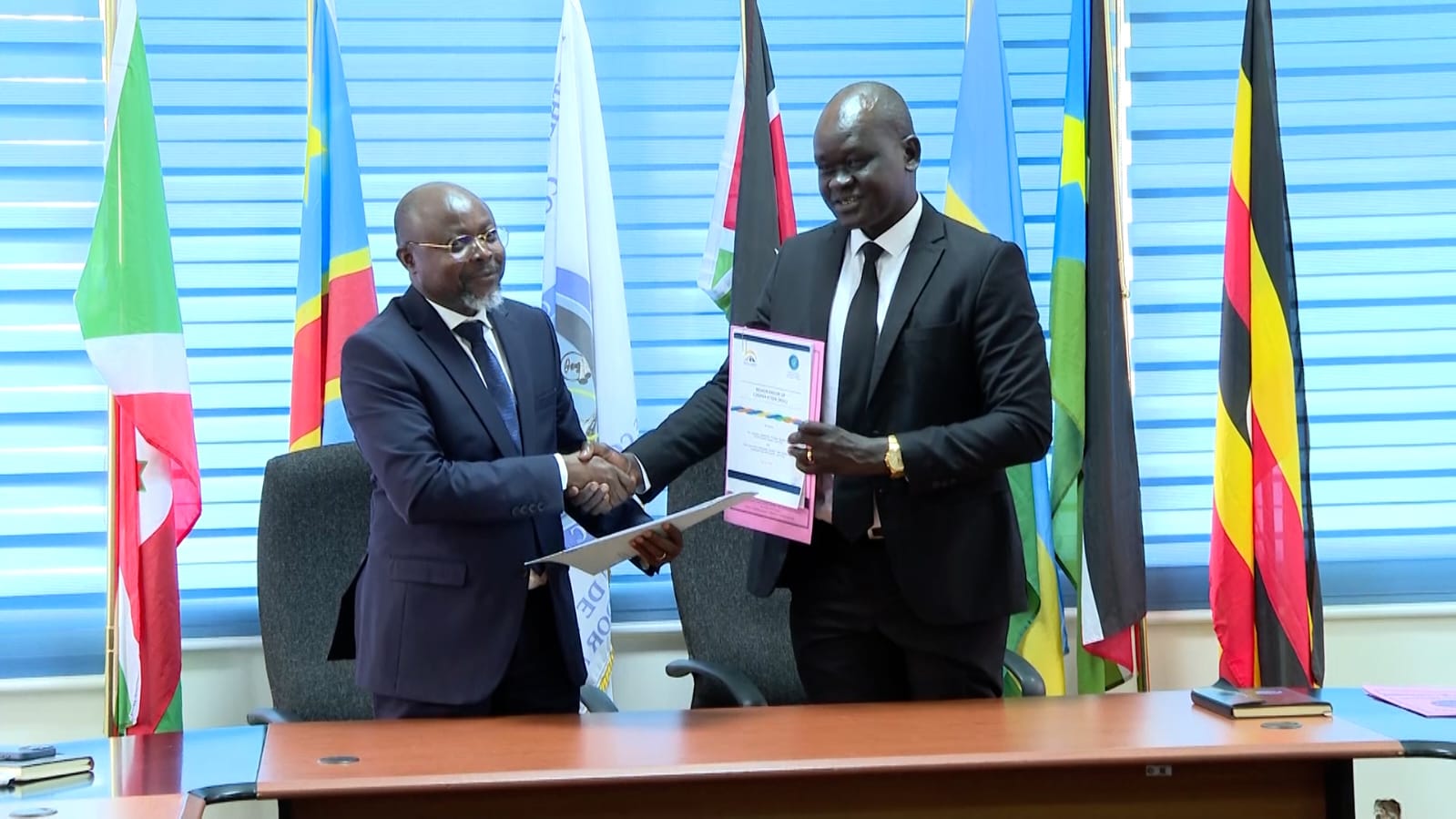
 CCTTFA executive secretary Okandju Okonge and NCTTCA executive secretary John Deng
Two agencies have signed a Memorandum of Cooperation to strengthen collaboration on transport efficiency, trade facilitation and sustainability in Eastern and Central Africa.
The agreement was signed by the Northern Corridor Transit and Transport Coordination Authority (NCTTCA) and the Central Corridor Transit and Transport Facilitation Agency (CCTTFA) at NCTTCA's offices in Nyali.
It establishes a structured framework for joint action between the two intergovernmental corridor institutions.
The corridors link land-linked countries in the Great Lakes region to the ports of Mombasa, Dar es Salaam, Tanga and Mtwara.
Under the agreement, the two agencies will work together in key areas.
These include inland waterways transport, green corridor development, multimodal infrastructure integration, digitalisation and data sharing, environmental sustainability and climate resilience, road safety, monitoring of non-tariff barriers (NTBs), and harmonisation of transport and trade policies and procedures.
The framework also prioritises capacity building, private sector engagement and coordinated resource mobilisation.
Speaking during the signing ceremony, NCTTCA executive secretary John Deng said the agreement reflects a shared commitment to regional integration, economic competitiveness and climate-resilient transport systems.
“Trade facilitation remains the core business of the two corridor institutions, and all our actions are meant to positively impact trade,” he said.
Deng said the MoC provides a framework for integrating activities where the two corridors have overlapping mandates, to optimise outcomes and ensure efficient use of resources.
He highlighted inland waterways transport, particularly on Lake Victoria, as a priority area.
Deng said increased use of the lake would help decongest roads and protect the environment.
He said joint efforts will focus on improving navigation safety through updated mapping, better communication systems, rescue centres and coordinated emergency response involving Kenya, Tanzania and Uganda.
Deng also said the institutions will collaborate on environmental sustainability and climate change initiatives.
These include green freight programmes, driver training, emissions data collection and the development of regional e-mobility and electrification roadmaps aimed at reducing reliance on fossil fuels.
On non-tariff barriers, Deng said the two corridors will take a joint approach to addressing persistent trade challenges.
“A common front is required to address issues that affect trade across the region,” he said.
CCTTFA executive secretary Okandju Okonge said high transport costs in the region are largely driven by over-reliance on road transport.
He said the development of alternative transport modes will help lower costs and reduce NTBs.
Okonge said the two institutions will work together to monitor and harmonise transport and trade policies and procedures.
He said the partnership was long overdue.
Okonge said the two corridors serve the same countries and populations, including Uganda, Rwanda, Burundi and the Democratic Republic of Congo.
He said the collaboration will improve efficiency, promote solidarity and increase the visibility of both institutions.
To implement the MoC, the parties will develop a three-year Joint Action Plan.
This will be overseen by a high-level steering committee made up of the executive secretaries of both institutions, supported by a joint technical committee.
The MoC will remain in force for an initial period of five years, with provisions for renewal and expansion by mutual agreement.