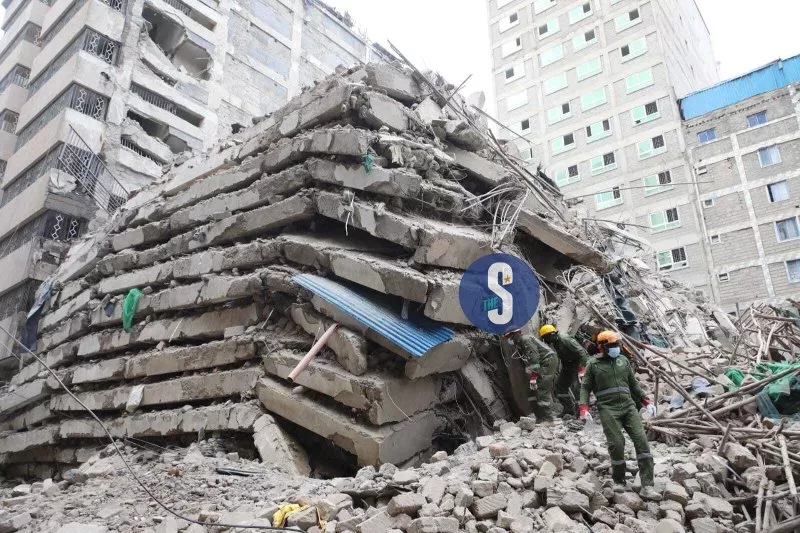
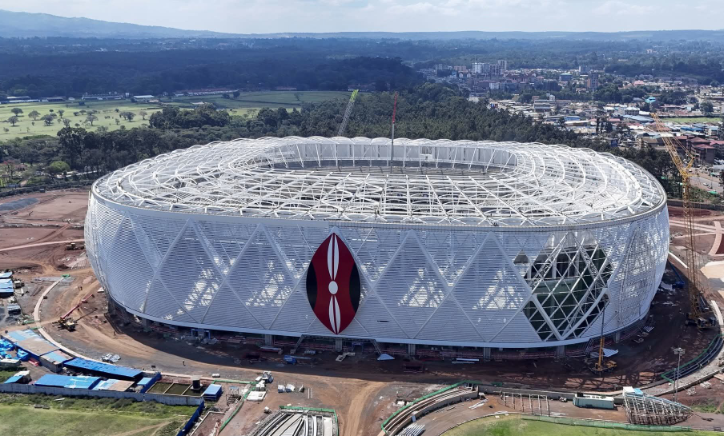
 Ongoing construction of the Talanta Stadium, which will host 2027 AFCON matches/FILE
Doubts have been cast over East Africa’s readiness to host the 2027 Africa Cup of Nations (AFCON), reviving painful memories of past missed opportunities for Kenya.
The debate has intensified following remarks by Ivorian journalist Mamadou Gaye, who openly questioned whether Kenya, Uganda, and Tanzania are adequately prepared to stage the expanded continental showpiece.
His comments have struck a nerve in a region where football fans still recall how Kenya lost the right to host the 1996 AFCON and later failed to deliver the 2018 African Nations Championship (CHAN).
Kenya was originally awarded the hosting rights for the 1996 AFCON, a decision that sparked widespread excitement across the country.
The prospect of watching some of Africa’s biggest football stars—including Ghana’s Abedi Pele, Liberia’s George Weah, Nigeria’s Austin “Jay Jay” Okocha, and Zambia’s Kalusha Bwalya—thrilled fans and promised to boost the country’s sporting profile.
However, the dream quickly collapsed. According to former Confederation of African Football (CAF) president Issa Hayatou, Kenya’s leadership ultimately admitted it was not ready to host the tournament.
The late President Daniel Toroitich arap Moi personally wrote to Hayatou to confirm that Kenya would withdraw, citing a lack of preparedness, particularly the failure to construct new stadiums in Nairobi and Mombasa.
“Then President Daniel Moi wrote to me saying Kenya was not ready. Morocco and South Africa were ready for the challenge, and eventually we settled on South Africa. It was an amazing tournament inspired by the late president Nelson Mandela,” Hayatou said during the screening of a documentary at the 39th CAF Ordinary General Assembly in Addis Ababa, Ethiopia, in March 2017.
The fallout was severe. Kenya was banned from the next two AFCON tournaments, while South Africa went on to host a memorable 1996 edition, beating Tunisia 2-0 in the final to claim their first and only continental title.
Beyond the sporting embarrassment, the loss of hosting rights dealt a blow to Kenya’s economy, football development agenda, hospitality industry, and national morale.
More than two decades later, history appeared to repeat itself. Kenya was awarded the right to host the 2018 CHAN, raising hopes that the country would finally stage its first major continental football tournament. Yet once again, the opportunity slipped away.
CAF stripped Kenya of the hosting rights following an executive committee meeting in Accra, Ghana, citing persistent delays and inadequate preparations.
In a statement, CAF said the decision was made “in light of accumulated delays from reports of the various inspection missions conducted in the country.”
A CAF inspection team that visited Kenya from September 11 to 17, 2017, found that only one of the four proposed venues was ready to host matches.
On October 14, 2017, CAF announced Morocco as the new host, with the tournament eventually played from January 13 to February 4, 2018.
The Football Kenya Federation (FKF) defended its efforts, insisting that it had done everything within its power to save the tournament.
“FKF did everything humanly possible to ensure that CHAN 2018 became a reality both to Kenyans and the entire East African Region,” the federation said at the time.
However, it conceded that “lack of up-to-standard infrastructure to host the competition and the need to improve the existing ones meant that Kenya would inevitably play second fiddle to better placed countries that have invested heavily on infrastructure development over the years.”
It is against this backdrop that concerns have emerged over East Africa’s joint bid to host the 2027 AFCON.
The tournament was awarded to Kenya, Uganda and Tanzania under the banner “Pamoja AFCON 2027,” marking the first time the competition will be co-hosted by three countries and the first AFCON in East Africa in nearly 50 years.
The last time the region hosted the tournament was in 1976, when Ethiopia staged the event.
Gaye’s criticism centres on the standards set by Morocco during the 2025 AFCON, which he described as a benchmark for future hosts.
He noted that Morocco was only awarded the tournament after Guinea failed to meet CAF’s requirements, and then went on to deliver a championship that raised the bar across the continent.
“From infrastructure to logistics, hospitality to security coordination, Morocco delivered a championship that set a new continental standard,” Gaye said.
High-speed rail, modernised airports, upgraded road networks and digitally integrated services were seamlessly operational.
Stadiums met international standards, transport systems connected host cities efficiently, and security arrangements were effective yet unobtrusive.
“In Morocco, you could go to any of the venues on top highways, by speed train, by rail, by bus. Everything is first class. I expect sub-Saharan Africa to reach that level,” Gaye said in an interview.
He also highlighted the fan experience, noting that dedicated five-star hotels hosted all 24 teams, offering advanced training and medical facilities, while matches were broadcast using cutting-edge 4K HDR technology, drones and spidercams.
While acknowledging that East Africa has made progress, Gaye questioned whether the region currently meets the demands of a tournament of AFCON’s scale.
Supporters of the joint bid argue that the region has learnt from past failures.
Football Kenya Federation President Hussein Mohammed said East Africa’s successful co-hosting of the 2025 CHAN demonstrated its growing capacity to deliver major tournaments.
“After setting new standards with the most successful CHAN in history, we are determined to raise the bar even higher in 2027. The journey begins now,” Mohammed said.
The Kenyan government has also sought to reassure critics. Sports Principal Secretary Elijah Mwangi said Kenya, alongside Uganda and Tanzania, is ready to host AFCON 2027 in terms of infrastructure and other requirements.
He pointed to the lessons drawn from CHAN 2025 and the benchmarking exercises conducted in Morocco.
“It is a great opportunity for us to show what we have. We shall make it better than CHAN and even better than Morocco,” Mwangi said.
As preparations formally begin following the symbolic handover of the AFCON flag by CAF President Patrice Motsepe, the spotlight is now firmly on East Africa.