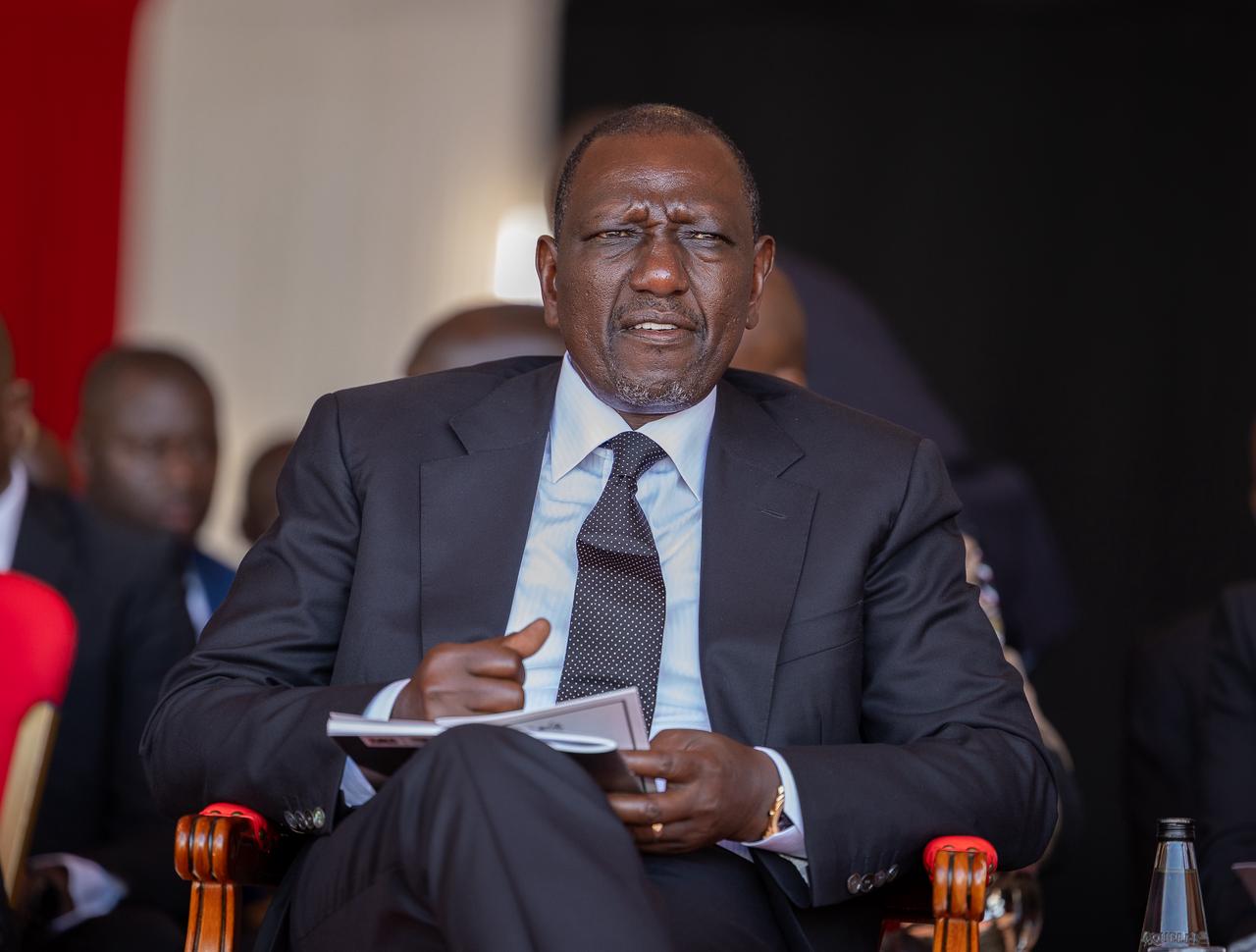
 President William Ruto/FILE
As proof that the Western vote will form an indomitable pillar of his 2027 re-election strategy, President William Ruto has rolled out a three-tier plan to seal every possible campaign loophole in the hopes of blocking challengers toppling his road to State House.
Ruto's decision to get off the blocks early is a realistic acknowledgement the massive Mt Kenya numbers that pushed him across the line in 2022 can never be bankable and, even though he continues a hard sell blitz in Central Kenya, a dependable alternative plan must come into shape.
The multi-layered plan entails creating dedicated campaign teams to deepen grassroots networks and broadening his influence to comb every village and trading centre to get his message where it matters most.
The usually splintered but numerically formidable bloc has long been considered a stronghold of the late opposition leader Raila Odinga and the Orange Democratic Movement party.
At the top of the plan are seasoned stalwarts Prime Cabinet Secretary Mudavadi, National Assembly Speaker Moses Wetang'ula, and Cooperatives Cabinet Secretary Wycliffe Oparanya.
The three political heavyweights will be tasked to deliver. The governors lead the second unit and select members of Parliament, while the third focuses on county-based teams at the grassroots.
The early rollout comes with a recent Western region poll indicating the contest between Ruto and the opposition will be dogged if not brutal because the popularity scales are near balance.
Although Ruto is by far the candidate who has caught the imagination of the majority, and is the most preferred, support for the opposition figures remains impressive, indicating Kenya Kwanza must do the heavy lifting to pocket the gains.
According to a recent Infotrak pulse of the region opinion poll, 25 per cent of voters listed Ruto as their choice.Former Interior Cabinet Secretary Fred Matiang’i trailed a distant second with 15 per cent, while rabble-rouser Trans Nzoia Governor George Natembeya, who emerged as the region's most influential figure, pocketed 13 per cent.
Political analysts warn Ruto faces significant, but not unsurmountable, challenges.
“It will not be an easy ride for the President in Western Kenya. He will need a team whose messaging resonates with local communities,” political commentator Martin Andati said.
The surge of firebrand Natembeya’s influence, eclipsing Mudavadi and Wetang'ula — both indispensable cogs in Ruto election juggernaut —has exacerbated the stakes.
Ruto has been on an all-embracing charm blitz, investing in high-profile development projects, appointing regional leaders to government positions, and leveraging on the popularity of Raila Odinga’s networks.
The President’s United Democratic Alliance party is negotiating a pre-election coalition with ODM, aiming to inherit portions of Raila’s support base.
In the run-up to the 2022 general election, Mudavadi and Wetang'ula led Ruto’s campaigns in Western, delivering the crucial vote bloc that arguably secured victory for the President.
Recent polls ranked Mudavadi as the second most influential leader in the region after Natembeya, with 32 per cent of respondents acknowledging his regional influence.
However, insiders disclose that the President will retain them as his lead campaigners– despite their alleged waning influence – alongside the new allies, especially from ODM, to enhance his political fortunes in the region.
In the last general election, Raila garnered 1, 016, 333 votes from the region against Ruto’s 630, 282.
Ruto got 141, 166 votes in Kakamega, 67, 633 votes in Vihiga, 255, 906 votes in Bungoma, 48, 801 votes in Busia, and 116, 776 votes in Trans Nzoia.
"It was your vote in Bungoma that dropped the weight of all that we were arguing about, and it was our vote that made the difference; it dropped one person, passed another," Wetang'ula told residents soon after the polls.
The second layer comprises governors, deputy governors, and influential local leaders forming the “Broad-Based Western for Ruto Two-Terms” team.
Unveiled at Kakamega’s Golf Hotel on January 6, the team is led by Bungoma Governor Kenneth Lusaka, with Kakamega Deputy Governor Ayub Savula as his deputy.
Teso South MP Mary Emaase serves as secretary and Vihiga Woman Representative Beatrice Adagala is treasurer.
The group is tasked with mobilising support and coordinating the President’s campaign activities across the six counties of Western Kenya.
Speaking at the launch, Lusaka projected a message of continuity and unity rather than political rivalry.
“We want to secure continuity, not disruption. That is why we are advocating for two terms for President Ruto,” he said.
Lusaka highlighted tangible gains under the Kenya Kwanza government, including revival of the sugar industry, construction of roads, affordable housing projects, markets, and classrooms.
He also urged political discipline, warning against the fragmentation and internal rivalries that have historically hampered the region’s leadership.
The first major grassroots meeting is scheduled for January 31 in Bungoma, followed by similar engagements in Vihiga, Kakamega, Trans Nzoia, and Busia counties.
Analysts suggest that the new campaign layer is intended to complement and, in some ways, counterbalance the influence of Mudavadi and Wetang'ula, whose ratings in the region have reportedly dipped.
“Their influence in Western Kenya is fading, and they may not be able to tilt the scale for the President on their own,” Andati noted.
The analyst doubted the ability of the new team to politically market the President, stating that the county bosses backing the President’s re-election are facing troubles in their own backyards.
Political observer Mark Bichachi said Western is a fertile ground for all the political players in the 2027 polls.
“It behooves the President to create campaign teams across the country. Jubilee Party won the 2017 election by canvassing both old and new voting blocs,” Bichachi said.
“One strategy to win an election is to ensure you get votes even in opposition zones while winning big in your zones.”
The third layer focuses on county-based teams, which will operate at the grassroots level.
Led by Members of Parliament and elected party officials, these teams are tasked with door-to-door campaigns and community engagements aimed at expanding Ruto’s reach in rural areas.
UDA national vice chairman Kelvin Lunani emphasised the importance of aligning Western Kenya with national government initiatives to ensure the region benefits from national resources.
He called on young leaders to respect senior politicians, eschew intimidation, and prioritise performance as the basis for elections.
But
Kakamega Senator Boni Khalwale poured cold water on the President 's latsst strategy to win over the Western vote bloc. Speaking to the Star, Khalwale said stated that while Ruto is an experienced politician, politics of the region has drastically shifted. He said the troops the President is relying on to deliver the vote basket are not equal to the task. "Lusaka and his team are wasting their time. If he comes to the headquarters of Kakamega, which is Ikolomani, people will ask who he is because he is a stranger. He is only known in Bungoma," Khalwale said.The former Senate Majority leader added that Western politics has become dynamic since the death of Kijana Wamalwa who controlled the region. "Let the teams try. We want to see what they will do beyond what we did for Ruto in 2022. But I think they are wasting their time," he said.
Busia Senator Okiya Omtatah also downplayed Ruto's strategy.
He said the people the President is relying on have allegedly lost touch with the ground.
" I don't think they have clout on the ground. These are people who fired their shots yesterday. They are cannons of yesterday. They hold no political future for the region," he said.
The campaign strategy also seeks to leverage ODM’s established networks in the region.
Raila Odinga dominated Western Kenya’s politics for decades, and tapping into those networks is seen as critical for Ruto’s bid to consolidate support among undecided voters and communities historically loyal to the late opposition leader.
Observers note that the Western vote is pivotal for the 2027 elections, given the bloc’s size and influence.
INSTANT ANALYSIS
Ruto’s three-tiered campaign strategy—national lieutenants, influential regional leaders, and county-based grassroots teams—reflects a meticulously calculated approach to navigate the political complexities of the region. As he intensifies his outreach, the coming months are expected to witness heightened political activity in the region, with alliances, coalitions, and campaign messaging likely shaping voter sentiment ahead of the 2027 general election.