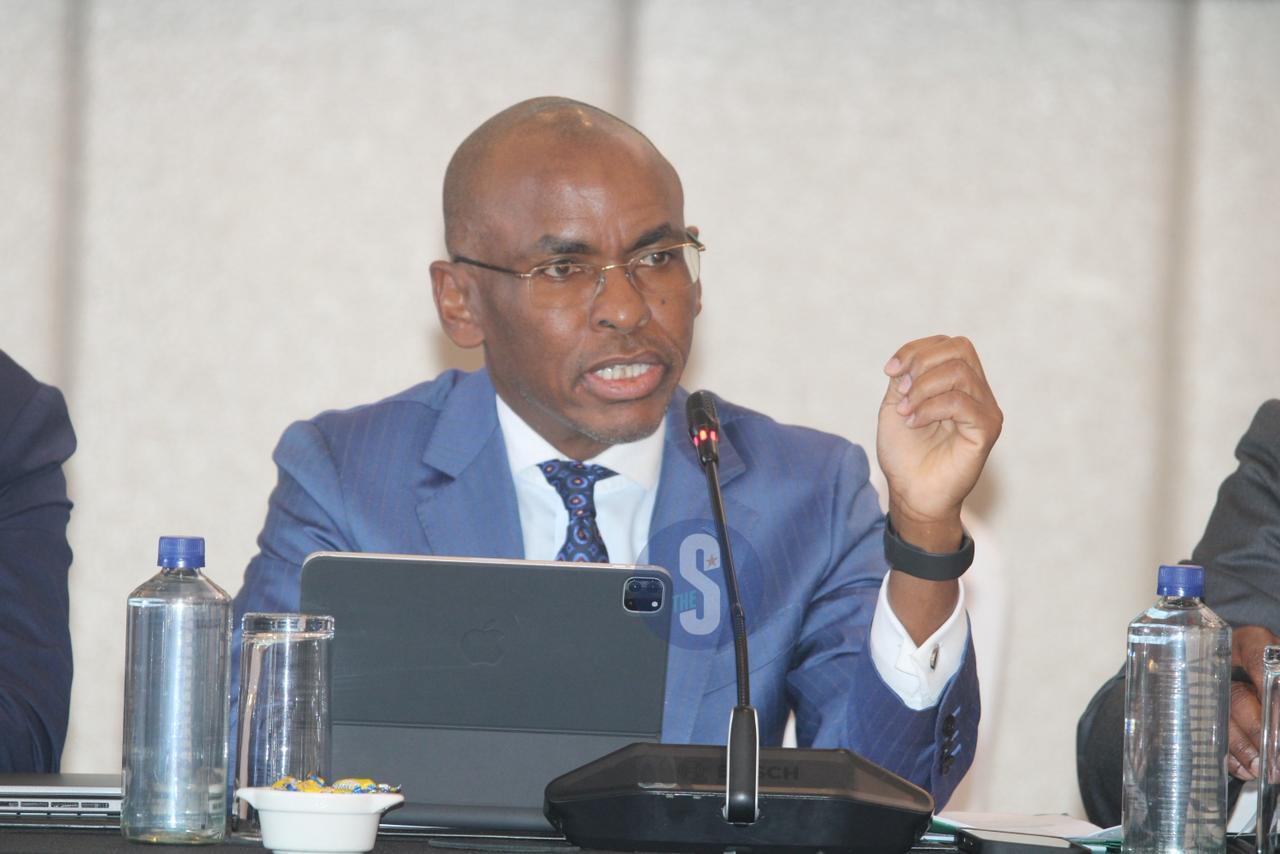
 Safaricom chief executive officer Peter Ndegwa when he appeared before Parliamentary Committees on Finance and National Planning and on Public Debt and Privatisation on January 19, 2026/DOUGLAS OKIDDY
Safaricom has moved to allay public concerns over its ownership and future operations, confirming that it will remain a Kenyan company.
The company said the proposed shareholder changes will not affect its governance, regulatory oversight or day-to-day operations.
Speaking before a joint sitting of the Parliamentary Committees on Finance and National Planning and on Public Debt and Privatisation on Monday, Safaricom chief executive officer Peter Ndegwa said the proposed partial divestiture of government shares in the telecommunications giant does not alter its national character or regulatory obligations.
“It is important to state clearly that the proposed transaction does not alter Safaricom’s governance framework, regulatory oversight, or national jurisdiction,” Ndegwa said during his presentation on the consideration of Sessional Paper No. 3 of 2025 on the partial divestiture of the government’s stake in Safaricom Plc.
Ndegwa emphasised that Safaricom will continue to operate fully within the Kenyan legal and regulatory framework.
“Safaricom will continue to operate fully under Kenyan law. The company remains licensed, supervised, and regulated by Kenyan institutions, including the Communications Authority of Kenya, the Central Bank, Capital Markets Authority, the Competition Authority of Kenya, and other relevant regulators,” he said.
He added that the company remains listed on the Nairobi Securities Exchange and continues to be accountable to Kenyan enforcement and oversight mechanisms, dismissing fears that the transaction could weaken local control or oversight.
“There is no transfer of operational control, no dilution of regulatory authority, and no weakening of governance standards arising from this transaction,” Ndegwa said, noting that Safaricom’s Board, management structure and decision-making frameworks remain intact.
The CEO further explained that the proposed transaction is strictly a shareholder-to-shareholder arrangement between the Government of Kenya and Vodacom Group.
Under the proposal currently before Parliament, the government plans to divest 15 per cent of its shareholding in Safaricom Plc, reducing its ownership from 35 per cent to 20 per cent.
Ndegwa clarified that Safaricom itself is not directly involved in the transaction.
“Safaricom itself is not a counterparty to this transaction. The company is not selling shares, setting pricing, or negotiating valuation. Our role is limited to complying with the obligations applicable to a listed company under Kenyan law and capital markets regulations,” he said.
Addressing concerns about Vodacom’s increased stake, Ndegwa said the multinational telecommunications firm is a long-standing and strategic investor in Safaricom, rather than a new or unfamiliar entrant.
“Vodacom is a strategic investor who is not a new or unfamiliar party to Safaricom,” he said.
He noted that Vodacom has been a shareholder since Safaricom’s inception and has had board representation for more than two decades.
“Vodacom has also been a key partner in Safaricom’s regional journey, including the entry into Ethiopia, bringing experience from multiple markets, technical expertise, and long-term investment capacity,” Ndegwa said.
From Safaricom’s perspective, he added, Vodacom’s increased shareholding reinforces a long-term investment orientation and continuity in strategy, rather than any shift in control or direction.
The remarks come amid heightened public and political debate over the government’s plan to reduce its stake in one of Kenya’s most profitable and strategically important companies.
Today, Safaricom serves over 60 million customers across Kenya and Ethiopia, supporting millions of households, businesses and institutions every day.
Ndegwa told lawmakers that maintaining stability, strong governance and regulatory compliance remains central to the company’s operations as it continues to expand regionally while remaining firmly anchored in Kenya.