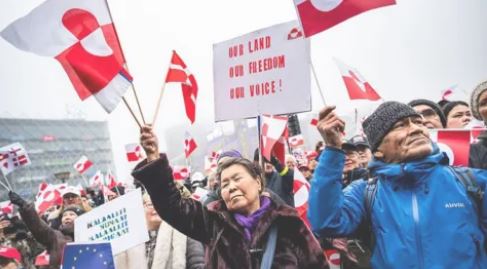
 Protesters in Greenland./SCREENGRAB
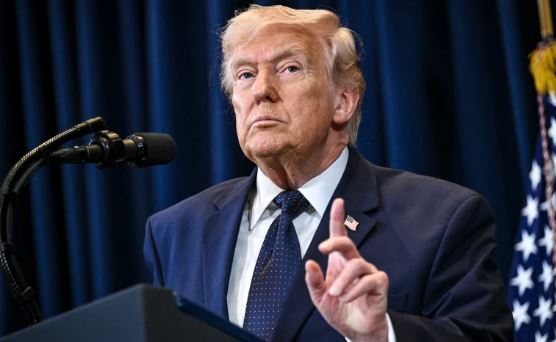
US President Donald Trump's tariff threats over Greenland "risk a dangerous downward spiral," Nato members say in a joint statement.
The leaders of Denmark, Finland, France, Germany, the Netherlands, Norway, Sweden and the UK add that they stand firmly behind "the principles of sovereignty and territorial integrity."
"Tariff threats undermine transatlantic relations and risk a dangerous downward spiral", they say.
UK Culture Secretary Lisa Nandy tells the BBC "the future of Greenland is a matter for the people of Greenland and the people of the kingdom of Denmark".
"That is non-negotiable, that is the starting point for the conversation, what happens next is a result of the conversations that we'll be able to have".
Pressed on whether the UK would ever allow Trump to take Greenland, Nandy says the government would never allow any changes to be made to the future of Greenland without the consent of the people of Greenland and Denmark.
The US president yesterday announced plans to impose a 10% tariff on goods from those eight countries from 1 February. Meanwhile, thousands have been protesting against Trump's plans in Greenland and Denmark.
'Europe will not be blackmailed,' Danish PM says
After a joint statement from all eight countries targeted by Trump's tariffs, we've just heard a further response issued by Denmark's Prime Minister Mette Frederiksen.
"The Kingdom of Denmark is receiving great support," she says, describing how she has been in "intensive dialogue" with allies including the UK, France and Germany.
"I am pleased with the consistent messages from the rest of the continent: Europe will not be blackmailed," she writes.
"At the same time, it is now even clearer that this is an issue that reaches far beyond our own borders."
As a reminder, Greenland is a self-governing territory controlled by Denmark, and Frederiksen points out: "We want to co-operate, and it is not we who are seeking conflict."
What are tariffs and how do they work?
Tariffs are taxes on imported goods, with the charge usually a percentage of a good's value.
For example, a 10% tariff on a $10 product would mean a $1 tax on top - taking the total cost to $11.
The tax is paid to the government by companies bringing in the foreign products.
These firms may pass some or all of the extra cost on to their customers, which in this case means ordinary Americans and other US businesses.
But they might also reduce the amount they import, change supplier, or stop importing the goods altogether if the tariff makes the product too expensive.
This then affects the company exporting the product, which will see sales and revenues fall. It might also have to cut jobs as a result.
Not all tariffs that Trump has threatened have been implemented, but just the possibility of these taxes coming in can have an impact.
What firms want is stability, so they can make long-term plans for their business in areas such as investment. If they are not sure what costs they are going to face, it makes it harder for them to make key decisions.
A weapon in the EU trade arsenal—what is the 'Anti-Coercion Instrument'?
The “Anti-Coercion Instrument” (ACI) which President Macron has spoken of was approved by Brussels in 2023 in order to deter attempts by outside powers to force policy changes on the EU or member states.
At the time the main threat was seen as coming from China, which had recently “punished” Lithuania for its links with Taiwan by putting restrictions on bilateral trade.
Today there would appear to be a clear-cut case of another outside power—the United States—using commercial muscle to change European policy on Greenland.
In these circumstances, the “anti-coercion instrument” is an added weapon in the EU trade arsenal.
If there is agreement that coercion has been attempted by an outside power, and if negotiations to resolve the conflict fail, then the EU has enhanced powers to retaliate “within international law”.
According to the EU, “The ACI permits import and export restrictions to be placed on goods and services, but also on intellectual property rights and foreign direct investment.
“Additionally, the ACI enables the imposition of various restrictions on access to the EU market, notably to public procurement, as well as the placement on the market of products under chemical and sanitary rules.”
The ACI has never yet been used. Last year, during the negotiations over tariffs between the US and the EU, there was talk of the EU invoking it but it never happened.