Read Also
The Law Society of Kenya (LSK) has called on MPs not to approve the sessional paper on the sale of Safaricom shares in its current form.
The society said the process of offloading 15 per cent government shares should be halted until glaring grey areas are addressed.
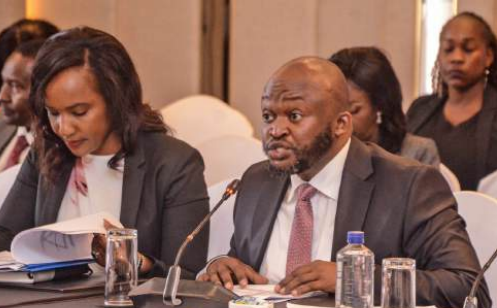
“We respectfully urge the National Assembly to decline the Sessional Paper in its current form,” LSK vice President Maura Kabata told MPs on Friday.
“We require the Sessional Paper be reviewed, revised and subjected to wider stakeholder engagement before any implementation is undertaken.”
LSK CEO Florence Muturi added that any decision on the national asset must factor the general good of the country.
“You cannot proceed with this transaction as is... at the end of the day you must be sure the decision is in the best interest of the country,” Muturi said.
Appearing before joint team of Parliament, Kabata raised fears of a possible undervaluation of shares.
“We require a transparent, competitive price discovery process, including consideration of multiple bidders,” Kabata said.
“We require disclosure of detailed valuation, financial and market-risk analyses; and a comprehensive national security, data sovereignty and fiscal impact assessment.”
LSK appeared before the joint sitting of the Finance and National Planning and Public Debt and Privatisation committees of the National Assembly.
The committee jointly chaired by Kuria Kimani (Finance) and Shurie Abdi (Balambala) has started a stakeholders’ engagement with regards to partial divestiture of the government’s shareholding in Safaricom PLC.
The government intends to offload up to 15 per cent of its 35 per cent controlling shares at the telco.
Already, the government has identified a South Africa-based company, Vodacom, as the strategic partner.
The government intends to raise Sh204 billion from the deal and ring fence the same for commercially viable infrastructure projects.
The lawyers’ body said handing a foreign majority stake in a crucial national asset exposes the country’s national data.
“Ceding majority control to a foreign-owned entity raises questions about where final strategic decisions will be made and whether they will align with Kenya's national digital economy agenda or the holding company’s portfolio strategy,” LSK said in its submission to the joint committee.
They cited the case of Zambia where the government was forced to reverse a similar transaction in the interest of the nation.
“The sale of Zambia Telecommunications Company (Zamtel) to a foreign investor resulted in underinvestment and weakened national telecom capacity,” Kabata said.
"The state was forced to reverse the transaction through re-nationalisation after protracted legal disputes, highlighting the risks of divesting strategic telecom assets without safeguards on control, reinvestment and data sovereignty.”