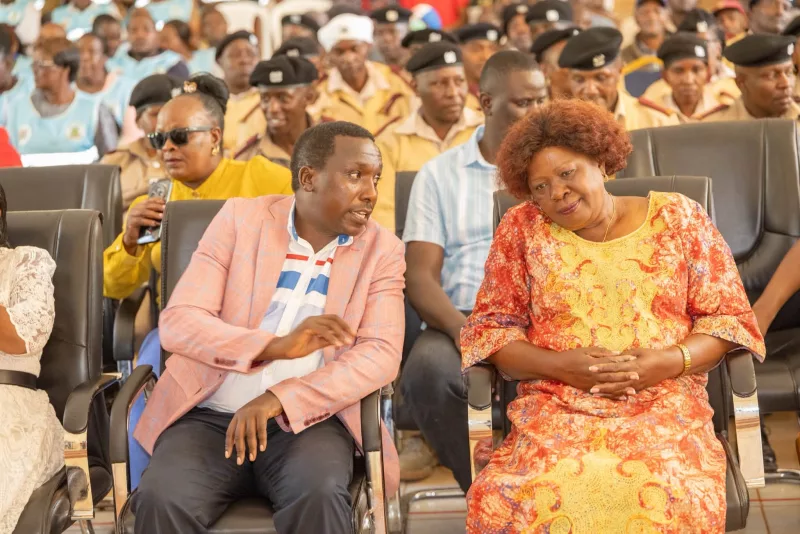
 Deputy President Kithure Kindiki and President William Ruto during the launch of the NYOTA Project Business Start-Up Capital disbursement of Sh147.5 million for young businesspeople in Machakos, Kitui and Makueni counties on January 15, 2026/PCS
Over the years, successive Kenyan governments have rolled out multiple statutory empowerment funds aimed at expanding financial access and supporting youth, women and persons with disabilities to start or grow businesses.
Framed as tools for economic inclusion and job creation, the initiatives have cumulatively disbursed billions of shillings to beneficiaries across the country.
From the administration of former president Mwai Kibaki through Uhuru Kenyatta to the current government under President William Ruto, empowerment funds have remained a central policy instrument.
However, even as they attract political support, economists, auditors and civil society groups have persistently questioned their effectiveness, sustainability and underlying motivations.
The Youth Enterprise Development Fund (YEDF) was established in 2006 and gazetted later that year to address high youth unemployment by offering affordable financing to youth-owned enterprises.
A year later, the Women Enterprise Fund (WEF) was created through Legal Notice No. 147 of August 2007 to provide credit and business support to women entrepreneurs, becoming fully operational in 2009.
During President Uhuru Kenyatta’s tenure, the government introduced the Uwezo Fund in 2013, a Sh6 billion initiative targeting youth and women groups, alongside increased utilisation of the National Government Affirmative Action Fund, which channels grants to women, youth and persons with disabilities across counties.
Ruto’s administration launched the Hustler Fund, formally known as the Financial Inclusion Fund, in November 2022.
Anchored in law through the Financial Inclusion Fund Act, the programme was designed to offer affordable credit, savings and insurance to underserved Kenyans in the informal economy.
With loans priced at an annual interest rate of eight per cent and an annual budget of about Sh50 billion planned over five years, the fund was positioned as an alternative to high-interest digital lending.
Most recently, the government rolled out the National Youth Opportunities Towards Advancement (Nyota) Project, a World Bank-supported initiative targeting vulnerable youth aged 18–29 and persons with disabilities up to 35.
The programme combines training, business grants, apprenticeships and linkages to government opportunities, focusing on those with Form 4 education or below.
Despite these efforts, empowerment funds have attracted sustained criticism.
The Auditor General has repeatedly flagged the Youth Fund and Uwezo Fund for weak governance, poor documentation of beneficiaries, mismanagement and high default rates, raising concerns over the potential loss of billions in public funds.
Critics argue that the programmes are often misused, captured by a few beneficiaries, lack systemic economic impact and sometimes serve as political optics rather than engines of long-term development.
Ruto has pushed back against such criticism, warning leaders against politicising government programmes.
He has defended the Nyota initiative, dismissing claims that grants of Sh50,000 are too little and accusing critics of offering no viable alternatives to youth empowerment.
However, governance expert Barack Muluka has described the Nyota fund as another untested experiment, arguing that such initiatives fall short of addressing structural unemployment. He cautions that without deeper economic reforms, empowerment funds risk becoming mere “photo opportunities” rather than catalysts for transformation.
Muluka has, however, criticised the Nyota, describing it as an untested experiment.
“Things like the Nyota just belong to a hodgepodge of experiments that have not been thought through. You wake up one morning, hatch a new one, go out, and experiment. It has not been tested, it has not been piloted, yet you start saying things like, we are going to become a first-world nation,” Muluka said.
He warned that such funds risk becoming mere political optics or “photo opportunities” if they fail to address structural unemployment and undercapitalisation.
Economist David Kingoo said statutory empowerment funds were created with the right intentions, but their impact has been diluted by duplication and weak frameworks.
He noted that Kenya has too many funds chasing the same objectives, resulting in minimal aggregate impact despite isolated success stories.
“From the borrowers’ perspective, yes, the funds have been impactful but on a national scale, there is too little results,” Kingoo said.
He said empowerment goes beyond disbursing money, arguing that the government must create a conducive business environment for enterprises to thrive.
He faulted the state for releasing funds without rigorously assessing business viability or monitoring usage.
He also warned against issuing funds at political rallies, saying it undermines accountability.
“People treat it as free public money,” Kingoo said, calling for a shift towards lending frameworks similar to commercial banks, anchored on discipline and sustainability.
In response to some of these concerns, the government has announced plans to merge the Uwezo Fund, Youth Enterprise Development Fund and Women Enterprise Fund into a single entity, the Biashara Kenya Fund (BKF).
Co-operatives and MSMEs Cabinet Secretary Wycliffe Oparanya said the consolidation will eliminate loopholes that allow misuse.
“We have cases where a woman applies for the Women Enterprise Fund, then again takes the Youth Fund, and later joins a self-help group to secure Uwezo Fund. This is exploiting the system, while many others who need support remain locked out,” Oparanya said on April 1, 2025.
Academic input has also shaped the debate. The University of Nairobi’s African Women’s Studies Centre noted that BKF is not unique but mirrors models used in other developing countries.
Its director, Prof Wanjiku Mukabi Kabira, proposed a phased transition.
“It would be prudent that the three funds — YEDF, Uwezo and WEF — are phased out over a period such as two years so that persons who already have loans can repay them and enable these funds to hand over clean books of account to the BKF,” Kabira said.
“Meanwhile, should the BKF formally commence within the said two years, it should handle only new cases of persons desirous of borrowing loans,” she added.
She proposed inclusive management structures involving women’s organisations, youth representatives and persons with disabilities.
INSTANT ANALYSIS
Kenya’s statutory empowerment funds have long aimed to spur economic inclusion, yet their impact remains contested. While initiatives like YEDF, WEF, Uwezo, Nyota, and the Hustler Fund have disbursed billions, governance gaps, duplication, and political interference have diluted results. Critics argue that structural unemployment and weak monitoring mean funds often serve as optics rather than transformative tools. Consolidating the YEDF, WEF and Uwezo into the Biashara Kenya Fund could improve efficiency, provided implementation is phased and accountability enforced. Experts stress that financial injections alone are insufficient—Kenya must pair funding with robust enterprise support, discipline, and systemic economic reforms to achieve meaningful empowerment.