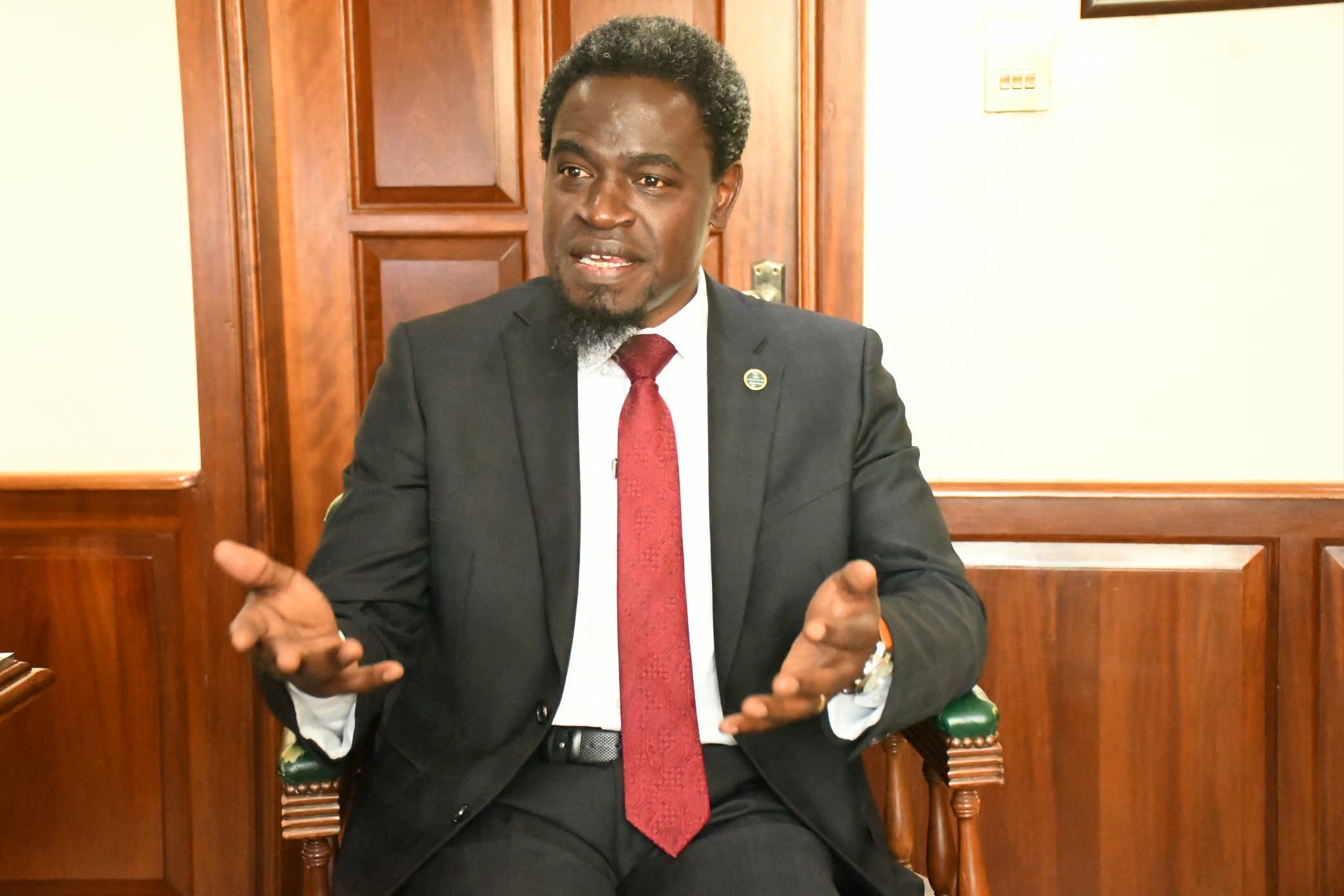
 Lawyer Nelson Havi during an interview at his office in Westlands, Nairobi
Former Law Society of Kenya President Nelson Havi has expressed interest in vying for the vacant position of Judge of the Supreme Court.
In a post on X, he framed his decision as an attempt to prompt a broader public discussion on the role and operations of the Judicial Service Commission (JSC).
Havi said his application is aimed at engaging the JSC on issues he has previously raised regarding its mandate and processes.
“I will apply for the vacant position of Judge of the Supreme Court solely for the purpose of coming to have a serious public conversation with you on the role of the JSC. You can keep this tweet as one of the materials to question me on,” Havi wrote.
His remarks came shortly after the JSC formally declared a vacancy in the Office of Judge of the Supreme Court, inviting qualified legal professionals to apply.
The Judiciary is seeking to fill one post on the seven-member bench following the death of Justice Ibrahim Mohamed on December 17, 2025.
Havi’s announcement comes against the backdrop of his previous public and legal engagements involving the JSC and members of the apex court.
The outspoken senior counsel has been at the centre of multiple legal battles touching on the disciplinary mandate of the JSC over Supreme Court judges, including petitions seeking the removal of all seven judges of the court.
More recently, on November 18, 2025, a three-judge bench of the High Court declined to recuse itself from hearing a case challenging the JSC’s authority to discipline Supreme Court judges.
The recusal application had been filed by Havi, who argued that Chief Justice Martha Koome, being a party to the underlying JSC petitions, ought not to have appointed the bench.
The judges declined the request and proceeded to hear the matter, which arises from petitions seeking the removal of the entire Supreme Court bench—petitions the judges themselves are contesting.
At the heart of the dispute is the scope of the JSC’s disciplinary powers and whether its current processes comply with constitutional and statutory requirements.
Discussions about disciplinary proceedings involving judges have featured prominently in recent legal matters.
In a separate matter, the High Court, in a decision delivered by Justices Roselyn Aburili, John Chigiti, and Alexander Muteti, barred the JSC from hearing any petitions seeking the removal of judges until regulations contemplated under Section 47 of the Judicial Service Act are put in place.
The court found that the absence of the regulations undermined due process in disciplinary proceedings against judges.
That decision, however, triggered a swift response from the JSC, which moved to the Court of Appeal, arguing that the ruling had effectively paralysed its constitutional mandate.
“The effect of the judgment is to curtail the exercise of a constitutional mandate by the Judicial Service Commission and make the Constitution subject to subsidiary legislation,” the JSC argued.
In response, a three-judge bench of the Court of Appeal comprising President Daniel Musinga and Justices Mumbi Ngugi and George Odunga granted interim orders suspending the High Court judgment pending the determination of the appeal.