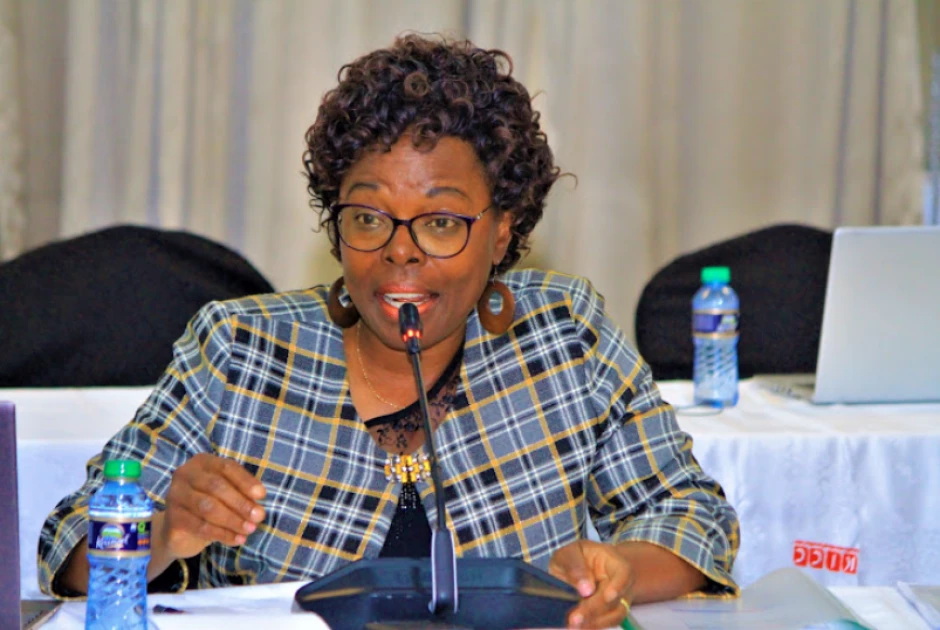
 Controller of Budget Margaret Nyakang’o/FILE
Counties are struggling to repay Sh7.85 billion in commercial bank loans as a cash crisis plagues the regional governments.
The latest expenditure report by Controller of Budget Margaret Nyakang’o shows that many counties have taken high-interest loans to cover salaries, utilities, and other pressing expenses.
Their borrowing is largely driven by delayed cash releases from the National Treasury and lack of local revenue.
“The combination of erratic Treasury disbursements and underperforming own-source revenue has forced counties to borrow to maintain basic functions,” Nyakang’o said.
These expensive bank loans come at a time when counties are also struggling with development, and most county revenues are consumed by salaries and other recurrent expenditures.
Analysts warn that counties’ reliance on bank loans to pay salaries and other recurring operational costs diverts resources away from development projects such as roads, water supply, and health facilities. They caution that unless cash disbursements improve and counties significantly boost their own-source revenue, financial vulnerability will deepen.
Some counties, particularly Nairobi, Machakos, and Kisumu, have historically relied on commercial loans to fill budget gaps. But with high-interest rates and penalties, continued borrowing is unsustainable and threatens long-term fiscal health.
The loans, outstanding as of September 30, 2025, underscore the heavy reliance of the counties, including those endowed with resources to generate their own revenue, on the national government for finances.
Currently, counties have yet to receive allocations for December 2025 and January 2026.If the funds are not released soon, some counties may struggle to pay staff salaries for January.
The delay in disbursements has often sparked tensions between county executives and the National Treasury and governors warn that persistent cash delays threaten services.
In the first quarter of the current financial year, counties collected Sh13.94 billion from their own-source revenue (OSR), representing just 15 per cent of the annual target of Sh93.89 billion.
Ideally, they should have achieved at least 25 per cent of the target by the end of the first quarter.
“Underperformance in revenue generation has led to budget shortfalls, hindering the full execution of planned activities,” Nyakang’o said.
“Six counties collected 10 per cent or less of their OSR targets, 31 counties collected between 11 and 19 per cent, while 10 counties achieved 20 per cent or more,” Nyakang’o said.
Nairobi county is among the hardest hit, struggling to repay Sh6.04 billion borrowed from Kenya Commercial Bank and Co-operative Bank of Kenya Limited.
“The county executive has a bank overdraft facility with Co-operative Bank of Kenya Limited to cover its personnel emoluments, which average Sh1.6 billion per month,” the report read.
As of September 30, 2025, the county had an overdraft balance of Sh1.54 billion and had paid Sh68.38 million in bank charges, commissions, and penalties during the review period.
The county also has a long-standing KCB loan of Sh4.5 billion, originally secured in 2010 during the term of the now-defunct Nairobi City Council.
Meanwhile, the Nairobi county assembly had an outstanding balance of Sh243.7 million with Family Bank at the beginning of the 2025-26 financial year.
During the reporting period, it borrowed an additional Sh73 million, raising the total loan to Sh316.67 million.
Nairobi is considered one of the counties with the highest OSR potential, given its vast revenue streams.
During the period, the county collected Sh2.47 billion in OSR from an annual target of Sh21.17 billion.
“County governments should enhance revenue collection mechanisms by improving revenue administration. Counties are encouraged to explore innovative strategies to broaden the revenue base and collection of revenue arrears,” Nyakang’o said.
The Machakos executive has a credit facility with KCB totalling Sh544.25 million, which was used to pay August and September salaries when Treasury disbursements were delayed.
In Kisumu, the executive relied on a KCB credit facility of Sh289.07 million to cover salaries during the period, while the county assembly did not borrow.
The county explained that the loan was necessary because cash allocations from the National Treasury were delayed, leaving limited liquidity for payroll management.
Homa Bay county entered into an advance payroll management overdraft facility with Equity Bank.
The arrangement carries an interest rate of 1.5 per cent and a 20 per cent excise duty on interest and bank charges. As of September 30, 2025, the county owed Sh471.48 million under this facility.
Homa Bay has also signed a tenant purchase agreement with the County Pension Fund for construction of its county headquarters and ancillary facilities.
The project, costing Sh820 million, requires a monthly repayment of Sh17.25million over four years.
The Vihiga county executive has a credit facility with KCB of Sh137.67 million, which was used to pay staff salaries during the review period, according to a memorandum between the county and the bank.
In Laikipia, the county assembly borrowed Sh24 million from Family Bank to pay salaries, while Nyandarua county assembly took Sh31.35 million from Equity Bank for July salaries, also due to delayed equitable share disbursements.
The Nyandarua assembly has repaid the loan.
Kakamega county did not disclose any active credit facility but has signed a renewable salary memorandum of understanding with commercial banks to manage monthly salary payments for both arms of government.
Over the years, county leaders have consistently raised concerns over delayed disbursements by the National Treasury, which they say has undermined the normal operations of devolved units and hindered service delivery.
The cash shortfall forces counties to borrow at high costs, exacerbating financial strain.
The Controller of Budget’s report underscores that while borrowing provides temporary relief, the interest costs and penalties erode county finances, leaving little room for development projects.
“With counties borrowing to pay salaries, there is limited capacity to fund infrastructural projects and other initiatives, which affects the overall delivery of services,” Nyakang’o said.
INSTANT ANALYSIS
Analysts warn that the counties’ reliance on bank loans to pay salaries and other operational costs diverts resources away from development projects such as roads, water supply, and health facilities. They caution that unless cash disbursements improve and counties significantly boost their own-source revenue, financial vulnerability will deepen. Some counties, particularly Nairobi, Machakos, and Kisumu, have historically relied on commercial loans to fill budget gaps. But with high-interest rates and penalties, continued borrowing is unsustainable and threatens long-term fiscal health.