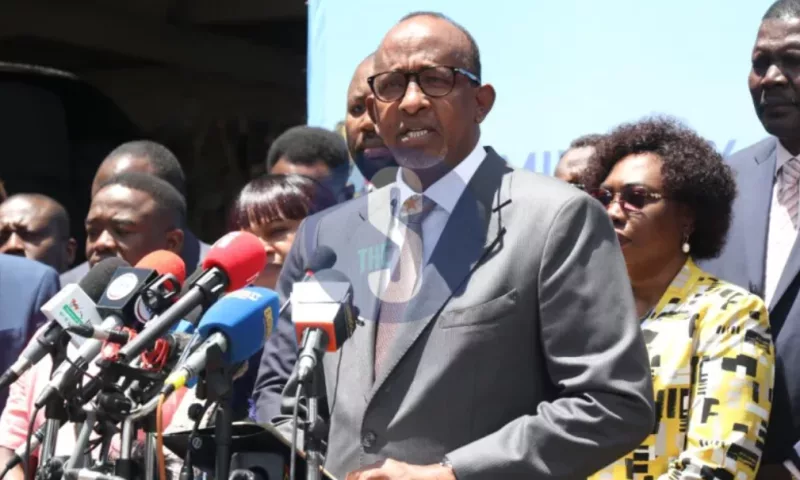
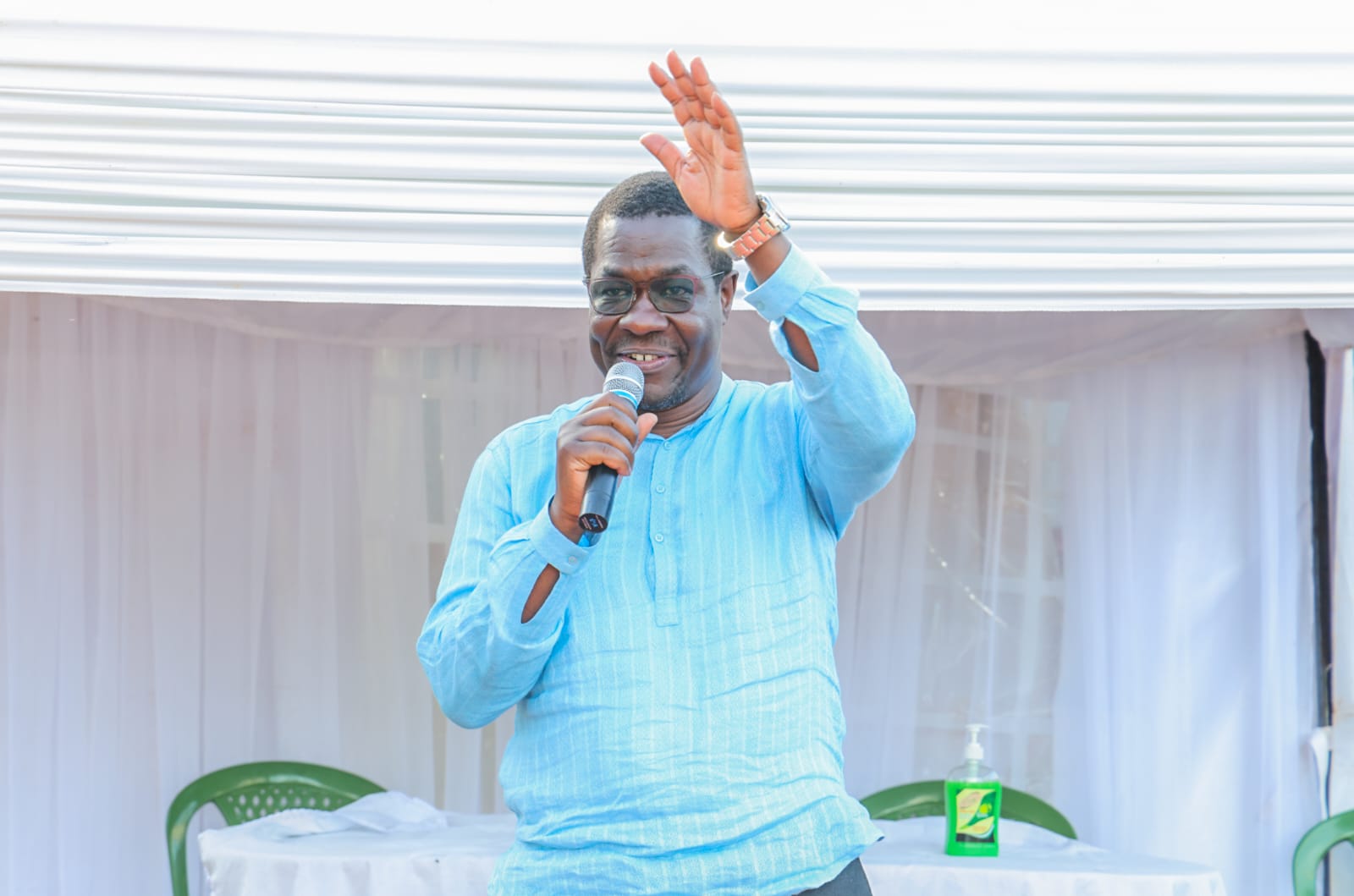
 Energy CS Opiyo Wandayi./COURTERSY
Communities living atop the South Lokichar oil basin are tipped for direct cash benefits, infrastructure projects, and a seat at the table.
A submission by Energy CS Opiyo Wandayi to a joint committee of Parliament considering the proposed project reveals that local counties and communities are projected to receive over $216 million (Sh28 billion) in direct revenue shares.
This would be alongside unprecedented infrastructure investments designed to outlast the oil wells. According to the detailed plan presented by Wandayi, the Petroleum Act (2019) mandates specific revenue sharing, a requirement that the government commits to live by.
It posits that 75 per cent of the government's "profit oil" goes to the national treasury, 20 per cent to the producing county government (Turkana and West Pokot), and 5 per cent to the local community. Over the project's life from 2026-2050, this translates to an estimated $173 million for county governments and $43 million for local communities, based on a $60/barrel oil price.
The funds, to be managed through established community trust funds, are earmarked for education, healthcare, water projects, and enterprise development.
Beyond cash, the Field Development Plan (FDP) commits to what officials term 'project enablers', that is,essential infrastructure that doubles as community legacy projects.
These include a major water pipeline from Turkwel to Lokichar, with a dedicated irrigation component for community farming along its route. Also planned are significant road upgrades and the replacement of critical bridges like Kainuk, improving connectivity for trade and travel. The residents are also promised access to reliable grid electricity brought in for the oil facilities, with potential for community offtake.
The Early Oil Pilot Scheme (EOPS) is cited as a proof of concept for local capacity. It employed a fleet of 100 trucks, largely locally owned and operated, and provided training in logistics, storage, and safety.
Local leaders have argued that the pilot proved that Kenyans can handle the technical jobs.
They have pushed for the full development to lock in these opportunities through a robust Local Content Plan. The CS also highlighted historical grievances that have bedevilled the sector.
He said the government acknowledges the need for a "structured framework" for land compensation and livelihood restoration for Project-Affected Persons (PAPs).
The success of the project, many observers note, will hinge on transparent and timely resolution of these issues. To realize the gains, the government is seeking parliamentary ratification for a revised financial framework deemed crucial to attract investment.
In the detailed response to Parliament, Wandayi outlined the strategic importance of the project and defended significant fiscal concessions. He cited a harmonized 85 per cent cost recovery limit for the involved oil blocks.
The project, operated by Tullow Kenya BV and its partners, targets ten oil discoveries with an estimated 2.85 billion barrels of oil in place. However, the fields are described as "marginal," making standalone development economically unviable.
A joint Field Development Plan (FDP) for Blocks T6 and T7 has been approved by the regulator and Cabinet Secretary, and now requires parliamentary ratification.
The central pillar of the government's submission is the justification for increasing the cost recovery limit, that is, the portion of revenue used by the contractor to recoup investment before profit-sharing. The government wants it set at 85 per cent for both blocks, up from the original 55 per cent and 65 per cent.
Wandayi argued that the hike is essential for "bankability" and attracting debt financing in a challenging global investment climate for hydrocarbons.
He stated that maintaining lower limits would lead to longer repayment periods and higher interest rates, ultimately reducing government take. The submission notes that similar limits exist in other African oil-producing nations.
The Cabinet Secretary also confirmed the government's optional 20 per cent participating interest in the development phase. If exercised, this would require state funding for 20 per cent of the estimated $5.722 billion in combined capital and operational expenditures across Phases I and II.
Detailed revenue projections, based on a conservative oil price of $60 per barrel, forecast the national government receiving approximately $648 million (Sh84.3 billion) from its share of "profit oil" over the project's life from 2026 to 2050. County governments and local communities in Turkana and West Pokot are projected to receive $173 million and $43 million, respectively.
The figures represent direct shares under the Petroleum Act and exclude taxes and levies. The CS also highlighted extensive environmental and social safeguards considered, including approved impact assessments, a zero-flaring policy, and plans for waste management and biodiversity conservation.
Furthermore, the Ministry provided an update on the now-concluded Early Oil Pilot Scheme (EOPS), which exported over 414,000 barrels of crude via truck to Mombasa between 2019 and 2022.
While the pilot generated $28.3 million in revenue, it incurred $62.7 million in costs, with the deficit being classified as recoverable exploration expenditure.
The Ministry reported that the pilot provided invaluable lessons on logistics, infrastructure, and market pricing that have informed the current commercial plan. In his conclusion, Wandayi framed the South Lokichar development as a strategic milestone that will boost investor confidence in Kenya's entire upstream petroleum sector.
He appealed to Parliament for support to advance the project, emphasizing the pursuit of "shared benefit for our people."
The joint committees of the National Assembly and Senate will now deliberate on the proposed Field Development Plan and the accompanying Production Sharing Contracts before a ratification vote.