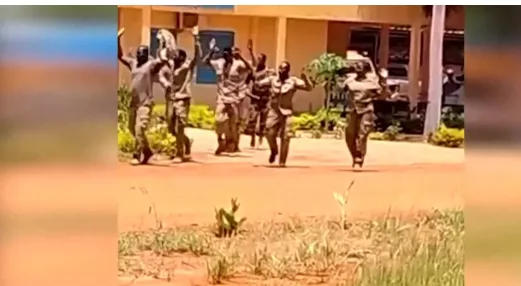
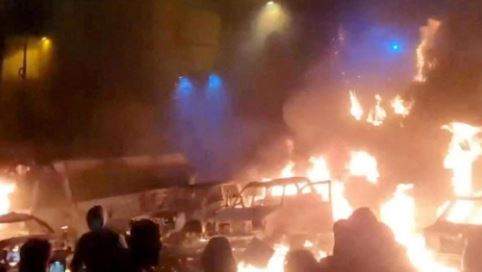
 Protesters and security forces clash over the weekend./SCREENGRAB
Protests that began in Tehran over the collapse of the Iranian currency on 28 December, before spreading to towns and cities nationwide, have led to more than 500 deaths, says a US-based observer group.
The rule of Iran's Supreme Leader, Ayatollah Ali Khamenei, is at stake - with demonstrators angry at crippling price rises, alongside social and political restrictions enforced by the government.
Among the many hundreds of videos of protests BBC Verify and BBC Persian have reviewed, one piece of footage shows a protest happening at a funeral in a Tehran mortuary.
The video, which first was first posted on Telegram at 00:45 local time (20:45 GMT) on Sunday, shows mourners at the Behesht-Zahra Mortuary, 20km (12 miles) south of the centre of Tehran, crying for “bravery” while they carry a casket.
Much of the video was blurred to anonymise people at the funeral, but we have been able to verify the mortuary where the ceremony took place by matching images of it - in particular its atrium - to those on Google Photos.
By reverse searching frames from the video we found no earlier copies cached online before Sunday.
Usually this ceremony would include calls of “There is no God but Allah”, but in this video we can hear chants of “death to Khamenei” - the Supreme Leader of Iran.
Now US President Donald Trump has repeated his threats to intervene, saying on Sunday that Iranian officials had called him "to negotiate" - but added "we may have to act before a meeting".
He has not elaborated on what military options he is considering. He will reportedly be briefed on Tuesday on specific options.
Iranian leaders have described demonstrators as a "bunch of vandals", and called on their supporters to take part in pro-government marches on Monday. Iran has also warned that both Israeli and US military and shipping centres in the region would become legitimate targets if the US attacked.
An internet blackout means reporting from Iran is difficult - but our team in London and the region, including the BBC's Persian service, will bring you the latest lines on this page.
In Iran protesting has a cost—and it is measured by the rising number of the dead.
Videos have emerged of a makeshift open air morgue just outside Tehran where people came searching, in grief, for their loved ones.
The BBC was able to count at least 180 white shrouds and dark body bags as refrigerated trucks kept pulling up with more.
The government has also been burying its own—the coffins of security forces and civilians were carried by crowds in what state TV says were at least 10 provinces.
Iran blames the US and Israel for their deaths. The government has called on Iranians to come out on the streets today to show their support.
It will also be watching whether its crackdown has given some protesters second thoughts about continuing their action.
US military looking at 'very strong options' in Iran - Trump
The US president spoke to reporters on board Air Force One, saying a meeting was being set up - but added he may have to act before any meeting.
"They're starting to, it looks like," Trump said, when asked if Iran had crossed his "red line" of protesters being killed.
"We're looking at it very seriously. The military is looking at it, and we're looking at some very strong options. We'll make a determination."
Last week, Trump warned Iran that he would intervene if demonstrators were killed.
"I tell the Iranian leaders: you better not start shooting, because we’ll start shooting, too," he said at a meeting with oil executives in the White House on Friday.
Iran's government has been "unable to provide the basics of life", says David Satterfield, a former US ambassador in the Middle East, and a former Middle East Envoy to President Joe Biden.
Those basics are "water, fuel, electricity, and food at rates that is affordable - not just by lower economic classes, but by the upper and upper-middle classes as well," he tells BBC Radio 4's Today programme.
"The regime doesn't have the resources to address the sources of the protests.
"If it is about cultural events as in [the protests in] 2022 the regime can - and did - relieve the sanctions on women, the dress codes ease, the covering of hair was no longer enforced by religious police.
"But if what you are after here is a living wage, a non-depreciating currency, fuel, electricity, water - that is not something the regime can easily pivot to."
Iranian state TV claims counter-protesters condemn 'terrorist' actions
Iran's state media network, Islamic Republic of Iran Broadcasting, is broadcasting what it says are protests against the actions of the anti-government demonstrations.
According to IRIB, the pro-government demonstrations are in several locations, including in Ilam, where anti-government protests recently occurred, and Zanjan.
The footage shows the streets filled with crowds, with one translated post on the network's Telegram channel describing the demonstrators turning out in solidary against recent "terrorist actions".
We reported earlier today that BBC Persian has seen text messages inviting people to attend pro-establishment rallies held today across country.
BBC Monitoring last week reported the state broadcaster on Friday intensified its rhetoric against anti-government protesters, whom it earlier referred to as "rioters".
As a reminder, our teams in London and across the region, including BBC Persian, are working to obtain and verify information from inside Iran, amid an ongoing internet blackout. Earlier we counted 180 white shrouds at a morgue after protests in Tehran.
Why are the protests erupting now?
These protests began just over two weeks ago with shopkeepers - often called the backbone of support for the Islamic Republic - in Tehran angry about the collapsing currency.
The demonstrations then spread to students and street protests in several cities across the country.
Based on videos, these are the biggest protests seen since 2022, and the anger isn’t just about economic issues. Protesters have been chanting slogans against the entire clerical leadership and the supreme leader.
Iran has faced a mix of recent problems - economic crisis, political repression, social unrest, and international tension over its nuclear and ballistic missile programme.
The leadership has been cracking down on protests for years. Security forces are often ready to act, and authorities can quickly close banks, schools and public institutions, while tightly controlling the state media narrative.
Officials increasingly blame those considered foreign enemies - especially the US and Israel - as they try to contain the unrest.
With the internet outage, most information coming out of Iran right now is from state media and officials.