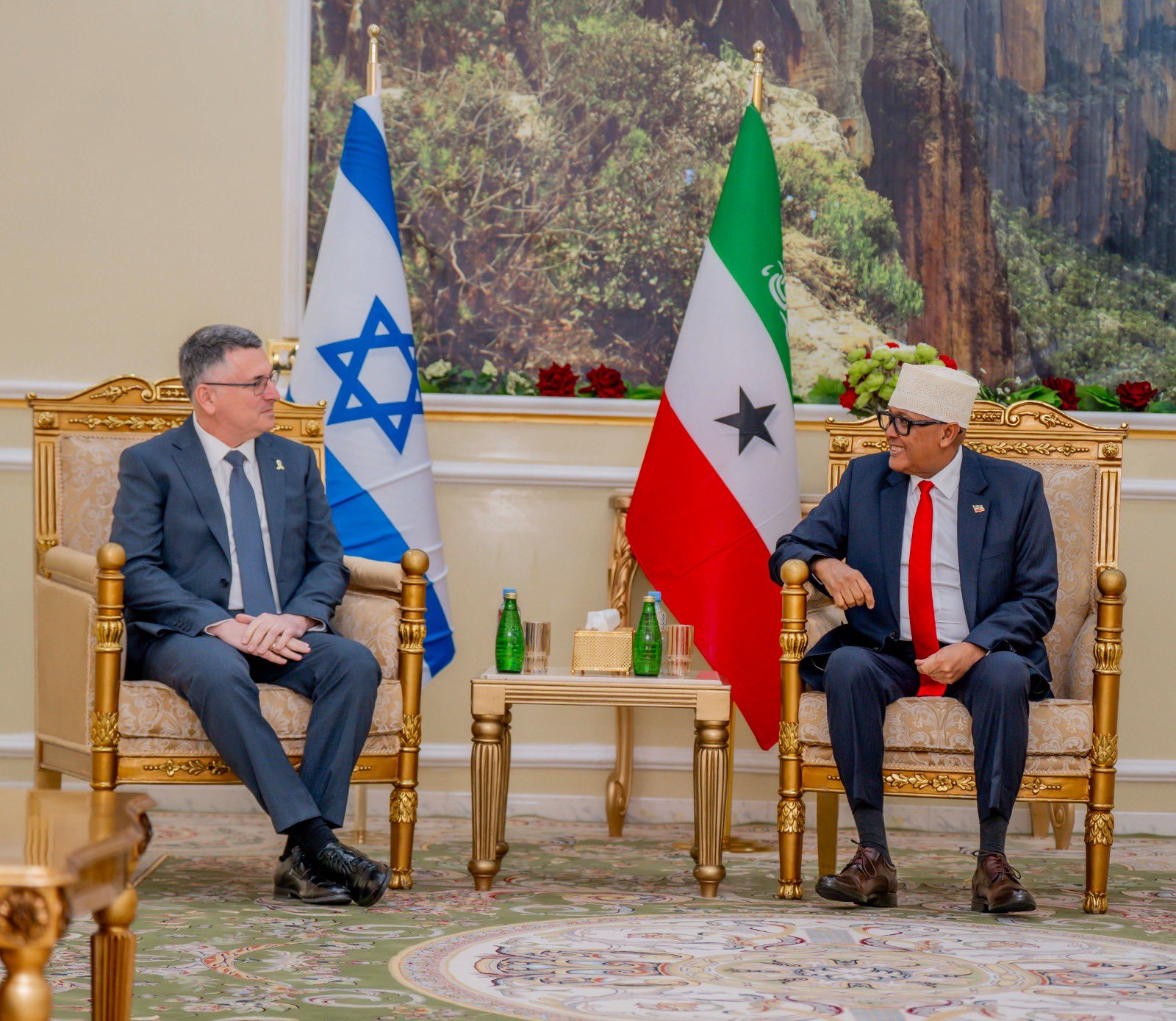
During the HornTalk Forum hosted by the Africa Policy Institute, experts warned that the region, which is already strained by conflict and political uncertainty in Sudan, South Sudan, Somalia and Ethiopia, can ill afford a move that reopens unresolved questions of borders and sovereignty.
On December 26, Israel became the first United Nation's member state to recognise the self-declared Republic of Somaliland as an independent and sovereign state.
The move immediately drew condemnation and opposition from various states and multilateral organisations. These include the AU, Igad, the Arab League and the EAC.
While Somaliland has operated as a de facto autonomous entity since declaring independence from Somalia in 1991, it has never been formally recognised by the AU or the UN.
Israel’s decision to extend recognition outside established multilateral frameworks is thus being viewed as a politically charged intervention in one of Africa’s most volatile regions.
Analysts argue the Horn is one of the most delicate geopolitical theatres in the world today, and any external action that alters the status quo on territorial integrity risks triggering consequences far beyond Somaliland.
At the heart of the controversy is the AU’s long-standing principle of respecting colonial-era borders, adopted to prevent endless territorial disputes and secessionist conflicts.
Recognition of Somaliland by a non-African state, critics say, undermines that consensus and weakens the AU’s authority in managing conflicts on the continent.
In May 2005, the AU sent a fact-finding mission to Somaliland led by Deputy chairperson Patrick Mazimhaka, which concluded Somaliland's quest for recognition as "historically unique and self-justified".
The mission recommended a special AU approach, including appointing a special envoy, but the AU has largely remained inactive on the issue since.
Responding to this, former AU Commission deputy chairperson Amb Erastus Mwencha says despite the recommendation, no green light has ever been given to the quest for independence.
“It is important to recall the context. Since 1991, following the collapse of the Siad Barre regime and the breakdown of the Somali state, Somaliland took advantage of that vacuum and established its own governing structures. It has since operated as a de facto authority,” he said.
“That said, within the AU, no formal decision has ever been taken to recognise Somaliland or to authorise it to begin a legal process of secession.
“The AU is bound by its own rules, which are aligned with the UN Charter. Under international law, self-determination must follow a clear procedural and legal framework consistent with national and international law. Until that happens, the African Union is constrained by those provisions.”
There is a fear that the recognition by Israel opens a Pandora’s box that if Somaliland is recognised outside agreed African processes, other regions with separatist ambitions will cite it as a precedent.
The concern is that Somaliland’s case could embolden groups seeking international recognition, reigniting dormant conflicts and complicating peace efforts.
Prof Peter Kagwanja says in some respects, Somaliland adopted a somewhat self-centred position in declaring independence from Somalia.
“The entire Somali nation was suffering under dictatorship, not just Somaliland,” he noted.
“While it is often argued that Somaliland was more brutally treated by the regime than other regions, the reality is that all Somalis endured repression.”
He said the 2005 AU fact-finding mission took place against the backdrop of a Somalia engulfed in conflict, while Somaliland projected itself as an island of peace.
The recognition also comes at a time when Somaliland’s own internal cohesion is under strain. Recent years have seen violent clashes in contested areas, particularly in the eastern regions, with some communities rejecting Hargeisa’s authority and aligning themselves with Somalia’s federal government.
External recognition could exacerbate these internal divisions, hardening positions and fuelling new rounds of conflict. Armed groups, including al Shabaab, have already cited foreign involvement as justification for renewed violence.
Israel’s involvement is also being viewed through a wider geopolitical lens.
The Horn of Africa sits astride critical Red Sea shipping lanes, making it strategically significant amid rising global tensions and conflicts in the Middle East.
The move is also seen as solely based on Tel Aviv’s own selfish national interests and strategic calculations, such as security, intelligence and access to the Red Sea corridor rather than support for self-determination of the Somalilanders.
That perception has heightened unease among regional states wary of external powers using local disputes to advance their own interests.
The analysts also noted that external interventions in the Horn of Africa, from the Cold War era to more recent proxy engagements, have often left neighbouring countries dealing with prolonged instability.
The recognition could also draw in other external actors, further internationalising the Somaliland question.
Countries with competing interests in the Red Sea and Horn of Africa may feel compelled to respond, potentially turning a local political dispute into a wider regional contest.
For Somaliland, the recognition may offer symbolic validation after decades of diplomatic isolation. But critics caution that symbolism comes at a high price if it destabilises relations with neighbours, undermines African solidarity and provokes internal and regional conflict.