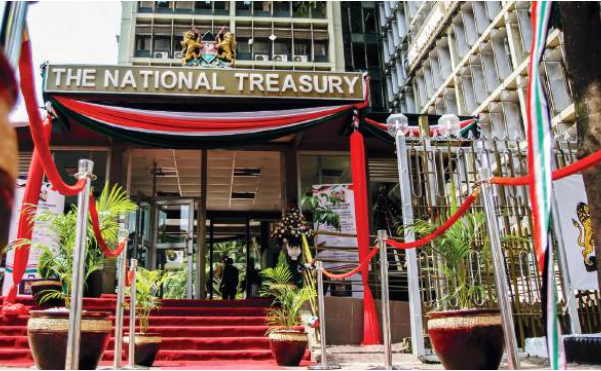
The National Treasury has proposed an additional Sh13 billion in equitable share to county governments in the next financial year.
In the draft Budget Policy Statement for the 2026/27 financial year, Treasury CS John Mbadi has proposed allocating counties Sh420 billion, up from the current Sh407 billion.
According to the Treasury, the allocation represents 21.87 per cent of the most recent audited and approved national revenues, in line with Articles 203 (2) and (3) of the constitution.
“The proposed equitable share for the financial year 2026/27 of Sh420 billion is equivalent to 21.87 per cent of the most recent audited and approved actual revenues raised nationally,” Mbadi said.
However, despite the enhanced allocation, the move is likely to set the stage for another fierce standoff between the national government, senators and governors.
Previous allocations have failed to impress senators and governors, who have been pushing for an allocation of more than Sh450 billion.
Their demands are expected to reignite tensions that have characterised revenue-sharing negotiations in recent years.
In the last financial year, senators and governors teamed up to reject a Sh405 billion allocation proposed by the Treasury and approved by the National Assembly.
Senators demanded Sh465 billion, while governors pushed for Sh536 billion, arguing that counties were struggling to meet devolved responsibilities amid rising costs.
The Commission on Revenue Allocation, which is constitutionally mandated to recommend how revenue is shared between the two levels of government, proposed Sh417 billion for counties.
However, after intense mediation between the Senate and the National Assembly, counties eventually settled for Sh407 billion.
The latest proposal for the 2026-27 financial year is likely to trigger a similar showdown, with the Senate expected to push back against what it views as continued underfunding of devolved units.
The Treasury defended the proposed allocation, citing revenue shortfalls and mounting expenditure pressures during the implementation of the 2025/26 budget. Mbadi said ordinary revenue had underperformed by Sh90 billion as of the end of September 2025, raising concerns about the sustainability of higher allocations.
“If this trend continues, it is bound to affect the projected ordinary revenue for FY 2026/27,” Mbadi said in the draft BPS.
He further noted that, historically, the national government has absorbed revenue shortfalls on its own, with the exception of the 2024-25 financial year.
The Treasury also pointed to unfavourable macroeconomic indicators, including declining revenue performance relative to economic growth.
According to the BPS, ordinary revenue as a share of gross domestic product has declined from a high of 18.1 per cent in the 2013-14 financial year to 14.5 per cent in the 2025-26 financial year, signalling that revenue collection is not keeping pace with economic growth.
Treasury has also prioritised debt servicing, proposing a higher allocation to the national government to meet public debt obligations.
The BPS notes that the 2026/27 budget framework has factored in annual debt redemption costs as well as interest payments on both domestic and external loans.
However, senators argue that counties are being unfairly burdened with non-discretionary expenditure imposed by national government policies.
These mandatory costs are estimated at Sh34 billion and include Sh4.1 billion for the housing levy, Sh6 billion for National Social Security Fund contributions and Sh11.8 billion for County Aggregated Industrial Parks.
Other obligations include Sh3.23 billion for community health promoter payments, Sh6.3 billion for annual Integrated Payroll and Personnel Database wage increments and Sh3.5 billion for doctors’ salary increases under the 2017 collective bargaining agreement and return-to-work agreements.
Governors have also criticised the proposed allocation, arguing it fails to reflect inflation, the expanding scope of devolved functions and rising demand for county services.
Kakamega Governor Fernandes Barasa, who chairs the Council of Governors’ Finance committee, accused the national government of deliberately weakening devolution by retaining functions and resources meant for counties.
“There should be a transfer of state-owned parastatals performing devolved functions to counties, together with the attendant resources,” Barasa said.
As the budget process moves to Parliament, the proposed Sh420 billion allocation is expected to ignite renewed political and institutional battles over equitable resource sharing and the future of devolution.