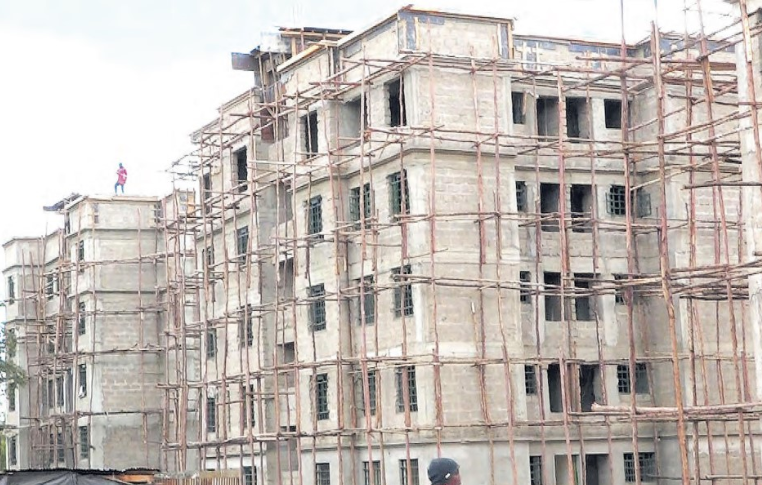
 Affordable Housing/FILE
Kenya's economy demonstrated significant resilience last year to grow by 4.9 per cent in the third quarter, supported mainly by a rebound of the construction sector, mining and growth in manufacturing and transport sectors.
This was an improvement compared to the 4.2 per cent growth recorded in the third quarter of 2024, as the economy continued on a post-pandemic growth trajectory despite both domestic and global shocks.
The country’s economic growth faces several hurdles among them high national debt, fiscal deficits, rising cost of living, unemployment (especially youth), climate vulnerability and weak revenue collection, alongside structural issues like inequality and slow industrialisation.
Latest Quarterly Gross Domestic Product Report by the Kenya National Bureau of Statistics (KNBS) however points to a strong macroeconomic environment, pegged on low interest rates in the market, stable inflation and string national productivity mainly in key sectors of the economy.
Agriculture, forestry and fishing sector expanded by 3.2 per cent while the construction sector rebounded from a 2.6 per cent contraction in the third quarter of 2024, expanding by 6.7 per cent in the quarter under review.
The mining and quarrying sector also recovered from a 12.2 per cent contraction in the third quarter of 2024, expanding by 16.6 per cent in the third quarter of 2025.
Other sectors that recorded notable growths include accommodation and food serving (17.7%), real estate (5.7%), financial and insurance (5.4%), transport and storage (5.2%), public administration (5.1%), wholesale and retail trade (4.8%) and information and communication (4.5%).
“During the third quarter of 2025, key macroeconomic indicators showed mixed performance. The average inflation for the quarter under review rose from 4.08 per cent in the third quarter of 2024 to 4.42 per cent in the third quarter of 2025, mainly driven by rise in prices of items in the food and non-alcoholic beverages category,” KNBS says in its report.
Inflation however remained below the mid-point of the target range of 2.5 per cent to 7.5 per cent.
Growth in the agriculture sector, which is the country’s economic backbone, in addition to forestry and fishing was however slow compared to last year’s four per cent.
This came with a decline in the exports of coffee, vegetables and fruits. Exports of coffee and vegetables declined from 17,732.8 metric tonnes and 20,480.9 metric tonnes in the third quarter of 2024 to stand at 8,312.7 metric tonnes and 16,617.0 metric tonnes, respectively, in the third quarter of 2025.
“Similarly, fruit exports declined by five per cent from 61,509.5 metric tonnes in the third quarter of 2024 to 58,414.5 metric tonnes in the quarter under review. Additionally, sugarcane and tea production declined during the period under review,” the bureau, led director general Macdonald Obudho, said.
Cane deliveries and tea production also declined during the period. On the positive side, there was an increase in milk production and exports of cut flowers.
Financial and insurance activities sector also recorded a slower growth of 5.4 per cent in the quarter under review, compared to a growth of 7.3 per cent recorded in the corresponding quarter of 2024.
This was despite a lower Central Bank Rate which was revised downwards from 12.75 per cent in September 2024 to 9.50 per cent in September 2025 to stimulate lending to private sector and support economic activities.
This saw the cost of credit easing with average interest rates on loans and other advances by commercial banks declining from 16.91 per cent in September 2024, to 15.07 per cent in September 2025.
Accommodation and food service activities during the quarter under review also grew at a slower pace of 17.7 per cent compared to a growth of 22.9 per cent in the third quarter of 2024, despite Kenya co-hosting the African Nations Championship (CHAN) in the quarter under review, which brought in visitors.
International visitor arrivals via the two major airports, the Jomo Kenyatta International Airport (JKIA) and the Mombasa International Airport (MIA) increased by 9.9 per cent to stand at 578,234 passengers in the third quarter of 2025, compared to 526,170 passengers in a similar quarter of 2024.
The information and communication sector also experienced a slowed growth in the quarter under review, with a growth of 4.5 per cent compared to a 6.9 per cent growth that was recorded in the same quarter of 2024.
Economic growth was mainly buoyed by the construction sector activities which recorded the biggest expansion of 6.7 per cent compared to a contraction of 2.6 per cent in the third quarter of 2024.
Indicators in the construction sector pointed to increased activities in the sector. For instance, cement consumption increased by 16.2 per cent to stand at 2,664.1 thousand metric tonnes during the third quarter of 2025.
In addition, iron and steel imports increased to 336,262 metric tonnes compared to 220,284.6 metric tonnes imported in a similar quarter of 2024.
The other growth was recorded in manufacturing estimated to have expanded by 2.5 per compared to a growth of 2.3 per cent in the corresponding quarter of 2024.
“The performance in the period under review showed mixed results, with growth primarily driven by the nonfood sub-sector, while the food sub-sector recorded a decline. In the manufacture of non-food products, growth was supported by the production of cement, galvanized sheets and assembly of motor vehicles,” KNBS said.