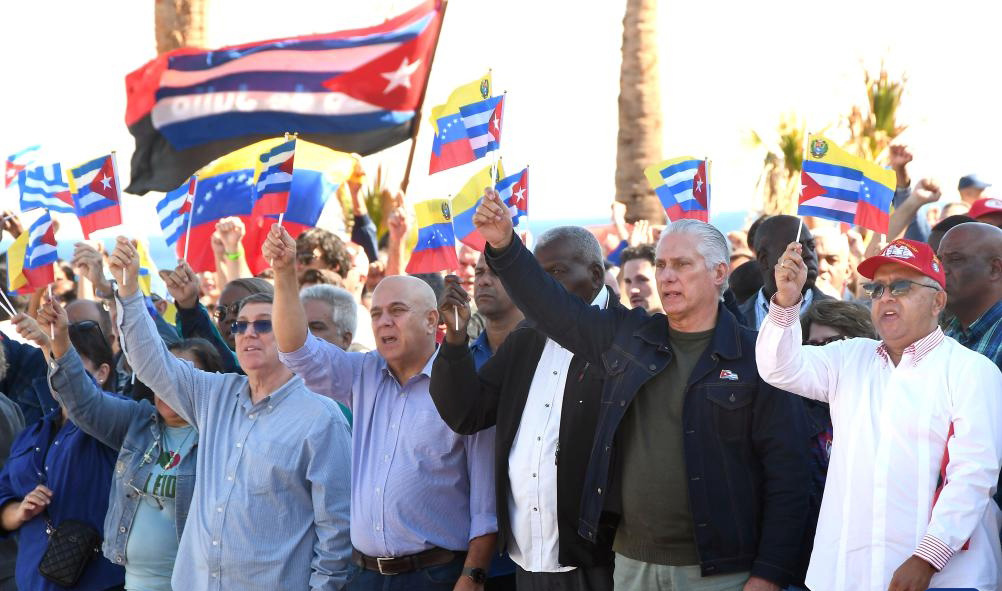
People protest against the latest US strikes on Venezuela and its capture of President Nicolas Maduro in Quito, Ecuador, on Saturday /XINHUA
The deposed Venezuelan president, Nicolas Maduro, was expected to appear in Manhattan federal court on Monday afternoon on drugs and weapons charges after his extraordinary capture by US special forces at the weekend.
Maduro and his wife, Cilia Flores, were seized in a shocking pre-dawn raid at a compound on Saturday during an assault on Caracas. At least 40 people, including civilians and Venezuelan military members, reportedly died in the attack.
This event, however, is not just a military triumph but rather a significant security blunder stemming from profound betrayal—specifically by Maduro's own bodyguards.
The situation raises the question of how American special forces were able to infiltrate one of the most tightly controlled security systems in the Western Hemisphere.
Multiple news agencies, aware of the operation revealed that high-ranking members of Maduro's personal security detail—men sworn to protect him at all costs—were the very ones who facilitated his capture. Instead of remaining loyal, these elite bodyguards, trained to put their lives on the line for the President, ultimately chose to accept American cash.
The series of events leading up to the capture is strikingly orchestrated. Around 1.45 am, Maduro was secured in a safe house in Caracas, one of several locations kept secret due to persistent assassination threats. Just 15 minutes later, explosions erupted across the city—distraction tactics designed to mislead as the real operation unfolded.
While Venezuelan military forces scrambled to respond to these diversionary attacks at Fort Tuna and La Carlota airport, a specialised team of Delta Force operators stealthily landed near Maduro's location.
In an unexpected turn, the American commandos walked into the safe house without encountering resistance. Key security protocols had been compromised: perimeter guards stood down, and only two bodyguards were on duty, surrendering instantly. The entire extraction was completed in less than 12 minutes.
By the time Venezuelan Defence Minister Vladimir Padrino Lopez realised that Maduro was missing, American helicopters were already heading into international airspace.
How did the US manage such a bold operation? A year-long intelligence gathering effort by the CIA and Defence Intelligence Agency had uncovered significant weaknesses in Maduro's security framework.
Despite their elite status, Maduro's bodyguards faced the same dire economic realities as ordinary Venezuelans, unable to afford basic necessities while witnessing the ostentatious lifestyles of Maduro and his inner circle.
American intelligence identified three specific bodyguards who appeared susceptible to recruitment. Each harboured personal grievances against the regime.
Over time, the CIA approached these guards through intermediaries, initially discussing vague concerns about Venezuela's future before presenting concrete proposals—offers of transformative financial rewards, opportunities for escape, and new beginnings for their families.
In a strategic move, American operatives extracted the families of these bodyguards before the operation commenced, ensuring their safety and providing reassurances. With loved ones secured, the bodyguards agreed to cooperate, resulting in a network of at least eight compromised members of Maduro's security detail.
When the operation was executed, it unfolded with military precision. The bribed security personnel abandoned their posts, allowing the Delta Force team to reach Maduro's quarters without hindrance. Upon waking, the President reportedly confronted American special forces—only to find the very bodyguards he trusted standing aside.
Conflicting reports describe whether Maduro realised his betrayal at that moment or mistakenly thought it was merely a drill. In either case, the dramatic extraction unfolded swiftly, allowing Maduro and his wife to be transported aboard American aircraft before Venezuelan military leaders could react.