It is a dull first Saturday evening of the year in Simatwet village, Trans Nzoia county.
The razzmatazz of Christmas and New Year festivities has died down. All one hears now is the usual crowing of roosters that survived the feasting and the monotonous braying of tired donkeys.
Simon Machayo, 48, a father of four, has just returned from a Moi's Bridge town, where he had gone to buy stationery to prepare his children for school.
"I squeezed my budget to balance between festivities and school needs for my children. I have bought a few things. The headache is with the son transitioning to senior school. Things are not clear," he said, ushering this writer into his semi-permanent house.
"2025 was tough. I hope this new one will be easy
on us. It will only be Singapore if the general cost of living drops, jobs are created,
and actual money circulates in the economy."
Machayo's wife, Selina, prays that there will be enough food, lower taxes, more job opportunities, and peace.
"Much easier life for the common Kenyan is my dream. Someone tell President William Ruto that this is my dream Singapore. I have a feeling it will be a better year,” she said.
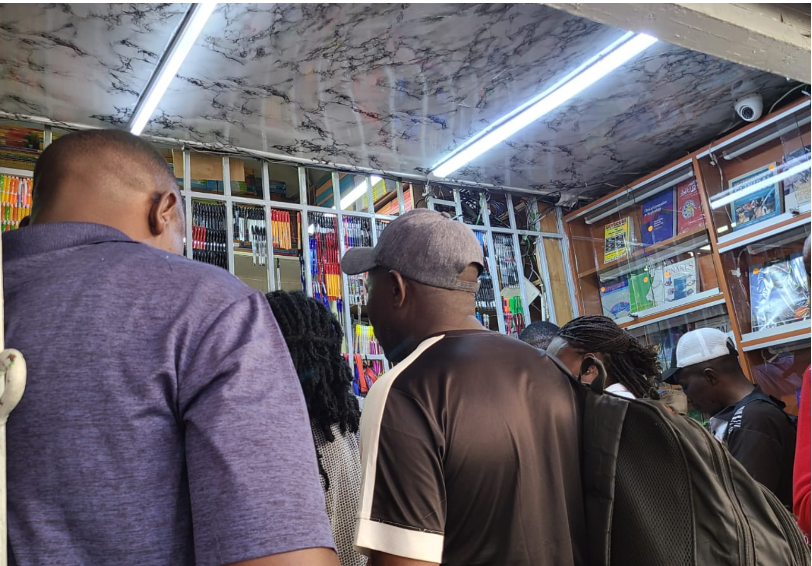
Parents across the country are facing mounting back-to-school costs even as the government moves to assure that school fees will not increase, a spot check across bookshops in Nairobi revealed.
Education Cabinet Secretary Julius Ogamba has maintained that fees will remain unchanged. Even so, many parents say the cost of textbooks under the Competency-Based Curriculum continues to strain household budgets.
At a bookshop along River Road, Nairobi, Catherine Wanjiru said she spent Sh7,300 on books alone for her Grade 6 child.
“This CBC system is expensive. I have bought all these books and those coming after her will never use them,” Wanjiru said, expressing frustration over the annual purchase of new learning materials.
Her frustrations cut across different households in the country, where parents are also struggling to meet other expenses including uniforms, transport costs, remedial and other expenses.
CS Ogamba has reiterated that schools should adhere to the 2019 fees circular, insisting no additional charges have been approved.
He said the government will continue supporting Free Day Senior School learners with Sh22,244 per learner per year, dismissing claims of extra levies.
According to the Ministry of Education, some boarding schools charge up to Sh53,554, while others charge up to Sh40,535. Special needs schools charge Sh12,790.
Meanwhile, despite the placement of learners to Grade 10 concluding on December 19, when results were released, major concerns remain over students being placed in day schools in far-flung regions.
“My daughter has been placed in a day school in Mandera, which is almost 1,400 kilometres away. This is so frustrating. I am trying to look for other local options,” Sabina Chana, a parent in Isebania, told the Star.
Figures by the ministry show that a total of 355,457 applications for review were received, with 211,636 approved.
Many applications were declined due to lack of subject combinations or limited school capacity, with top schools such as Alliance High School, Kenya High School and Mang’u High School each receiving up to 20,000 applications against an average capacity of 500 slots.
Currently, 88 per cent of learners have been placed, with 51 per cent in STEM, 38 per cent in Social Sciences and 11 per cent in Arts and Sports Science.
The placement challenges have seen the Education Ministry that had initially excluded head teachers from the process, rope them in in a review window running from January 6 (Tuesday) to 9 (Friday) 2026, to fix the problem.
Meanwhile, the government has released Sh44.25 billion as term one capitation for public basic education institutions, covering primary, junior and senior schools.
The National Parents Association has called on the government to try and fund all students with capitation while parents meet their part of fees including those from private schools.
It also wants the government to send “a stern circular” to all senior school heads not to send learners home for “any single given reason.”
“Heads of schools should support and retain all senior school students in class whether with all required materials or not including school fees balances that parents may have. We all understand the economic situation and the prevailing financial crisis parents are facing,” the association’s chairman Silas Obuhatsa said.
The NPA has also called on parents to follow the government's placement instructions for senior school and support the process to make it a success.
“Though the process has teething issues, soon all these shall be a thing of the past. The government can't manage to place all Grade 10 learners in the traditional national schools because of lack of space. Let parents send their children to the provided schools to save time,” he said.
“Teachers in all schools are the same and therefore parents should not go by school names. It is learners who perform not buildings or school names. We want all senior school students to report in good time to make use of the huge funding the government has invested in schools.”
The back-to-school expenses come amid mixed feelings on the year 2026, with the high cost of living still a concern for many, despite low inflation numbers.
While the micro and macroeconomic indicators look good, with inflation remaining at 4.5 per cent in December, as per the Kenya National Bureau of Statistics, the cost of basic foods edged upwards.
"During the review period, prices of various commodities went up except housing, water, and energy categories, which dropped marginally, while others such as education, insurance, and financial services, remained the same," the state statistician said in the latest monthly update.
The December measure of the cost of living was however higher compared to the three per cent recorded in a similar period the previous year.
According to the Consumer Federation of Kenya, disposable income for many families has shrunk, with many barely surviving.
“Headline inflation figures may suggest stability, for political optics, but they mask a deeper reality:Real incomes have continued to significantly decline. Wages have failed to keep pace with the rising cost of essentials— food, transport, electricity, rent and taxation. The result is that households have little or nothing left after meeting basic needs. Yet the expenditure side keeps climbing North,” Cofek secretary general Stephen Mutoro told the Star.
Consumer spending is visibly subdued, not because Kenyans have suddenly become frugal, but because purchasing power has been eroded.
“Cofek’s position is that economic success must be measured not only by macroeconomic indicators, but by household welfare,” Mutoro said.
The government is however positive over the new year mainly on the positive macroeconomics and food security.
Although the weatherman has predicted that dryness, which is expected until February, will push another 1.5 million people into abject poverty , the country had a bumper harvest in 2025.
According to the Ministry of Agriculture, the country is projected to harvest a record 70 million bags of maize, up from 67 million in 2024, and more than double the 34.3 million bags recorded in 2022.
Kenya has also imported a significant amount of rice in the past few months to bridge the annual demand that stands at about 1.3 million metric bags, against a domestic production of just 20 per cent.
Several local and international agencies have also projected sound economic growth in 2026.
For instance, the Focus Economics Survey suggests that GDP growth could reach five per cent in 2026, slightly above the estimated 4.9 per cent for 2025 and outpacing the wider Sub-Saharan African average of 4.1 per cent.
Although the increase is modest, the survey says it represents a significant change that could make life much more affordable.
Experts have noted that monetary policy is becoming more accommodative, investment appetite is returning and household spending is gradually strengthening.
The World Bank has also projected Kenya's economy to expand by almost a similar rate, largely pushed up by sound monetary policies, improved agricultural output and government expenditure.
The global lender says that eased lending rates will boost businesses and trigger job creation.
The Central Bank of Kenya has slashed the anchor rate eight consecutive times, hitting a flat nine per cent in December.
The average lending rate by local banks has dropped from a high of 17 per cent in 2023 to current 13.5 per cent. Lending to the private sector has also improved significantly in the past 14 months.
The bank expects the shilling to continue holding steady against major global currencies like the US dollar, a move likely to support importation.
The local currency has held stable against the dollar back in the past 18 months, closing the market at 129.3 on Friday from a high of 160 in 2023.
Chief executives of top firms also hope for a better year. The Central Bank’s November survey shows that 43 per cent are “very optimistic” about economic growth in 2026 compared to 2025.
Forty per cent are expecting the expansion to stagnate, with 16.7 per cent expecting it to worsen in the coming year.
Speaking at the post-Monetary Policy Committee press briefing, CBK Governor Kamau Thugge said the optimism has been rising in the past months, driven by easing loan rates and a stable foreign exchange regime.
“The optimism was attributed to resilient agricultural production supported by favourable weather conditions, the stable macroeconomic environment with low inflation and stable exchange rate, declining interest rates, and improved private sector credit growth,’’ Thugge said.
The positivity is reflected by the growth of activities in the private sector, which touched a five-yearhigh in November on ease of borrowing, granting traders access to cheaper loans, while a stable shilling lowered import costs.
Economist Stanley Mwale anticipates the government to execute several large infrastructure projects that will see money circulating in the economy.
"I am not sure about turning Kenya into Singapore in a short time. However, I know that President William Ruto's government will execute some high-profile projects as the country approaches 2027 general elections. This will be very positive for the economy as the state is the biggest spender."
He adds that if all factors remain constant, 2026 will be a better year just like other pre-election years.
"However, I anticipate some volatilities in local and international space. I fear it will be a politically charged year, with pockets of clashes. Internationally, the US attack on Venezuela, Russia's war with Ukraine, usual wrangles in the Middle East, and China's soft aggression against Taiwan will fuel anxiety in the marketplace."