Zhou Xiangji, Research Fellow, Xinhua Institute
Proper handling of the relationship between development and conservation is a formidable global challenge and a persistent issue facing human society in its progress.
Over a decade ago, as autumn turned to winter, smog of varying intensity blanketed parts of China, making air purifiers a must-have appliance in many urban families. In recent years, however, air purifiers have become mere decorations in many Chinese homes.
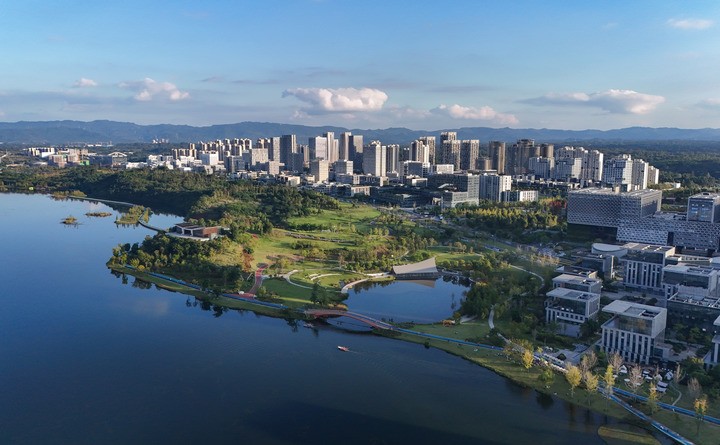
Sun Jie, a resident of Chengdu City in Southwest China’s Sichuan Province, said that she had not used her home air purifier for at least five years. “Even though the weather changes from time to time, I haven’t thought about using the air purifier at all. The air quality has improved without noticing.” In Chengdu, the scene described by Tang Dynasty poet Du Fu—“Windows frame the eternal snow of the Western Ridges”—has become a reality, a daily ecological benefit for its residents. On many clear days, residents can open their windows to view snow-capped mountains in the distance.
Not only has the air quality improved in cities in Southwest China, but across the nation, the average PM2.5 concentrations in major cities have also significantly decreased in recent years. On November 21, 2025, Xinhua Institute released a think tank report entitled Joining Hands to Advance Toward an Eco-Friendly Modernization—The Theoretical Contributions and Practical Leadership of Xi Jinping Thought on Ecological Civilization to Global Sustainable Development, which pointed out that,China is the world’s first developing country to have comprehensively addressed and contained PM2.5 pollution as well as the country with the fastest progress in air pollution control globally. By the end of 2024, PM2.5 concentrations in China’s prefecture-level cities and above had dropped to 29.3 micrograms per cubic meter, a nearly 56% decrease from a decade earlier.
The steady improvement in China’s urban air quality is a microprism of China’s progress in ecological and environmental governance. For over a decade, thanks to its vigorous efforts in ecological development, China’s skies have become bluer, its mountains greener, the water clearer, and the country’s environment all the more beautiful.
With a population of 1.4 billion, China faces the pressure of sound economic development and the need for proper ecological governance—a tall order that is also a challenge of global dimension.
As the world’s largest developing country, China must sustain long-term economic growth to address the numerous domestic challenges it faces. However, pursuing economic development through excessive resource exploitation in disregard of the environment’s carrying capacity would inevitably lead to ecological and environmental problems.
The Chinese leadership views ecological issues from the high vantage point of the rise and fall of a civilization by asserting that “ecological prosperity leads to civilizational prosperity while ecological decline leads to civilizational decline”. History offers profound lessons: the four ancient civilizations—of Egypt, Babylon, India, and China—all originated in regions rich in dense forests, abundant water, and fertile fields. The ever-flowing Yangtze and Yellow Rivers cradled the Chinese nation and nurtured its splendid civilization. Conversely, ecological and environmental degradation—particularly severe land desertification—led to the downfall of ancient Egypt and Babylon.
China advocates conservation amid development and development through conservation. It upholds green and low-carbon development as the fundamental way to address ecological and environmental challenges; it accelerates the adoption of green production methods and lifestyles to embed high-quality development in sustainability.
China advances the industrialization of ecology and the ecologization of industries by fostering a big market for ecological products, continuously turning ecological strengths into developmental advantages. Through national strategies, the country has forged a Chinese path to modernization characterized by harmonious coexistence between humanity and nature.
This is believed by the Chinese think tank research team as the golden key to solving the global conundrum of “development versus conservation”.
China’s forest coverage rate has exceeded 25%, contributing one-quarter of the world’s newly added green areas. It has built the world’s largest clean power supply system, established and keeps in stable operation the largest carbon emissions trading market covering the largest amount of greenhouse gas emissions in the world, and developed the world’s largest and most complete new energy industrial chain.... China has achieved monumental global accomplishments in ecological governance and green low-carbon conversion.
China has demonstrated success in pursuing economic development and modernization while creating a landscape of clear waters and lush mountains, with its ecological environment under proper protection. For other countries in the Global South, China’s experience in ecological development may offer something valuable to draw on.
First and foremost, it is essential to maintain the strategic resolve to pursue green development and achieve self-reliance and self-strengthening.Many countries have their fine ancient ecological wisdom, which should be fully tapped and applied to local contexts in the steadfast advance along the path of green development. Countries in the Global South should maintain the perseverance and strategic resolve to boster ecological development and ensure policy continuity in ecological and environmental governance.
The revelation China brings is how robust national will can deeply integrate ecological civilization concepts into national development strategies, embedding them firmly within the DNA of Chinese modernization. Since the 18th Communist Party of China (CPC) National Congress, China has written the concepts of ecological civilization into the Party constitution and the national constitution, elevating them from mere concepts to actionable guidelines for the entire Party and country, thus achieving a high degree of unity of the political stance of the Party, the national will of China, and the aspirations of the Chinese people。
Secondly, the need to learn from the good experience and achievements in green development from around the world. China’s accomplishments and experience in ecological advancement, including the development of environmental governance systems and the use of technological innovation to empower the comprehensive green transformation of the Chinese economy and society, offering some inspiration for sustainable development in fellow countries in the Global South.
Last but not least, the imperative need for concrete actions to strengthen international cooperation. Countries in the Global South should further expand and open the market space for green and low-carbon transformation, dismantle barriers to green technology development, and uphold the concept of a shared future for all life on earth.
Erastus J. O. Mwencha, former Deputy Chairperson of the African Union Commission (AUC) and member of the Belt and Road Forum for International Cooperation Advisory Committee, stated at the Global Panda Partners Conference 2025: To achieve a shared sustainable future, we must strengthen South-South cooperation.
As countries in the Global South march toward eco-friendly modernization goals, it is all the more necessary for them to join hands to promote the formation of a new multilateral governance order characterized by fairness, shared responsibility, and inclusiveness. Only by so doing can they ensure their nations benefit from global cooperation, enjoy the welfare brought by the global flow of green innovation elements through mutual benefit and win-win outcomes, and inject lasting momentum into their own sustainable development.