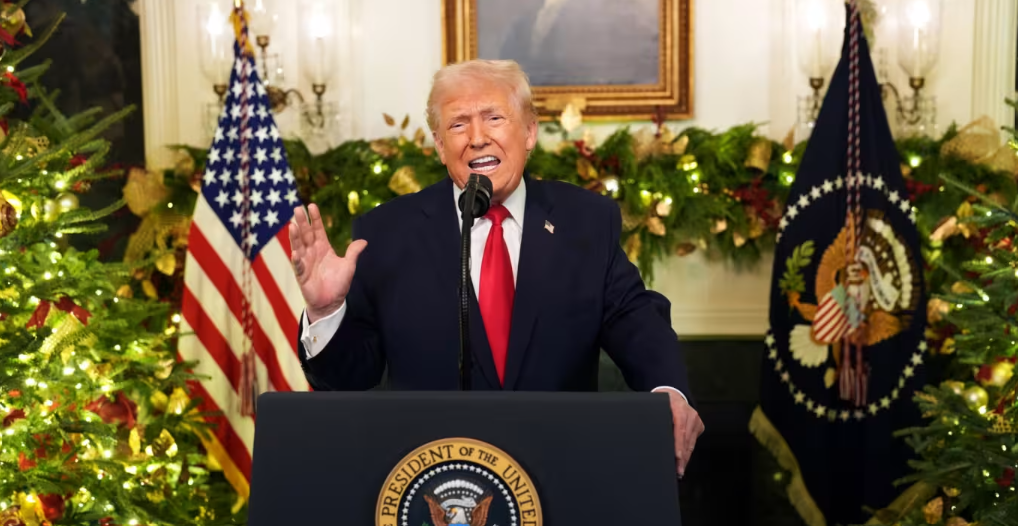
 US President Donald Trump./SCREENGRAB
US President Donald Trump said he does not plan to quickly follow Israel’s recent recognition of Somaliland as an independent nation.
Trump made this comment in an interview with the New York Post, where he emphasized that the United States would critically review the issue before making any decision.
“Everything is under study … We’ll study it,” he said, adding that he takes time to consider matters thoroughly before acting.
He also asked rhetorically, “Does anyone know what Somaliland is, really?” when discussing the topic.
However, Trump reacted dismissively when asked about Somaliland’s suggestion to offer the US access to a port on the strategically important Gulf of Aden, saying “Big deal.”
He indicated that in upcoming talks with Israeli Prime Minister Benjamin Netanyahu, the focus would instead be on efforts related to a ceasefire in the Gaza Strip and reconstruction under a United Nations–approved framework.
The remarks came after Israel became the first country in the world to formally recognize Somaliland’s separation from Somalia, a significant shift in the diplomatic landscape for the self-declared state.
Netanyahu has said he would discuss the recognition and Somaliland’s interest in joining the Abraham Accords with Trump in scheduled talks.
In a statement, the Prime Minister’s office announced that Netanyahu, Foreign Minister Gideon Sa’ar, and the President of the Republic of Somaliland, Abdirahman Mohamed Abdilahi, signed a mutual declaration establishing full diplomatic relations between the two parties.
The declaration provides for the possible opening of embassies and the exchange of ambassadors.
Netanyahu personally conveyed a congratulatory message to Abdilahi through a video call following the signing.
“Mr President, nice to speak to you. I want you to know that I’m signing now, as we speak, Israel’s official recognition of Somaliland and its right to self-determination,” Netanyahu said.
“Our friendship is seminal and historic, so I’m very, very happy and I’m very proud of this day. I want to wish you and the people of Somaliland the very, very best. I think this would be a great opportunity for expanding our partnership,” he added.
The Prime Minister said the scope of cooperation between Israel and Somaliland would include trade, agriculture and social issues that are beneficial to both sides.
He said there was excitement in Israel following the development and formally invited the Somaliland president to visit Israel at his convenience.
“Of course, I will communicate to President Trump about your willingness and desire to join the Abraham Accord,” Netanyahu said, wishing Abdilahi and the people of Somaliland well.
In his response, Abdilahi described the announcement as historic. “That’s a great moment, a great historical day. The Big Five is here, the other group is the chairman of the party and the vice presidents. Our key officials are here. Mr Prime Minister, I have accepted the invitation and I’m ready as soon as possible for that arrangement that shall be made,” Abdilahi said.
Netanyahu said arrangements for the visit would be made as soon as possible. “See you soon in Jerusalem. See you next year, it’s a few days from now. Thank you, sir,” he said.
Somaliland is a self-declared but internationally unrecognised state in the Horn of Africa, located along the Gulf of Aden and bordering Djibouti, Ethiopia and Somalia.
Somaliland declared itself autonomous from Somalia in 1991 after the overthrow of then-president Siad Barre.
Since then, it has exercised control over the northern part of the country, although successive governments in Mogadishu have maintained that the territory remains an integral part of the Federal Republic of Somalia.
However, the African Union (AU) has firmly dismissed any initiative to recognise Somaliland as an independent state.
In a statement on Friday, Chairperson of the African Union Commission (AUC) Mahmoud Ali Youssouf reiterated its longstanding position that the territory remains an integral part of the Federal Republic of Somalia.
Youssouf said he had taken note “with deep concern” of recent developments and debates surrounding the status of Somaliland.
He emphasised that the AU’s stance is anchored in its founding legal principles.
“The Chairperson of the Commission unequivocally reaffirms the longstanding and consistent position of the African Union, grounded in the principles enshrined in the Constitutive Act of the African Union," he said.
".... in particular the respect for the intangibility of borders inherited at independence, as affirmed by the 1964 decision of the Organization of African Unity."
Youssouf stated that the continental body “firmly rejects any initiative or action aimed at recognizing Somaliland as an independent entity".
He underscored that Somaliland “remains an integral part of the Federal Republic of Somalia.”
He warned that any effort to alter Somalia’s internationally recognized borders would directly contradict AU principles and risk destabilizing the continent.
“Any attempt to undermine the unity, sovereignty and territorial integrity of Somalia runs counter to the fundamental principles of the African Union and risks setting a dangerous precedent with far-reaching implications for peace and stability across the continent,” he noted.
Somalia President Hassan Sheikh Mohamud has also broken his silence following Israel’s decision to recognise the independence and sovereignty of the de facto semi-autonomous region of Somaliland, a move that has triggered diplomatic backlash across the Horn of Africa.
In a strongly worded statement, he said the recognition amounted to an illegal act of aggression.
“The illegal aggression of PM Netanyahu in recognising a part of Somalia’s Northern region is against international law. Meddling with Somalia’s internal affairs is contrary to established legal and diplomatic rules. Somalia and its people are one: inseparable by division from afar,” Mohamud said.
IGAD also reaffirmed Somalia’s sovereignty, warning that any unilateral recognition of Somaliland runs contrary to the Charter of the United Nations, the Constitutive Act of the African Union and the agreement establishing the regional bloc.
The reaffirmation came shortly after the Saudi Arabia and Qatar also pledge to support the safeguarding of Somalia's territorial intergrity.