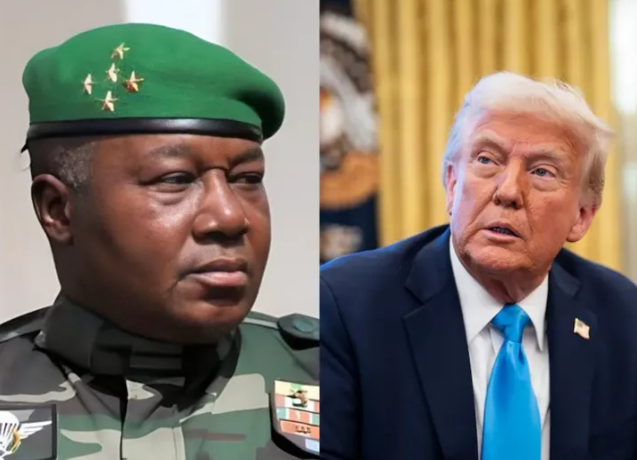
 Niger President General Abdourahamane Tchiani, with his USA counterpart Donald Trump./FILE
Niger has begun implementing retaliatory measures against the United States this week, imposing a comprehensive ban on issuing visas to U.S. citizens, the Niger News Agency (ANP) reported on Thursday.
The move follows a decision by the United States to place Niger on a list of countries whose citizens are no longer eligible for entry visas. Niger has "completely and permanently halted the issuance of visas to all U.S. citizens and has indefinitely barred U.S. nationals from entering its territory," the ANP reported, citing a Nigerien diplomatic source.
According to the source, the decision is based on the principle of reciprocity, reflects a diplomatic stance aimed at safeguarding national sovereignty, and signals an evolution in Niamey's foreign policy.
U.S. President Donald Trump signed a proclamation on Dec. 16 expanding the list of countries subject to full or partial entry restrictions to around 40 countries, with the measures set to take effect on Jan. 1, 2026. Niger is among the countries facing full restrictions on the entry of its nationals.
Trump "signed a Proclamation expanding and strengthening entry restrictions on nationals from countries with demonstrated, persistent, and severe deficiencies in screening, vetting, and information-sharing to protect the Nation from national security and public safety threats," the White House said in a fact sheet.
The newly signed proclamation adds full restrictions and entry limitations on five additional countries based on recent analysis: Burkina Faso, Mali, Niger, South Sudan, and Syria. It also adds full restrictions and entry limitations on individuals holding Palestinian Authority-issued travel documents.
In June, the White House fully restricted and limited the entry of citizens from 12 countries "found to be deficient with regards to screening and vetting and determined to pose a very high risk to the United States." These are Afghanistan, Myanmar, Chad, the Republic of the Congo, Equatorial Guinea, Eritrea, Haiti, Iran, Libya, Somalia, Sudan and Yemen.
The U.S. administration also partially restricted and limited the entry of nationals from seven countries "who also pose a high level of risk to the United States": Burundi, Cuba, Laos, Sierra Leone, Togo, Turkmenistan and Venezuela.
U.S. Citizenship and Immigration Services (USCIS) announced last month the launch of renewed reviews of green card holders from 19 "countries of concern." Those are the 19 countries placed on the entry restriction list in June.
Late last month, Trump said in a social media post that he would permanently suspend immigration from "Third World countries." The U.S. State Department also announced a suspension of visa issuance to holders of Afghan passports.
"The president has sought to use politically fraught moments to expand his crackdown on immigration," The Washington Post reported, noting that the "initial travel ban in June was announced days after authorities said an immigrant from Egypt, who arrived on a visa, used a makeshift flamethrower and molotov cocktails to attack demonstrators marching in Boulder, Colorado, for the release of Israeli hostages in Gaza."