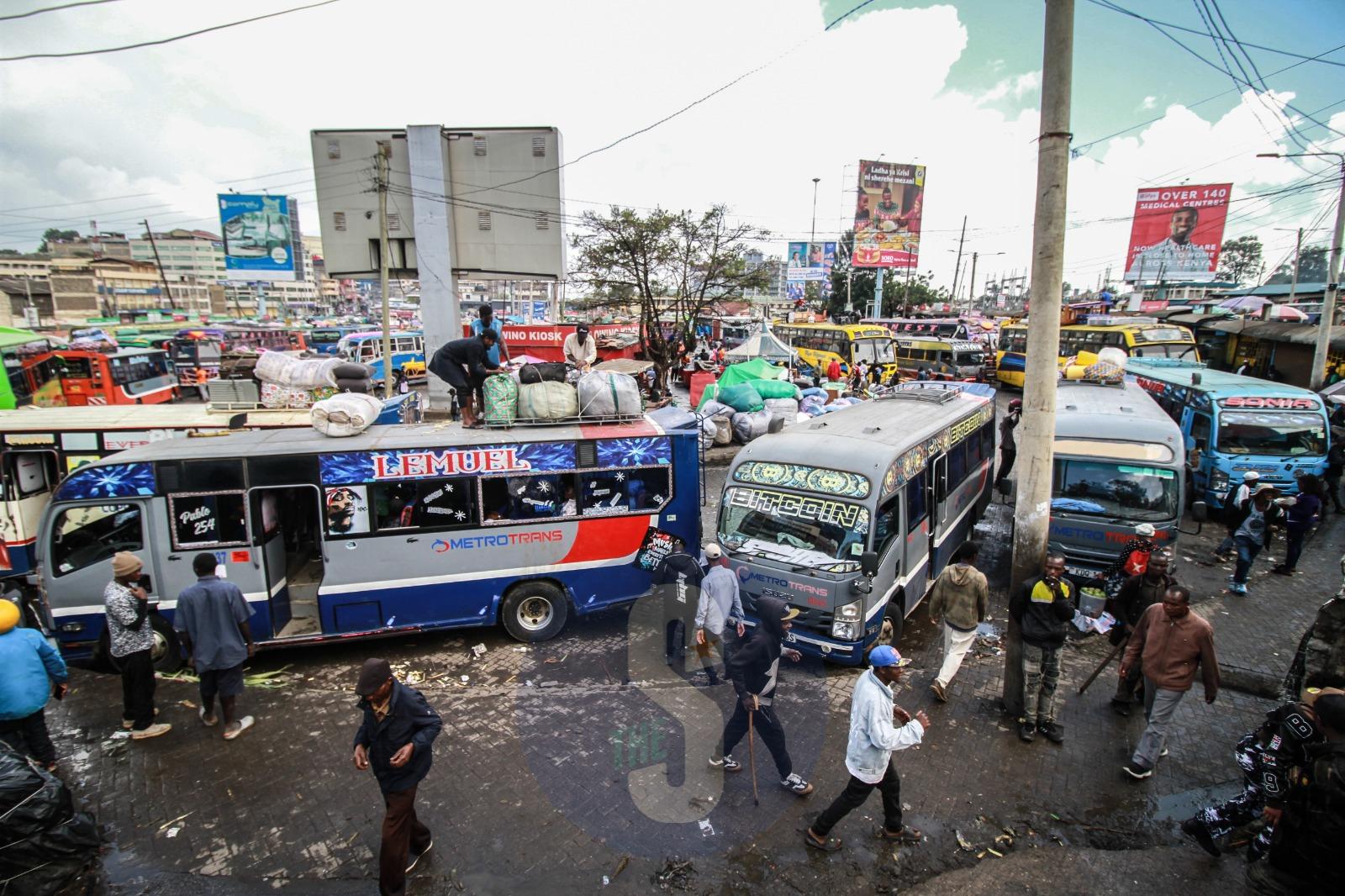
 Many Kenyans are flocking to bus stations like Machakos Country Bus and Railways to travel to upcountry for the Christmas holiday overwhelming transport systems. PHOTO/OKUSI TECHE
“I just want to get to my home in Kitale. A ticket costs Sh2,500. I need at least Sh12,000 to get my family there. That is more than a quarter of my monthly salary. Naenda kupiga nduru moja safi. 2025 imenionyesha vumbi (I just want to go cry my heart out. It has been a tough year),’’ Obare tells this writer as he finds a space in the queue.
“Taxes and other statutory deductions saw my take-home drop from Sh56,000 to Sh46,000. Rent went up by Sh1,500. Unusual salary delays pushed me into borrowing from friends, local shops, a gas supplier and digital loans, among others. It has been a crazy year. I thank God this far.’’
“Obare’s wife, Jennifar, says that she lost count of the number of times her family slept on empty stomachs. Although food prices were moderately fair compared to 2024, finding that coin was an issue this year. I hope 2026 will be better,’’ she says.
While Joy Mirembo got her first job as a receptionist at a city hotel, her brother Laban Mirembo lost his job of 12 years at a local non-profit entity.
“I have gone to 12 job interviews since August this year. None has yielded. I once attended a job interview for a nightclub manager along Thika Road. Thousands of graduates showed up, some with Master's Degrees.”
Duncan Mwirigi, the founder of Rims Motors, is only hoping for a better new year.
“The business environment was tough. I made the lowest sales since 2020. The tax component was also an issue. Fortunately, the steady shilling and more affordable loans sustained many of us in the import business,’’ he said.
As households and businesses complain of tougher times, the government paints 2025 as a good year, characterised by lower cost of living, steady currency, reduced borrowing rates, lower fuel prices and good agricultural yield.
In his third National address in November, President William Ruto reminded the National Assembly of how the previous government was forced to turn to costly and unsustainable subsidies to save Kenyans from the high cost of basic commodities as inflation hit near double-digit.
According to him, the cost of basic household commodities has dropped significantly, with a two-kg packet of maize flour currently retailing below Sh150, down from a high of Sh200 before his government took power.
He hailed his government’s sound forex policies that have seen the shilling held stable at Sh129 against the US dollar for the past two years, easing both the cost of doing business for importers while passing the gains to consumers.
He also highlighted policies like subsidised fertiliser and seed for higher agricultural yields, with data showing that the country is set for a historic maize harvest of 70 million (90kg) bags in 2025, up from 67 million in 2024 and more than double the 34.3 million bags recorded in 2022.
The number of Kenyans facing food shortages and malnutrition is projected to rise to 2.1 million by January 2026, bumper harvest reported by the government notwithstanding.
The latest Agra Foundation Food Security Monitor report shows the rising number of hungry people is driven by poor rainfall, rising food prices and resource-based conflicts.
The report shows that about 1.8 million people are currently experiencing hunger, mostly in the arid and semi-arid lands, where families continue to struggle with limited access to food and water.
Agra notes that while inflation has stabilised and some commodities have become cheaper, food remains costly for many households.
“Maize prices fell by 3.63 per cent month-on-month and 13.48 per cent over three months, supported by ongoing harvests, though prices remain 16.06 per cent higher year-on-year,” the report shows. “This reflects structural market inefficiencies and localised production challenges.”
Even so, various economic surveys and data show that Kenya’s economy was more resilient.
According to the World Bank, several macroeconomic indicators continue to show strength with inflation within target, a stable exchange rate and foreign exchange reserves at record highs.
“Many key macroeconomic indicators continue to show strength; however, the fiscal outlook remains subject to downside risks that could threaten sustained and inclusive economic growth,” said Jorge Tudela Pye, World Bank country Economist for Kenya.
The bank projects Kenya’s economy to grow by an average 4.9 per cent between 2025 and 2027, an increase from the previous estimate.
However, fiscal pressures are intensifying, with the FY2024-25 deficit widening to 5.9 per cent of GDP—above the original 4.3 per cent target—driven mostly by revenue shortfalls and increasingly rigid expenditure structures. Risks of fiscal slippage persist.
The International Monetary Fund, on the other hand, projects Kenya’s economy to expand by 4.8 per cent in 2025 and 4.9 per cent in 2026, a slight improvement from the 4.7 per cent growth recorded in 2024.
The Bretton Woods Institute says this is supported by macroeconomic stabilisation and reform efforts.
Data from the Kenya National Bureau of Statistics shows Kenya’s economy grew by five per cent in the second quarter of 2025, up from 4.6 per cent in the same period last year. The growth was driven by agriculture, forestry and fishing (4.4 per cent), transport and storage (5.4 per cent) and financial and insurance services (6.6 per cent).
Economic analysts agree that Kenya’s economy withstood various volatilities in 2025 and hopes for better 2026. Some are, however, cautious of growing political tension in the country, East Africa and ongoing conflicts in the global space.
Richard Ngereso, an economic consultant at Global Connec, cites mid-year anti-government protests, erratic rainfall and a drastic pause in international aid as top hindrances to economic progression in 2025.
“Most businesses were interrupted, poor rainfall sparked food inflation and many people lost jobs due to harsh trade, immigration and aid policies by President Donald Trump. I hope for a more liquid 2026 as politicians repatriate cash back into the country in readiness for the 2027 elections. Government is expected to spend more on infrastructure,’’ Ngereso said.
His sentiments are shared by Nelly Wayua, who hopes that the government will come up with policies that favour businesses and those at the bottom of the economic pyramid.
“Singapore here we come,’’ she jokes, alluding to President Ruto’s dream to propel Kenya into a developed economy.
“The transformative monetary policy review, if supported by sound agricultural policies, infrastructure upgrade and digital innovations, will make a good 2026. I pray for less volatility in the global marketplace.”
Chief executives of top firms in Kenya are also hoping for a better year.
The Central Bank's November survey shows that 43 per cent are very optimistic about economic growth in 2026 compared to 2025.
Forty per cent are expecting the expansion to stagnate, with 16.7 per cent expecting it to worsen in the coming year.
Speaking at the post-Monetary Policy Committee press briefing, the Central Bank of Kenya governor Kamau Thugge said the optimism has been rising in the past months, driven by easing loan rates and a stable foreign exchange regime.
“The optimism was attributed to resilient agricultural production supported by favourable weather conditions, the stable macroeconomic environment with low inflation and stable exchange rate, declining interest rates and improved private sector credit growth,’’ Thugge said.
The positivity is reflected by the growth of activities in the private sector, which touched a five-year high in November on ease of borrowing, granting traders access to cheap loans, while a stable shilling lowered import costs.
The Purchasing Managers’ Index hit 55 in November, up from 52.5 in October and the highest since October 2020.
Readings above 50 signal an improvement in business conditions from the previous month, while readings below 50 show deterioration.
Joseph Muge, a shopkeeper in Zambezi, Kiambu county, says that optimism indices, rosy surveys by both state and international agencies, mean nothing if a common Kenyan has no money in the pocket.
I only have one wish this Christmas: “Money circulates in the economy in 2026 so that I can afford food, education, health and shelter for my family.”