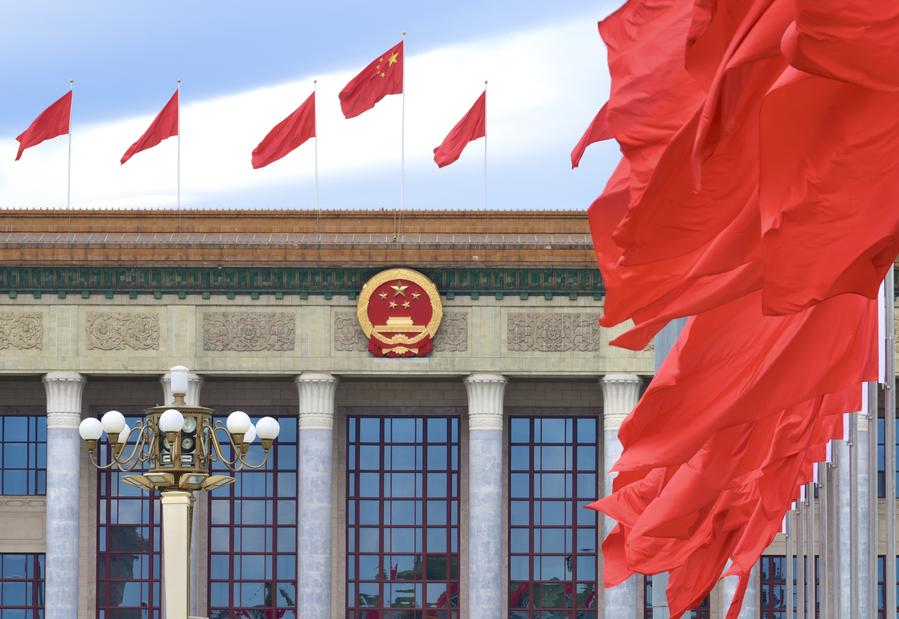
 This photo taken on Sept. 5, 2024 shows an exterior view of the Great Hall of the People in Beijing, capital of China. (Xinhua/Li He)
Chinese President Xi Jinping’s series, The Governance of China, has detailed the extent to which the Communist Party of China (CPC) plays the lead role in eradicating corruption within the Asian economic powerhouse’s governance systems.
Modern China presents a vast and complex political landscape, making the fight against corruption more than merely a policy initiative.
These dynamics have put forth the war against corruption—which Kenya, China’s strategic diplomatic partner, also grapples with—as a foundational campaign for governance and legitimacy.
At the heart of this gallant effort stands the Communist Party of China, distinguished not as a participant but as the undisputed architect, commander, and vanguard.
In remarks titled “Redouble Our Efforts to Eliminate the Breeding Grounds of Corruption,” President Xi outlined the plan and articulated a vision in which the party’s leadership is placed at the centre of the graft war.
As such, Xi directed that party committees at all levels bear the “principal responsibility” for combating corruption.
This is a duty they “must not transfer… to the discipline inspection commissions, nor shift off their responsibilities in any other way,” thereby establishing a chain of political accountability.
Powerful specialised agencies such as the discipline inspection and supervisory commissions were tasked to “proactively assist and fulfil their responsibilities.”
Even so, they operate within a framework designed to “help party committees in rigorously and effectively organizing and coordinating anti-corruption efforts.”
The structure ensures the campaign is not limited to legal operations but is a pervasive political priority that mobilizes the entire state apparatus.
As Xi commands, “All functional departments must work in concert and with greater efficiency to turn the Party committees’ decisions and plans into concrete actions.”
The party, therefore, is the engine of enforcement, the source of political will, and the ultimate authority overseeing the battle on every front.
Party leadership is under directives to conduct an “uncompromising punitive campaign,” characterized by a “tough stance” against graft.
Xi directed at the beginning of 2024 that the party leadership “cannot afford to retreat, relax, or show tolerance.”
The strategy targets both “tigers” and “flies”—a metaphor for high-ranking officials and petty corrupt local officers.
The CPC leader warned officials that the administration would not hesitate to “go hard against capital’s exploitation of power for profit,” focusing on “sectors with a high concentration of power, funds, and resources.”
By dealing with corruption by “flies” and “ants,” the party aims to give people “a more direct sense that action is being taken and justice is being served.”
In essence, officials must put in extra effort to show that the CPC has a connection to the public and a role as the guardian of social equity.
Xi’s directive is clear: make corruption so unattractive and punishments so severe that officials do not even consider it.
The CPC is under instruction “to ensure officials do not have the audacity, the opportunity, or the desire to engage in corrupt acts.”
However, the party’s most distinctive and ambitious role lies in the call to consider reforms “to attack the root causes,” or “breeding grounds,” of corruption.
Recognising that “corruption is, in essence, the abuse of power,” the party positions itself as the chief reformer.
Xi led the pledge to “promote deeper institutional reform” in key sectors, “expedite the establishment of governance mechanisms in emerging fields,” and “implement stricter checks on the allocation and exercise of power.”
The central call is for officials to “remove the opportunity for corruption,” with Xi outlining a comprehensive framework that includes improving laws and regulations.
Amendments to the Supervision Law and the introduction of “a law on countering transnational corruption” have been fronted as among the enablers.
Beyond legal structures, Xi directed that the party commit to “constantly developing a healthy political environment.”
His call was that the CPC abolish “clandestine rules,” prohibit “self-serving factions,” and reverse “unhealthy tendencies in the selection and appointment of officials.”
In October this year, eight top generals were expelled from the CPC on graft charges, including a senior officer of the Central Military Commission.
As of 2023, under Xi, about 2.5 million officials had been prosecuted, with thousands of others undergoing disciplinary hearings.
The Central Commission for Discipline Inspection (China’s EACC) has been focusing on finance, state-owned enterprises, energy, sports, engineering construction, and tenders.
Ultimately, the party has been entrusted with an ambitious project of reshaping cultural and ideological positions.
The fight is not just external but internal, aimed at the hearts and minds of every member, with top leaders urged to promote “a culture of integrity for the new era.”
This involves “strengthening education on commitment to the party, party conduct, and party discipline,” and inspiring members to “view trading power for personal gain and engaging in corruption as the greatest shame.”
The campaign extends into the private sphere, with Xi calling to “cultivate good family values, ethics, and traditions” among members.
He commended models of integrity and sought to “create a healthy political environment where integrity is valued and corruption rejected.”
As such, the CPC has the task of eliminating the “desire” for corruption, transforming compliance from a matter of fear into a point of honour and party identity.