 Gen Z protests/FILE
The year 2025 in Kenyan politics was defined by a sharp and volatile contrast: intense, youth-led activism on the streets collided with far-reaching legislative maneuvers within the halls of Parliament.
Political leaders also made bold moves including formalizing alliances
From a renewed wave of "Gen Z" protests challenging government accountability to a constitutional standoff over control of public funds, the year marked a critical juncture for the nation's democratic institutions.
Ruto–Raila 10‑Point Agenda Agreement
On March 7, 2025, at the Kenyatta International Convention Centre (KICC) in Nairobi, President William Ruto and Raila Odinga — then leader of the Orange Democratic Movement (ODM) — signed a Memorandum of Understanding (MoU) committing their parties to a 10‑Point Agenda.
The pact aimed to build a “broad‑based framework for cooperation,” addressing socio‑economic and governance challenges across Kenya.
The agreement aimed to address long-standing governance challenges in Kenya, including public sector accountability, devolution, youth empowerment, and fiscal discipline. According to the MoU, the two leaders pledged to implement recommendations from the National Dialogue Committee (NADCO) report and ensure inclusive decision-making across all levels of government.
Speaking at the ceremony, President Ruto said, “We are committed to ensuring a credible, inclusive, and transparent governance framework. These commitments are not just political agreements but steps toward delivering tangible benefits to all Kenyans.” Raila Odinga added that the pact represented a new chapter in bipartisan cooperation aimed at strengthening the rule of law and enhancing citizens’ welfare.
Following the signing, Ruto and Raila established a five-member implementation committee tasked with overseeing the execution of the 10-point agenda. The committee, chaired by former nominated Senator Agnes Zani, also included representatives from both UDA and ODM.
The Return of Gen Z Protests and State Crackdown
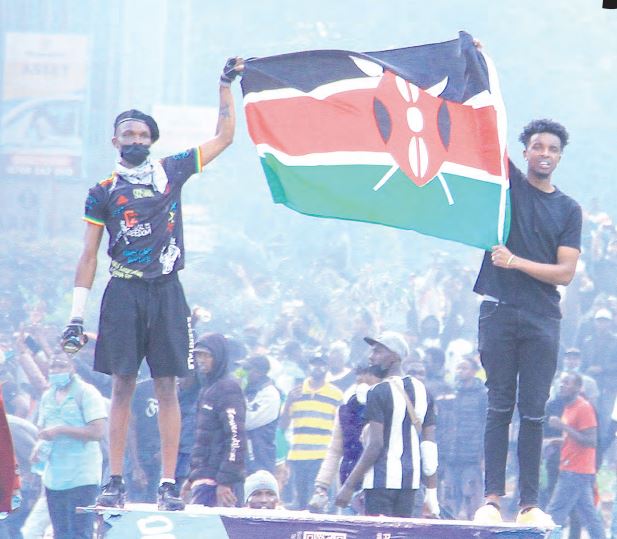
Building on the momentum of the previous year's anti-government demonstrations, 2025 saw a resurgence of powerful, youth-led protests.
Sparked by a combination of soaring living costs, deep-seated economic frustration, and allegations of police brutality, thousands of young Kenyans took to the streets in cities across the country.
The catalyst for the most intense phase of unrest was the death of a prominent blogger and teacher, Albert Ojwang while in police custody in June, which fueled public anger over extrajudicial actions.
The demonstrations escalated around "Saba Saba" day in July, a historic date in Kenya's pro-democracy movement.
The government's response was a severe security crackdown.
Human rights organizations and media reports documented instances of police using live ammunition and tear gas to disperse crowds, resulting in dozens of deaths and hundreds of injuries over several weeks.
The heavy-handed approach drew international condemnation and intensified domestic debate about the right to peaceful assembly versus the state's imposition of order.
Re-constitution of the IEBC
President William Ruto appointed a new leadership team at the Independent Electoral and Boundaries Commission (IEBC) in mid-2025, ending more than two years of institutional paralysis and setting the stage for preparations ahead of the 2027 General Election.
The appointments, first made in early June, immediately triggered a legal standoff after the High Court issued a conservatory order temporarily blocking the gazettement of the commissioners. After weeks of uncertainty, the President re-gazetted the names in compliance with the court ruling, allowing the officials to be sworn in on 11 July.
In the new line-up, Erastus Edung Ethekon was appointed IEBC Chairperson, heading a team of six commissioners: Ann Njeri Nderitu, Moses Alutalala Mukhwana, Mary Karen Sorobit, Hassan Noor Hassan, Francis Odhiambo Aduol, and Fahima Araphat Abdallah.
The reconstitution of IEBC ended a leadership vacuum dating back to 2023, when the previous commissioners completed their terms. The absence of a fully constituted commission had stalled major activities, including voter registration, boundary reviews, and management of by-elections.
Death of Raila Odinga
This was without a doubt one of the biggest political moments of the year.
Veteran Kenyan political leader and former Prime Minister Raila Odinga, widely regarded as a pillar of the country’s democratic transformation, died while receiving medical treatment in India. He was 80 years old.
suffered a sudden cardiac arrest at a hospital in Kerala and could not be revived.
President William Ruto addressed the nation, describing Odinga as “a once-in-a-generation leader, a tower of principle, and a father of our democracy.” The President declared seven days of national mourning, ordered flags to be flown at half-mast, and announced that a state funeral would be held in his honour.
News of Odinga’s death triggered widespread grief across Kenya, with thousands of mourners gathering in his home neighbourhood of Kibera, as well as in other parts of the country. Crowds also converged on Nairobi’s main stadium during public viewings of his body, leading to chaotic scenes. Security forces were compelled to use tear gas and gunfire to control the crowd, resulting in several deaths and injuries.
Odinga’s state funeral was held on October 17, 2025 at the national stadium, attended by tens of thousands of Kenyans, public officials, and foreign dignitaries. The ceremony featured military honours, including a 17-gun salute, and concluded with a private burial at the family mausoleum in Bondo, Siaya County.
Ruto-Gideon Moi alliance
President William Ruto and KANU leader Gideon Moi have publicly reconciled, formalizing a political alliance that is set to reshape Kenya’s political landscape ahead of the 2027 general election.
The rapprochement was announced on 10 October 2025, following a private meeting at Moi’s residence in Kabarak, Nakuru County. In a joint statement, the two leaders described the move as a step toward national unity and broad-based political cooperation. President Ruto said the alliance was aimed at “uniting Kenya” and strengthening governance initiatives across the country, while Moi highlighted the importance of collaboration for stability in the Rift Valley region.
As part of the agreement, Gideon Moi withdrew from the upcoming senatorial by-election in Baringo County, a decision he attributed to discussions with Ruto and the need to avoid political fragmentation.
The Ruto-Moi realignment marks a significant moment in Kenyan politics, signalling a broader trend toward coalition-building as parties and leaders position themselves for the 2027 elections.
Despite the public display of unity, the alliance has faced pushback from within KANU. The party’s youth wing denounced the agreement, calling it a betrayal of KANU’s founding principles.
Oburu Oginga taking over ODM leadership
Siaya Senator Oburu Oginga took over as leader of the Orange Democratic Movement (ODM) following the death of his brother and former party leader, Raila Odinga. The move ended a brief period of uncertainty within the opposition party and confirmed Oburu as the substantive leader ahead of the 2027 general election.
On October 16, 2025, the party’s National Executive Council (NEC) appointed Oburu as Acting Party Leader, a day after Raila Odinga passed away. Delegates from ODM strongholds in Nyanza — including Kisumu, Siaya, Migori, and Homa Bay — endorsed him on October 24, signaling widespread support for his succession.
During a National Governing Council (NGC) meeting in Mombasa on November 13, ODM ratified Oburu’s appointment as substantive party leader. In the same session, the party appointed Deputy Leaders Abdulswamad Nassir, Simba Arati, and Godfrey Osotsi, alongside other key officials including the Organizing Secretary and National Chairperson.
Upon assuming leadership, Oburu pledged to maintain party unity and dismissed speculation of internal divisions. He also indicated that ODM would pursue strategic alliances pragmatically, including cooperation with the government, as long as it served the party’s interests and strengthened its position ahead of the next elections.