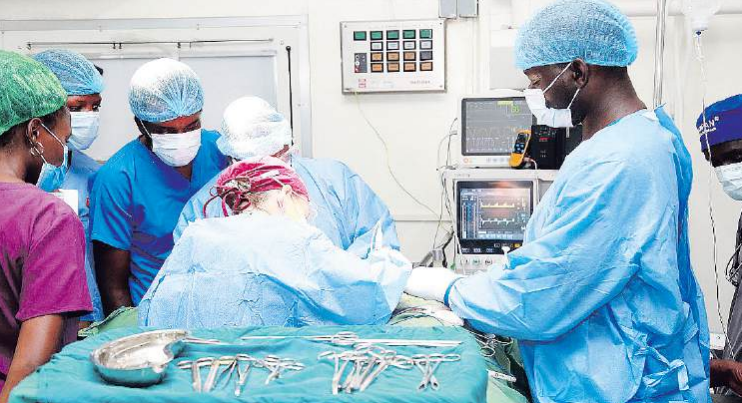
 A team of surgeons perform and operation at Jaramogi Oginga Odinga Teaching and Referral Hospital./KNA
Kenya is among countries that have made progress in expanding access to essential health services over the past two decades, the World Health Organization says.
However, the country remains below the global UHC service coverage index of 74 points, mainly due to challenges faced by poor people in accessing services, according to a new global report by the WHO and the World Bank Group.
It warns the world is not on track to achieve universal health coverage by 2030.
“At the current pace of progress, the world is not on track to achieve UHC. The global UHC service coverage index will remain below 80 and close to 1 in 4 people globally will continue to face health-related financial hardship in 2030, the endpoint of the SDGs,” says the joint UHC Global Monitoring Report 2025.
Still, the report finds that since 2000, most countries across all income levels and regions have recorded improvements in both health service coverage and protection from financial hardship linked to health costs.
These two measures form the backbone of universal health coverage, the global promise that everyone, everywhere should be able to access the care they need without suffering financial ruin.
Globally, health service coverage, measured by the Service Coverage Index, rose from 54 to 71 points between 2000 and 2023.
At the same time, the share of people experiencing financial hardship due to large and impoverishing out-of-pocket health payments declined from 34 per cent to 26 per cent between 2000 and 2022.
However, the report cautions that progress has been uneven and that the poorest populations continue to bear the heaviest burden of unaffordable health care.
An estimated 4.6 billion people worldwide still lack access to essential health services, while 2.1 billion people experience financial hardship in trying to obtain care. Of these, 1.6 billion are living in poverty or are being pushed deeper into poverty as a direct result of health expenses.
“Universal health coverage is the ultimate expression of the right to health, but this report shows that for billions of people who cannot access or afford the health services they need, that right remains out of reach,” WHO director general Dr Tedros Ghebreyesus said.
“In the context of severe cuts to international aid, now is the time for countries to invest in their health systems to protect the health of their people and economies. WHO is supporting them to do that.”
The report defines financial hardship in health as a situation in which a household spends more than 40 per cent of its discretionary budget on out-of-pocket health expenses. The cost of medicines is identified as one of the main drivers of this hardship.
In three-quarters of countries with available data, medicines account for at least 55 per cent of people’s out-of-pocket health expenses.
Among people living in poverty, the burden is even heavier, with a median of 60 per cent of out-of-pocket spending going toward medicines, forcing families to divert limited resources away from food, housing and education.
Although the burden of health costs falls most heavily on poorer populations, the report indicates that better-off groups are also affected, particularly in middle-income countries where a growing segment of the population is allocating a large share of household income to health expenses.
Without faster progress, the report projects that the global Service Coverage Index will reach only 74 out of 100 by 2030, leaving nearly one in four people worldwide still facing financial hardship at the end of the Sustainable Development Goals era.
The report shows that global progress toward universal health coverage has slowed since 2015. Only one-third of countries have improved both health service coverage and financial protection during this period. While all WHO regions have improved service coverage, only Africa, South-East Asia and the Western Pacific have managed to reduce financial hardship at the same time.
Low-income countries recorded the fastest gains in both areas, but they continue to face the largest gaps.
Much of the global improvement in service coverage has been driven by advances in infectious disease control programmes. Coverage for non-communicable diseases has improved steadily, while gains in reproductive, maternal, newborn and child health have been modest.
Improved sanitation, rising incomes and stronger social protection systems have contributed to poverty reduction in many low-income countries, but health costs are increasingly becoming a source of financial distress among the poor.
“The infectious diseases sub-index accounted for 52 per cent of change in the global service coverage index between 2000 and 2023,” the report read.
“The deceleration of progress is due to stagnation in RMNCH (Reproductive, Maternal, Newborn and Child Health) and service capacity and access sub-indices. Non-communicable diseases (NCDs) sub-index scores rose globally and across WHO regions, but NCDs finished the period with the lowest score among the four coverage sub-indices,” the report says.
Inequalities remain stark. In 2022, three out of four people in the poorest segments of the population experienced financial hardship from health costs, compared with fewer than one in 25 among the richest.
Women, people living in poverty, rural residents and those with less education reported greater difficulty accessing essential health services. Even in regions with relatively strong health systems, such as Europe, vulnerable groups including people with disabilities and the poorest households continue to report unmet health needs.
The report warns that these findings likely underestimate the true scale of inequality because displaced populations and people living in informal settlements are often excluded from data used to track progress.
In Kenya, efforts to expand universal health coverage have accelerated in recent years, with reforms aimed at increasing insurance coverage, strengthening primary health care and reducing out-of-pocket spending.
The government has transitioned from the National Hospital Insurance Fund to the Social Health Authority, expanded registration for health insurance, and passed new laws to support primary health care networks, digital health systems, and health facility financing.
Kenya has also invested in preventive and promotive services, including immunisation, maternal health and community-based primary care, which align with the report’s findings that strong primary health care systems are essential for equitable progress toward universal health coverage. Significant challenges remain.
Many Kenyans still pay directly for medicines, diagnostics and specialist services, particularly when facilities lack supplies or when insurance coverage is incomplete. Rural areas continue to face shortages of health workers and disparities persist between counties in access to quality care.
The WHO-World Bank report stresses that achieving universal health coverage by 2030 will require urgent action, strong political commitment and sustained investment. With five years remaining on the SDG timeline, the report calls on countries to ensure essential health services are free at the point of care for poor people.
It also calls for expanding public financing for health systems, reducing high out-of-pocket spending on medicines, accelerating access to services for NCDs, strengthening primary health care and adopting multisectoral approaches addressing the wider social and economic drivers of health.
The report was presented at the UHC High-Level Forum in Tokyo, jointly hosted by the Government of Japan, the World Bank Group and WHO. The forum also marked the launch of the UHC Knowledge Hub in Tokyo, established to support ministries of health and finance in strengthening health financing.