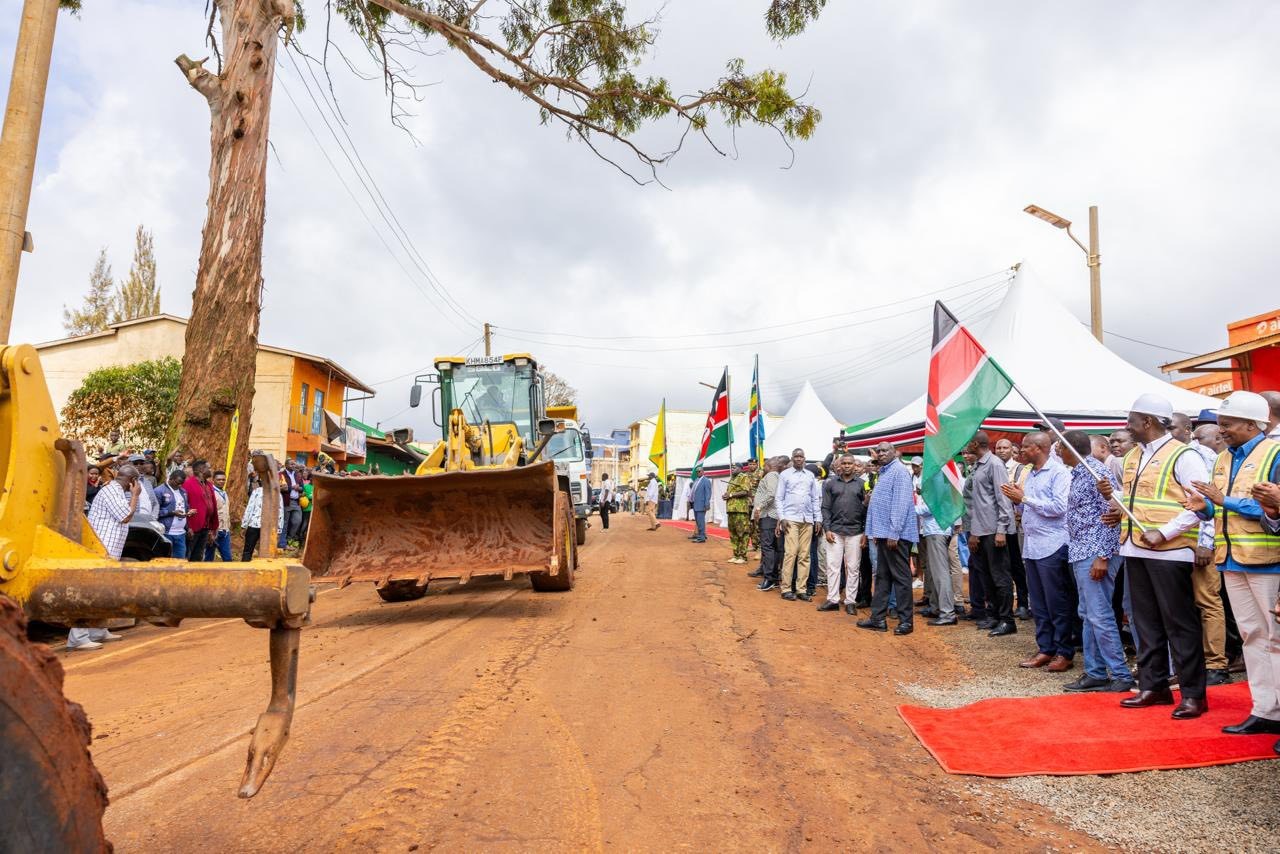
 President Ruto launches key road projects to transform connectivity in Machakos County Machakos County on November, 14, 2025./PCS
President William Ruto appears to be rolling out a carefully choreographed, multi-pronged strategy aimed at weakening the opposition and penetrating its traditional strongholds.
From promising multi-billion-shilling development projects in opposition zones to frequent tours of 'hostile' regions, Ruto is on the overdrive to realise his re-election bid.
The President is also on charm offensive, launching direct political attacks on rivals and deploying loyal political lieutenants on the ground. At the core of the strategy, analysts say, is an attempt to reframe the political contest away from personalities and alliances towards development delivery.
The President is portraying opposition leaders as divisive, tribal and disconnected from the everyday needs of wananchi. Political analyst Peter Kagwanja says the President’s approach reflects a deep understanding of Kenya’s political script and a long-term vision that gives him an edge over his rivals.
“I am basically warning ourselves, as opposition, that if you want to fight with a master, please prepare for it because it is not a joke,” Kagwanja said.
According to Kagwanja, Ruto is not only politically astute but also development-conscious—attributes that could prove decisive in a country where infrastructure and economic empowerment often trump ideological debates.
“Ruto is somebody who understands the script, but more importantly, somebody who thinks long term. He does not think today. He thinks five to 10 years ahead,” he said.
Central to Ruto’s charm offensive is the promise of mega infrastructure projects, many of them deliberately targeted at regions that either rejected him in 2022 or are now drifting towards the opposition.
“The President is free to try. He seems to be employing the same strategy he used in 2022 — reaching out directly to the people — but I doubt if it will yield the same results this time,” governance analyst Martin Andati said.
During his recent State of the Nation address, the President announced plans to dual the Muthaiga–Kiambu–Ndumberi road, a key artery in the politically critical Mt Kenya region.
also unveiled plans for major road upgrades, including Karatina–Nanyuki–Isiolo; Makutano–Embu–Meru–Maua; and Nakuru–Nyahururu–Karatina. In Nairobi, Ruto announced the proposed construction of an expressway linking Thika Town to Museum Hill, a project expected to ease congestion while also serving as a political statement to the Mt Kenya’s largely opposition-leaning electorate.
“If you ask people from Mt Kenya why they voted for Ruto, they will tell you it’s because they felt sidelined by the previous government and were hopeful,” Kagwanja said.
“They didn’t fear, despite knowing he has the potential of being a strongman in the Moi model, because development trumps everything.”
The President’s intensified focus on Mt Kenya comes against the backdrop of growing resistance led by former deputy president Rigathi Gachagua, who has vowed to lock Ruto out of the region and reduce him to a one-term President. However, political observers argue that visible development projects could blunt the opposition’s momentum in the mountains.
“If Ruto delivers development, the debts we are talking about will be swamped because the country is hungry for development,” Kagwanja said.
Ruto has complemented infrastructure pledges with an aggressive political outreach. His allies, led by Deputy President Kithure Kindiki, have been holding back-to-back empowerment meetings across Mt Kenya, while large delegations of regional leaders have been hosted at State House.
Senior government officials have also been dispatched to counter anti-Ruto narratives and sell the administration’s record. “Our message is simple—don’t be misled by those spreading falsehoods. Look at the projects, jobs and transformations happening across the country,” Government Spokesman Isaac Mwaura said at a recent forum in Kiambu.
“This government is about delivery, not noise.”
Despite his alleged waning popularity in Mt Kenya, Ruto retained key political players from the region, including MPs, whom he plans to ride on to crack the region. In Ukambani, traditionally loyal to Wiper Party leader Kalonzo Musyoka, Ruto has also stepped up his engagement, announcing plans to expand the Machakos Junction–Mariakani Road.
The President recently concluded a four-day development tour of the region, during which he launched multi-million-shilling projects and issued direct political appeals to residents. He has promised to complete the construction of the much-awaited Thwake Dam and implement two others to address the problem of water scarcity.
“I was the problem; I allowed people to come and confuse Ukambani and take it to the opposition,” Ruto said at one rally.
“But now I am here. Tell those people that Ruto has come and we have said Ukambani is in government. Will you tell them you’re tired of the opposition?”
Kalonzo is widely viewed as the leading presidential contender within the United Opposition coalition and Ruto’s increasingly sharp attacks on him are seen as an effort to weaken his national appeal early. The President has repeatedly portrayed Kalonzo as indecisive and uninterested in development, questioning his readiness to lead the country.
Beyond development and rhetoric, Ruto’s allies are advancing a more controversial strategy: fragmenting Mt Kenya politically by pitting the east against the west. Public Service Cabinet Secretary Geoffrey Ruku has openly called for the political separation of Mt Kenya East—comprising Tharaka Nithi, Embu and Meru—from the rest of the region.
“If it means getting Tharaka Nithi, Embu and Meru counties out of Mt Kenya, that’s what we’re going to do,” Ruku said.
He said Mt Kenya East has historically aligned itself with successive governments—from Jomo Kenyatta to Mwai Kibaki and Uhuru Kenyatta—and now sees itself as unfairly targeted despite being “a heartbeat away from the presidency”.
“It cannot be that we supported Kenyatta I, Kibaki and Kenyatta II, and just when we are a heartbeat away, the government becomes hostile. That cannot be allowed,” Ruku said.
Embu Governor Cecily Mbarire said Mt Kenya East would chart its own political destiny and avoid being dragged into battles that do not benefit its people. She said the region currently holds the Deputy President’s office and should focus on consolidating its influence within government rather than engaging in confrontational politics.
While Ruto’s tactics mirror the grassroots-heavy approach that propelled him to victory in 2022, analysts caution that the political terrain has shifted.
“The President is free to try. He seems to be employing the same strategy—reaching out directly to the people—but I doubt it will yield the same results this time,” political analyst Martin Andati said.
INSTANT ANALYSIS
With economic pressures mounting and political alliances fluid, Ruto’s success will likely hinge on whether promised projects materialise and whether voters remain persuaded that development outweighs political grievances.
For now, however, the message from State House is clear: the battle for 2027 has begun—and Ruto intends to fight it on his own terms.