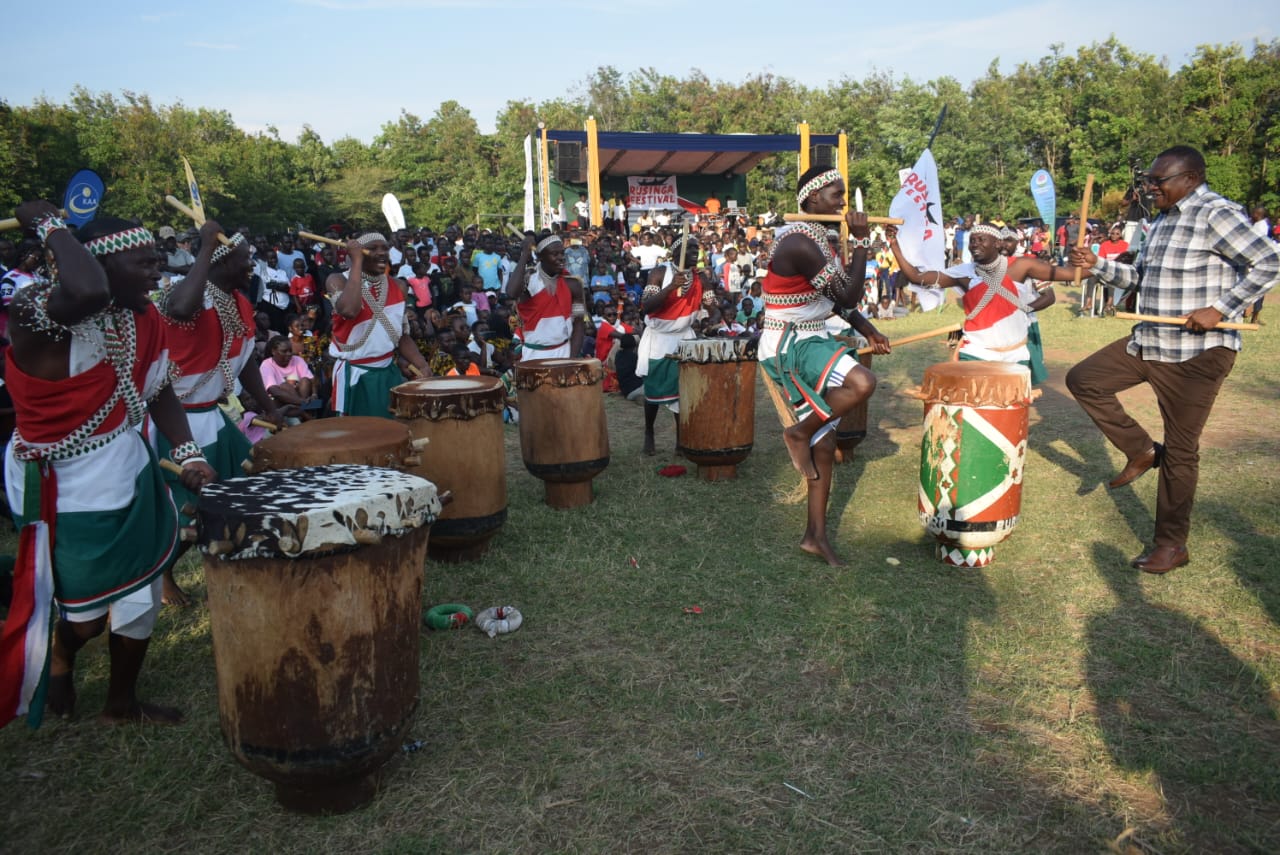
 County Secretary Bernard Muok hits a drum during Rusinga Festival in Suba North constituency in Homa Bay County./ROBERT OMOLLO
The drive to revive the Abasuba community’s language and culture through festivals is gaining momentum, following gains recorded during this year’s extravaganza.
The community held the 14th edition of its cultural festival at Kamasengre Secondary School grounds in Rusinga Island, Suba North Constituency, Homa Bay County.
The annual event was initiated after 2003, when the United Nations Educational, Scientific and Cultural Organization (UNESCO) listed Abasuba as a community language facing extinction.
Dubbed the Rusinga Festival, Abasuba community stakeholders have since partnered with various organisations to mobilise resources to revitalise and preserve the culture.
Rusinga Festival committee chairman Narkiso Okello said the community’s culture had been eroded due to assimilation into the Luo community.
“There are people who teach community members the Abasuba language during the festival. I believe that through this initiative, we now have young people who can speak the language with little difficulty,” Okello said.
 Participants at Rusinga Festival entertain attendees at Kamasengre ground in Suba North constituency,Homa Bay County./ROBERT OMOLLO
The county government is sourcing learning materials to support teaching in schools. Teaching children the language at an early stage will help them become proficient.
The Abasuba community has also translated the Bible into their language in partnership with the Bible Translation and Literacy (BTL) team.
“Having a Bible written in the Abasuba language is one of the greatest achievements of the festival. Many people learn culture and traditions by reading books in their native language,” he said.
The festival provides a platform for showcasing Abasuba culture and traditions, including traditional foods, cooking methods, artefacts, souvenirs and tools.
Participants engage in activities such as traditional dances, songs, chants, boat racing, wrestling, tug of war, storytelling and folklore, with winners receiving awards.
“The event attracts many people since it is held during the December holidays. It reduces idleness among the youth and prevents engagement in social ills,” Okello said.
The festival is supported by partners including the Kenya Wildlife Service (KWS), Kenya Airports Authority (KAA), Kenya Tourism Board (KTB), Pwani Oil Products (POP) and Victory Farms.
KWS has been offering attendees, especially children and parents, free visits to Ruma National Park to promote tourism. Other attractions in the area include Birds Island and the Mawanga historical home.
Abasuba cultural enthusiast Victor Warekwa said the festival has united the community in safeguarding its heritage.
He called for increased support from institutions such as the Ministry of Education and the Kenya Institute of Curriculum Development (KICD) to fast-track Abasuba language learning in schools.
“The festival is a milestone, recognised globally. It celebrates and safeguards the Abasuba community’s intangible cultural heritage,” Warekwa said.
Suba North MP Millie Odhiambo and Homa Bay County Secretary Bernard Muok underscored the festival’s importance in preserving Abasuba culture.
“Such events enhance integration locally and globally. People from Rwanda, Uganda and even Europe come to celebrate with us, fostering peace and harmony,” Odhiambo said.
Muok said the county government recognises cultural diversity and prioritises its preservation.
“We support the promotion of the Abasuba language, dialect and culture,” he said.