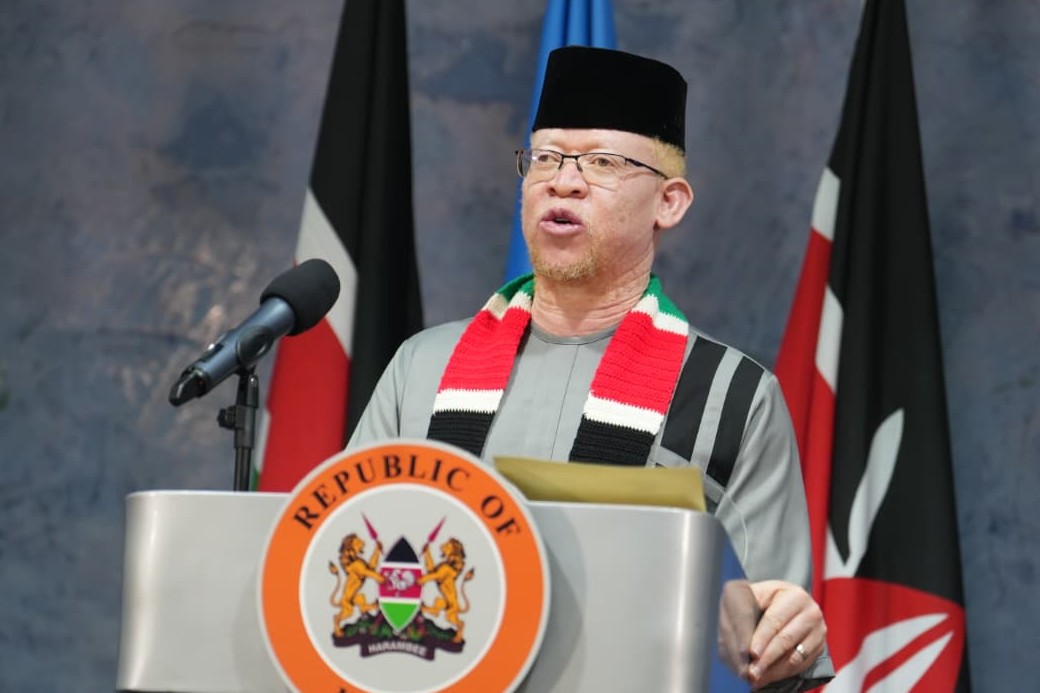
 Government spokesperson Isaac Mwaura delivers his final weekly briefing on the government's scorecard, December 19, 2025. /ISAAC MWAURA/X
The government has expressed confidence in the progress made in rolling out the Social Health Authority, a major pillar in the delivery of Universal Health Coverage and a significant improvement on the defunct National Health Insurance Fund.
Government spokesperson Isaac Mwaura says the new system has already tripled NHIF’s coverage, with more than 27 million Kenyans now registered under SHA.
He dismissed claims that the programme is not working, arguing that the scale of enrolment and service expansion points to a system that is steadily taking root across the country.
“There are those saying it’s not working, but when you look at SHA, over 27 million Kenyans have been registered. Even the Community Health Promoters who have been carrying out door-to-door registration across 8.9 million households are now fully covered under SHA,” Mwaura said.
He noted that more than 10,000 health facilities have so far been onboarded onto the SHA platform, while about 107,000 Community Health Promoters are actively serving households nationwide.
According to Mwaura, this has expanded preventive healthcare coverage to about 68 per cent of households, strengthening early intervention and community-level health services.
Mwaura was speaking on Friday while delivering his final weekly briefing on the government’s scorecard, where he outlined key economic milestones and progress under the First World Transformation Agenda, which seeks to uplift living standards and modernise service delivery across sectors.
Kenya officially transitioned from NHIF to SHA on October 1, 2024, with the aim of achieving universal medical coverage through enhanced benefits delivered via the Social Health Insurance Fund (SHIF).
The fund is digitally managed to improve access, efficiency and accountability, with salaried Kenyans making mandatory contributions based on their gross income.
The government, meanwhile, meets the cost of coverage for vulnerable and indigent citizens.
Beyond healthcare, Mwaura said, continued investments in education and health infrastructure are improving access to essential services, particularly in historically underserved regions.
Turning to the broader economic outlook, Mwaura said the bottom-up economic transformation agenda has expanded access to capital, skills and modern systems, bringing millions of Kenyans into the formal economic matrix and positioning the country on a path to first-world status.
He stressed that the agenda is inclusive, cutting across geography and occupation.
“Diaspora investment is now a cornerstone of our economic growth strategy, and we have developed a guidebook to facilitate their engagement,” he said.
He added that the National Infrastructure Fund and the Sovereign Wealth Fund are mobilising resources from divestments and mineral royalties to finance large-scale development projects.
Mwaura further cited gains in agriculture following a shift from consumption-driven policies to production-led support, noting that more than 7.1 million farmers have benefited from 21 million bags of subsidised fertiliser.
He said maize production is projected to reach between 67 and 70 million bags, while tea earnings have hit Sh215 billion and coffee exports have grown by 73 per cent, boosting rural incomes and food security.
“Our goal is to ensure that every Kenyan, from our farmers to our youth, participates meaningfully in the nation’s transformation,” he said.