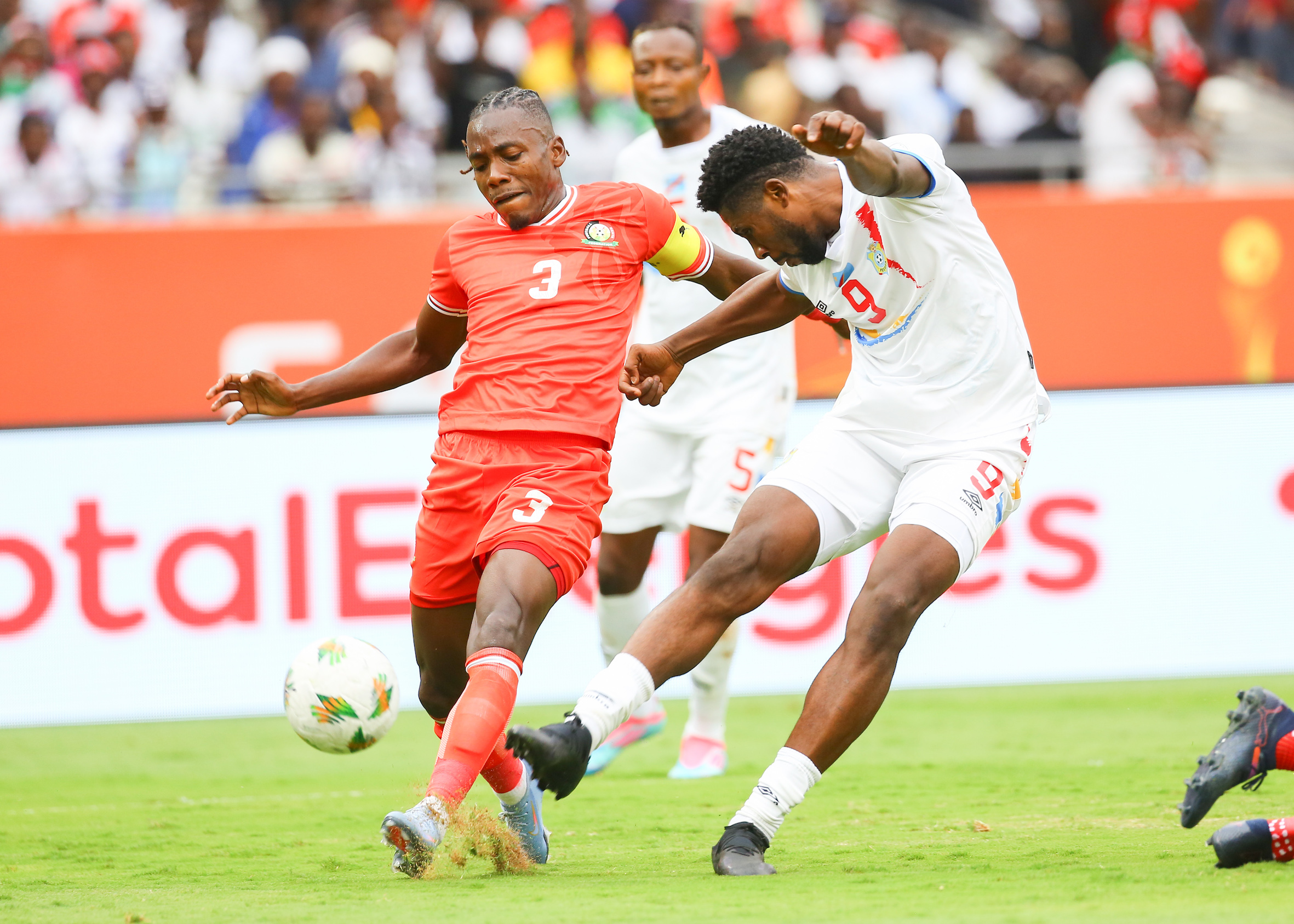
 Harambee Stars' captain Abdi Omar in action against Jephte Kitambala of DR Congo during a Chan 2024 match at Moi Stadium, Kasarani in August/HANDOUT
As the 2025 Africa Cup of Nations kicks off in Morocco today, Harambee Stars were nowhere to be seen.
Instead, East Africa will be represented by Uganda and Tanzania — two familiar rivals who have quietly moved ahead while Kenya stalled. For a nation that once prided itself on regional football dominance, the absence cuts deep.
Kenya’s failure was sealed on November 15, 2024, with a 1–1 draw against Zimbabwe in a must-win Group J qualifier.
That single result ended the Stars’ hopes and exposed deeper problems. Kenya needed victory to stay alive, then help elsewhere. They got neither. What followed was silence, frustration and now reflection.
Former national team coach Jacob ‘Ghost’ Mulee says the warning signs were obvious long before the final whistle.
“This did not happen overnight. When your neighbours qualify and you don’t, it tells you everything. We talk about talent every year, but talent without planning means nothing,” Mulee said.
“This campaign was lost months earlier. You don’t prepare for AFCON in panic mode.”
Mulee believes Uganda and Tanzania offer lessons Kenya has failed to learn.
“They trusted continuity. They stuck with coaches. They improved their domestic structures. We keep resetting. That is why we are watching instead of playing.”
Salim Babu, one of the most respected coaches in the Kenyan Premier League, points to the domestic game.
“Our league is not intense enough. You cannot play at walking pace locally and then switch gears internationally,” he said.
“Uganda and Tanzania have raised their standards. We haven’t. That gap shows at qualification time.”
Babu also questioned the lack of investment in fundamentals.
“Facilities matter. Refereeing matters. Player development matters. You can’t skip steps and expect AFCON football.”
Former Harambee Stars captain Musa Otieno believes Kenya’s biggest weakness is psychological.
“We freeze when the pressure rises. You saw it against Zimbabwe. The tension was obvious. We struggle to close games. That’s a mentality problem,” he said.
Otieno said watching Uganda and Tanzania compete should sting.
“Our neighbours believe they belong on that stage. We look like guests asking for permission. At this level, belief is everything. You either step up or you disappear.”
AFC Leopards head coach Fred Ambani did not soften his verdict, especially with Kenya set to co-host the 2027 Africa Cup of Nations alongside Uganda and Tanzania.
“This is embarrassing. You cannot be missing AFCON while preparing to host one. There must be accountability — players, officials, everyone. This can’t continue,” he said.
AFCON 2025 marks the tournament’s 35th edition and will run from December 21, 2025, to January 18, 2026. Morocco hosts after Guinea was stripped of the event due to lack of readiness.
The tournament was moved from its traditional June–July window to avoid clashes with Fifa’s expanded Club World Cup.
Ivory Coast arrive as defending champions. The tournament mascot, ASSAD the Barbary lion, and the Puma-designed ITRI match ball headline CAF’s commercial push. Matches will be played across nine venues in six Moroccan cities.
The build-up has included protests by Moroccan youth groups over public spending, but CAF president Patrice Motsepe has insisted the tournament will proceed without disruption.
For Kenya, the contrast with Uganda and Tanzania is unavoidable. Both nations have earned their place. Kenya has not. And with 2027 fast approaching, the margin for error is shrinking.
“This should be a turning point,” Ambani said. “If it isn’t, 2027 will expose us. Hosting means nothing if your team isn’t competitive.”
AFCON 2025 will go on without Kenya. The question now is whether Kenyan football finally accepts that regional pride is no longer guaranteed — and that relevance must be earned again.