
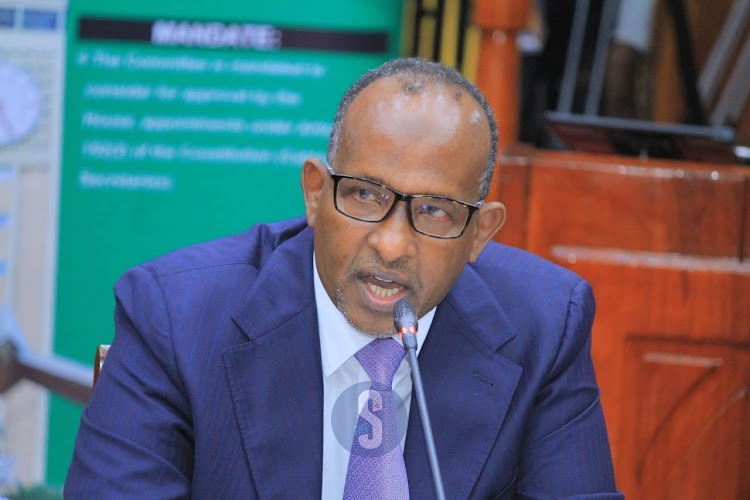
 Aden Duale/FILE
Absenteeism by doctors in public hospitals is a major problem in Kenya. The World Bank indicates 60 per cent of doctors are absent from their work stations at any unannounced visit.
Duale said from January the SHA digital claims platform will flag and block claims submitted by doctors registered in public facilities if those claims show they carried out procedures or treated patients in private hospitals during the hours they are logged on as being on official duty in government institutions.
The CS announced the directive on December 16 in Tharaka Nithi county.
“It has become so rampant that doctors working in government facilities are opting to send patients to private facilities they are operating in and either denying the facilities that pay them salaries or disregarding them completely,” Duale said.
He said the practice was denying public hospitals both patients and revenue, even as the doctors involved continued to draw government salaries during official working hours.
“Doctors keen on earning on locum at office hours, between 8 am and 5 pm, are committing fraud,” Duale said.
The CS cited Kenyatta National Hospital, saying it has 26 fully equipped theatres staffed by top specialists, yet patients are often given surgery dates months away.
He said patients are then contacted by brokers offering next-day procedures in private facilities, conducted by the same doctor employed by KNH.
Duale directed the Digital Health Authority to work with SHA to enforce the new controls. He also warned private hospitals that submit such fraudulent claims will be sanctioned.
Tharaka Nithi Governor Muthomi Njuki, who is Council of Governors head of Health committee, backed the warning and accused some doctors of exploiting public hospitals to sustain private practice.
“Some doctors were extremely ambitious but wanted many jobs to make more money,” Njuki said.
He said some county hospitals were better equipped than the private facilities patients were being referred to.
The doctors union, the Kenya Medical Practitioners, Pharmacists and Dentists Union (KMPDU), suggested that the policy was unrealistic and likely to worsen service delivery if implemented unilaterally.
The union claimed the Cabinet Secretary’s plan failed to reflect the realities of public hospitals, where chronic staff shortages blur the line between on-duty and off-duty time.
“The public health system of Kenya continues to operate under severe and chronic health workforce shortages, with doctor-patient ratios falling far below internationally accepted standards, leading to extended working hours, emergency call duties, and thus blurred distinctions between ‘on-duty’ and ‘off-duty’ times,” the union said.
KMPDU said it formally objects to the use of fixed clock-time (8am-5pm) as a basis for automatic rejection of insurance claims pre-authorised by public sector doctors.
“Time-based administrative controls do not effectively reflect the operational realities of public hospitals and risk arbitrary, disproportionate, and inequitable enforcement,” it said.
KMPDU also faulted the government for failing to consult health workers before announcing the policy.
“The proposed mechanism has not undergone formal consultation with organised labour and/or other major stakeholders in the health sector,” the union said.
Rampant absenteeism by doctors is a major concern in Kenya.
World Bank health service delivery assessments have repeatedly found high absenteeism among doctors in Kenya’s public facilities during unannounced visits, while broader workforce reports show the country remains far below global benchmarks for doctor-to-patient ratios.
One of the most cited studies is the 2018 World Bank’s Service Delivery Indicators (SDI): Kenya Health Sector Report.
Based on unannounced visits to thousands of public health facilities, the SDI report found that more than half of health workers were absent at the time of inspection.
Doctors recorded the highest absenteeism rates, at over 60 per cent, followed by nurses and clinical officers. The report concluded that absenteeism significantly reduced the availability of skilled care, even where facilities were staffed on paper.
The findings were reinforced in the World Bank’s Delivering Quality Health Services in Kenya: A Health Public Expenditure Review, which noted that high absenteeism meant public funds spent on salaries did not translate into services at the point of care. The report warned that weak enforcement of attendance rules and limited consequences for absenteeism were eroding efficiency and public trust in government health facilities.
The World Health Organization’s Global Health Workforce Network country assessments on Kenya also highlight absenteeism as a governance challenge, pointing to poor facility-level management, lack of real-time attendance monitoring, and weak sanctions.