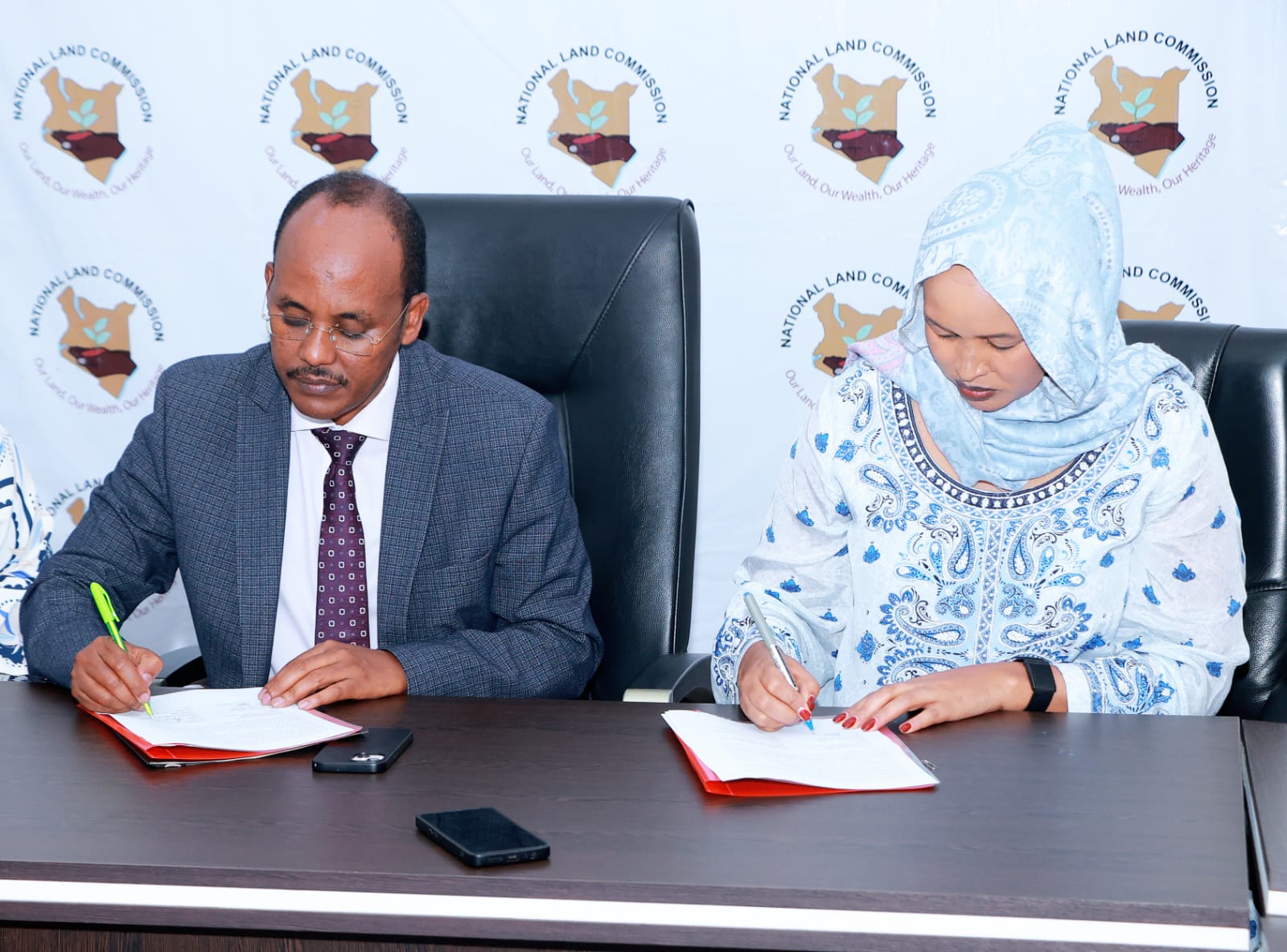
Community Land Action Now president Dr Abubakar Lewano and National Land Commission CEO Kabale Tache sign an MOU to strengthen community land rights on December 17 at the commission's offices.
THE National Land Commission and Community Land Action Now have signed a memorandum of understanding to secure land rights, promote justice, and unlock community potential.
The agreement was signed on Wednesday at NLC offices in Nairobi by NLC CEO Kabale Tache and CLAN president Abubakar Lewano, with commissioners Tiyah Galgalo and Esther Murugi witnessing the ceremony.
“This partnership is about creating real, tangible progress where it matters most,” said Tache, highlighting plans to empower landholders and transform land governance from the ground up.
Under the MoU, the two institutions will collaborate on policy dialogues, land tenure facility projects, monitoring land rights, research on community land interests, dispute resolution, and addressing historical land injustices.
The partnership also supports the transition of group ranches to community lands, with 46 of 315 group ranches already transitioned and 63 undergoing subdivision.
Tache said the collaboration will strengthen justice and harmony through Alternative Dispute Resolution and Traditional Dispute Resolution mechanisms, adding that the MoU represents a hands-on approach to advancing community land governance.
Lewano noted that the partnership will turn policy into practical protection, ensuring monitoring of resource disputes, safeguarding land rights, and addressing historical injustices.
The MoU will run until April 2027 and aims to serve as a model for collaboration in securing community land rights, livelihoods, and ecosystems.
Established under Article 67(1) of the Constitution, NLC manages public land, advises on national land policy, and investigates present or historical land injustices.
CLAN, Kenya’s largest network of indigenous communities and support organizations, promotes community land registration, sustainable resource management, and inclusive governance across 21 counties.
Since its inception, CLAN has grown to a network of 85 members, including 54 indigenous communities and 31 NGOs and CBOs, championing land rights, climate resilience, gender equality, and responsible investment.