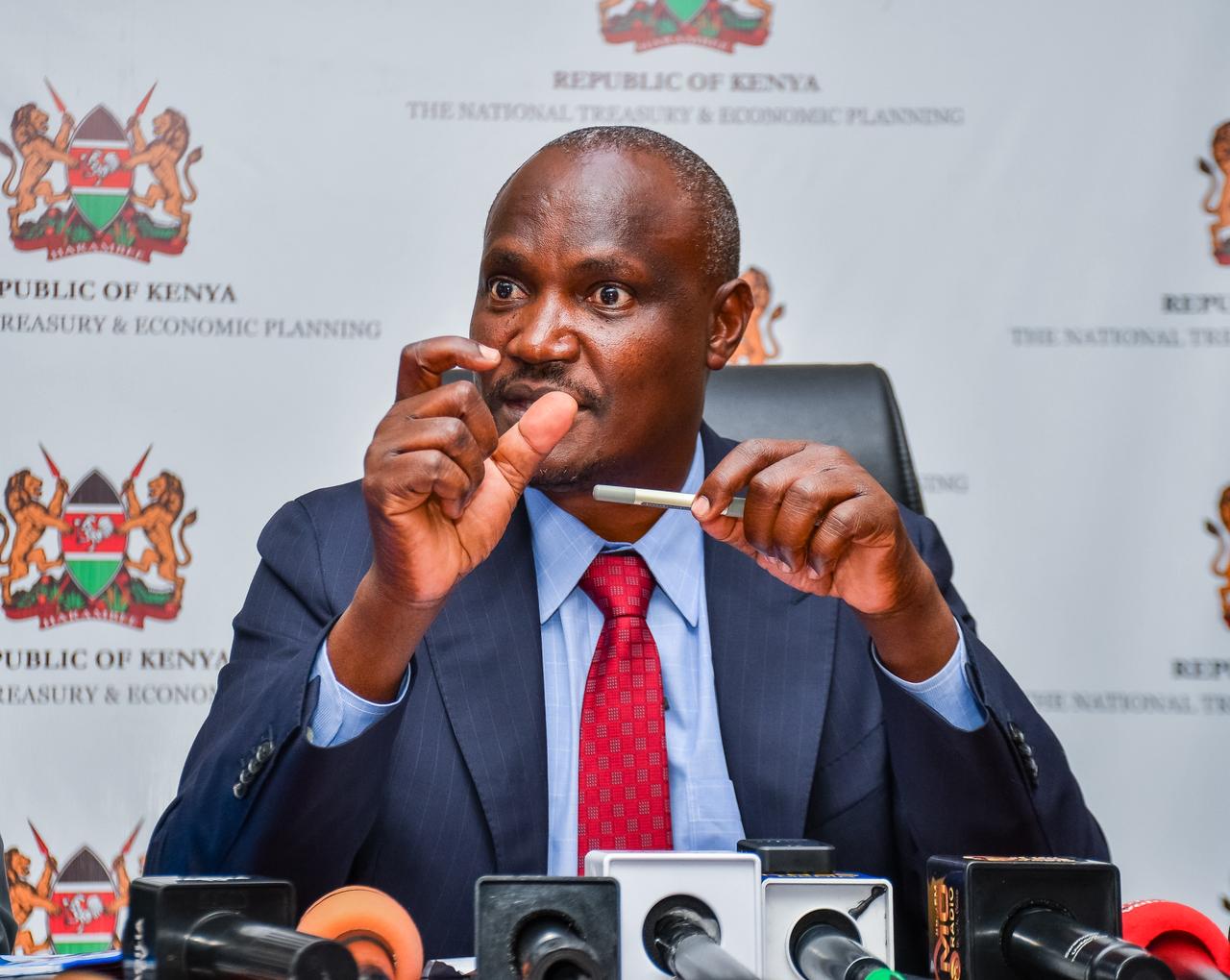
The ambitious spending plan is, however, already under strain from a heavy debt burden and a worsening fuel crisis that threatens to slow economic growth.
The budget, tabled in Parliament, projects total revenues of Sh3.63 trillion, leaving a fiscal deficit of Sh1.11 trillion.
Treasury says it was forced to revise the economic growth prospect downwards following the fuel crisis.
"We are revising our 2026 growth projection downward from 5.3 per cent to 5.0 per cent," the Treasury said in the budget summary.
"If the conflict persists with prolonged supply disruptions and sustained high oil prices, growth would weaken further."
The books show that Parliament, the Judiciary, and security have got a major boost, even as the global analysis points to cuts compared with the current year’s budget.
Parliament has been allocated Sh48.69 billion, being Sh47.1 billion for recurrent expenditure and Sh1.6 billion for development.
The allocation reflects a slight reduction from the Sh50.8 billion ceiling initially approved in the 2026 Budget Policy Statement.
The Judiciary received Sh30.44 billion, comprising Sh27.8 billion for recurrent expenses and Sh2.6 billion for development projects.
Treasury has allocated Sh927 million for the Judicial Service Commission, aimed at expanding access to justice.
A summation of the allocations shows that the security sector commands a substantial Sh567 billion.
The Ministry of Defence leads with Sh250 billion, including Sh239 billion for recurrent expenditure and Sh10.6 billion for capital projects.
The amount is to support military modernisation, defence industrialisation, and the newly established space management programme.
The National Police Service has been provided with Sh147 billion, among other things, to fund the recruitment of 10,000 police officers and 3,210 non-uniformed staff.
It is also to support modernisation of the National Forensic Laboratory, the operationalisation of the NPS Referral Hospital, and the construction of police housing and General Service Unit camps.
The National Intelligence Service has been allocated Sh58.6 billion, a drop of about Sh3 billion compared with the current budget year.
Internal Security has been allocated Sh55.5 billion to support the Kenya Coast Guard, National Government Administration Officers, disaster response coordination, and the National Campaign Against Drug and Substance Abuse.
The state also targets the completion of the Miritini Treatment and Rehabilitation Facility.
Correctional Services is set to receive Sh42.7 billion to manage an average daily population of 64,000 inmates, recruit 3,000 prison officers, and operationalise the Magereza Level IV Hospital.
Immigration and Citizen Services has been allocated Sh25.9 billion.
State House has been allocated Sh13.64 billion, being Sh12.62 billion recurrent and Sh1.03 billion capital, and is down from this year’s Sh17 billion.
The budget covers maintenance of State Houses and State Lodges nationwide, coordination of Cabinet business, and administration of statutory benefits for retired Presidents, Vice Presidents, and designated state officers.
The Office of the Deputy President has been allocated Sh3.68 billion, the Executive Office of the President Sh7.15 billion, the Office of the Prime Cabinet Secretary Sh840 million, and the State Department for National Government Coordination Sh1.06 billion.
The State Department for Cabinet Affairs has been provided with Sh269 million.
The budget allocates Sh379.5 billion to President Ruto's flagship BETA pillars, with infrastructure receiving the largest share at Sh134.8 billion, followed by social sectors at Sh122.5 billion.
Education has dominated thematic allocations, consuming Sh668 billion, which is nearly 29 per cent of the total Sh2.34 trillion allocated to key sectors.
National security follows with Sh567 billion, roads Sh230 billion, housing and urban development Sh136 billion, and environmental protection Sh118 billion.
DEBT LION SHARE
The Consolidated Fund Services, which comprises debt interest and pension obligations, has been allocated Sh1.5 trillion, up from Sh1.37 trillion in the current year.
Domestic interest payments alone account for Sh987 billion, with foreign interest adding Sh267 billion and pension obligations Sh247 billion.
The Treasury projects the present value of public debt-to-GDP, which stood at 65.3 per cent in June 2025, will remain above the statutory limit of 55 per cent throughout the medium term.
"We remain committed to a growth-supportive consolidation strategy," the Treasury said, projecting that the fiscal deficit will narrow to 3.6 per cent of GDP by 2027-28 and further to 3.3 per cent by 2028-29.
County governments will receive Sh420 billion as an equitable share, up from Sh415 billion, representing 20.5 per cent of the last audited national revenue.
An additional Sh75.7 billion in conditional and unconditional allocations will flow to counties, including Sh57.4 billion from development partner loans and grants.
For individual voteheads, the Teachers Service Commission leads constitutional offices with Sh422.7 billion.
The allocation is to cover salaries for in-post teachers, conversion of 20,000 intern teachers to permanent and pensionable terms, and teacher capacity development.
The IEBC has been allocated Sh24.97 billion, an amount significantly higher than the current year, reflecting preparations for the 2027 General Elections.
The office of the Auditor General has been allocated Sh9.83 billion, EACC Sh5.1 billion, ODPP Sh6.64 billion, and the National Land Commission Sh4.02 billion.
The government projects ordinary revenue at Sh2.99 trillion, targeting to raise tax revenue above 20 per cent of GDP through policy and administrative reforms.
Development expenditure is projected at Sh749 billion, which accounts for 29 per cent of ministerial spending, just below the set minimum of 30 per cent. Even though the Treasury expects it to rise to 31.4 per cent by 2027-28.
MPs are expected to scrutinise the government's allocations for various ministries and state departments.
INSTANT ANALYSIS
This is CS Mbadi's second budget, and reflects a marginal decline from the current financial year's allocations. A number of minstries and state agencies got huge boosts in the second supplementary estimates approved by MPs recently.
Comments 0
Sign in to join the conversation
Sign In Create AccountNo comments yet. Be the first to share your thoughts!